
Creative Biolabs is offering the most comprehensive services for antibody development projects. With strict regulation and effective execution, we are dedicated to providing the most valuable solutions to complete your projects.
HighlightsCreative Biolabs is offering the most comprehensive services for antibody development projects. With strict regulation and effective execution, we are dedicated to providing the most valuable solutions to complete your projects.
HighlightsCreative Biolabs has established a broad range of platforms for developing novel antibodies or equivalents. These cutting-edge technologies enable our scientists to meet your demands from different aspects and tailor the most appropriate solution that contributes to the success of your projects.
HighlightsWith deep understanding in antibody-related realms and extensive project experience, Creative Biolabs offers a variety of references to help you learn more about our capacities and achievements, including infographic, flyer, case study, peer-reviewed publications, and all kinds of knowledge that can assist your projects. You are also welcome to contact us directly for more specific solutions.
HighlightsGet a real taste of Creative Biolabs, one of the most professional custom service providers in the world. We are committed to providing highly customized comprehensive solutions with the best quality to advance your projects.
Highlights Loading...
All listed services and products are For Research Use Only. Do Not use in any diagnostic or therapeutic applications.
Estrogen receptor 2 (ESR2, also termed ERβ / NR3A2) is a nuclear‑localized steroid‑responsive transcription factor encoded by the ESR2 gene. This receptor predominantly localizes within the nuclear compartment of somatic cell populations in reproductive, neural and metabolic tissues. As a canonical nuclear receptor, ESR2 possesses conserved DNA‑binding domain and ligand‑binding domain, which enable its biological function. It can bind estrogen‑derived steroid ligands and subsequently engage specific genomic response elements to modulate target‑gene transcriptional output under physiological hormone conditions. Loss of ESR2‑dependent transcriptional regulation could disturb estrogen‑dependent gene programs, which might alter tissue proliferation and metabolic homeostasis. ESR2 tends to exhibit moderate ligand selectivity and participates in fine‑tuning hormone‑controlled cellular function across multiple tissue microenvironments. Distinct cell subtypes may generate divergent gene expression profiles upon estrogen exposure, which likely relies on properly regulated ESR2 transcriptional activity. Upon ligand association, ESR2 might undergo conformational rearrangement to recruit co‑regulator protein complexes and steer downstream gene transcription. Conserved residues within its ligand‑binding pocket appear to support selective recognition of estrogen‑related steroid molecules.
ESR2 is proposed to form homodimers or heterodimers with other nuclear receptor family members after ligand binding, which could modify the magnitude of target‑gene transcriptional responses. Sequence variants mapped to the ESR2 gene might change steroid‑ligand binding properties and may correlate with abnormal tissue hormone‑responsive phenotypes. No other nuclear estrogen receptor can fully recapitulate the unique gene‑regulatory spectrum mediated by ESR2. Variations in ESR2 expression levels likely match tissue‑specific hormone regulatory demands, rendering this receptor a compelling subject for nuclear receptor‑focused structural and functional research. While the predominant pool of ESR2 resides within nuclear and cytoplasmic compartments, a minor receptor fraction may associate with plasma membrane periphery and contribute to non‑genomic signaling events; ESR2 lacks intrinsic transmembrane helices and is not classified as an integral membrane receptor. Its modular domain architecture (DNA‑binding domain plus ligand‑binding domain) distinguishes it from transmembrane GPCR‑type hormone sensors. It may mediate ligand‑dependent transcriptional reprogramming and participates in maintaining tissue estrogen sensitivity. Reduced functional ESR2 abundance could impair estrogen‑triggered gene regulation, making ESR2 suitable for mechanistic studies of nuclear steroid receptor biology.
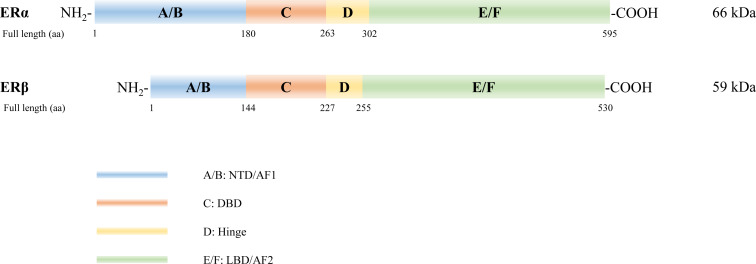 Fig. 1 Schematic representation of human ESR2 (ERβ / NR3A2) modular domain architecture, highlighting the conserved DNA‑binding domain (DBD) and ligand‑binding domain (LBD), which underpin estrogen ligand recognition, genomic response element engagement and transcriptional regulatory activity.1
The biological functions of nuclear‑localized ESR2 estrogen receptor are focused on steroid ligand recognition and gene transcriptional control:
Creative Biolabs offers purified ESR2 protein samples generated under unified preparation workflows, including full‑length ESR2 constructs and isolated variants covering DNA‑binding domain and ligand‑binding domain regions. Truncated molecular constructs cannot support complete steroid‑ligand recognition and DNA‑dependent transcriptional coupling events; full‑length constructs are therefore better suited for research focused on nuclear estrogen receptor. Uniform quality assessment is performed across sample batches. Molecular‑characterization work may be conducted under cell‑free biochemical experimental setups. The modular domain conformation tends to be preserved across batches and supports comparative steroid‑interaction‑oriented research. Purified full‑length ESR2 samples retain intact ligand‑binding and DNA‑interacting surfaces, which could enable reliable detection of transient protein‑ligand or protein‑DNA molecular complexes for comparative functional research purposes.
Not finding the Protein product you need? Contact us to start your one-stop custom service!
Creative Biolabs provides cellular research models featuring adjustable ESR2 expression abundance, suitable for functional observation of nuclear estrogen receptor‑mediated transcriptional regulation and steroid‑receptor‑interaction‑related research. Sample evaluation covers sustained intracellular receptor detection and ligand‑response analysis, enabling side‑by‑side comparison of gene‑transcription output under varied receptor‑abundance conditions. These cellular research models could be paired with gene‑expression‑detection workflows to track hormone‑response shifts associated with receptor‑expression magnitude.
Not finding the stable cell line product you need? Contact us to start your one-stop custom service!
Anti ESR2 recombinant antibodies are generated following standardized workflows, compatible with intracellular/nuclear localization profiling for reproductive derived cells and identification of ESR2 containing molecular complexes. This antibody portfolio supports multi dimensional observation of ESR2 distribution within reproductive and neural derived tissue research specimens.
Not finding the recombinant antibody product you need? Contact us to start your one-stop custom service!
Beyond catalog products, Creative Biolabs offers specialized custom services for ESR2 research:
ESR2 acts as a nuclear estrogen receptor containing DNA‑binding domain and ligand‑binding domain, and may mediate estrogen‑dependent target‑gene transcriptional regulation within research contexts.
Variations in ESR2 expression status might alter tissue‑associated estrogen‑responsiveness; ESR2 likely acts as an important participant in biological processes governing reproductive and metabolic tissue homeostasis.
No, all ESR2 related products and services are strictly for research use only, and cannot be applied in clinical workflows. All material design and functional screening are optimized exclusively for basic laboratory research, without meeting clinical application criteria.
Offerings include full‑length ESR2 protein, target‑specific recombinant antibodies and tunable expression cell research models, supporting research on steroid‑ligand binding and nuclear‑receptor‑driven gene transcription.
Laboratory‑oriented analytical workflows may adopt steroid‑ligand‑interaction assays within cell‑free biochemical research environments to characterize the steroid‑recognition profile of ESR2 samples.









