
Creative Biolabs is offering the most comprehensive services for antibody development projects. With strict regulation and effective execution, we are dedicated to providing the most valuable solutions to complete your projects.
HighlightsCreative Biolabs is offering the most comprehensive services for antibody development projects. With strict regulation and effective execution, we are dedicated to providing the most valuable solutions to complete your projects.
HighlightsCreative Biolabs has established a broad range of platforms for developing novel antibodies or equivalents. These cutting-edge technologies enable our scientists to meet your demands from different aspects and tailor the most appropriate solution that contributes to the success of your projects.
HighlightsWith deep understanding in antibody-related realms and extensive project experience, Creative Biolabs offers a variety of references to help you learn more about our capacities and achievements, including infographic, flyer, case study, peer-reviewed publications, and all kinds of knowledge that can assist your projects. You are also welcome to contact us directly for more specific solutions.
HighlightsGet a real taste of Creative Biolabs, one of the most professional custom service providers in the world. We are committed to providing highly customized comprehensive solutions with the best quality to advance your projects.
Highlights Loading...
All listed services and products are For Research Use Only. Do Not use in any diagnostic or therapeutic applications.
ETFA, or alpha-ETF, is an approximately 35 kDa soluble protein within the mitochondrial matrix, which serves as an essential subunit of the electron transfer flavoprotein (ETF) heterodimer, which associates with ETFB to establish a mobile electron transport intermediate in the mitochondrial matrix. The ETF heterodimer donates these electrons to the membrane-associated electron transfer flavoprotein ubiquinone oxidoreductase (ETFDH, also called ETF–QO) that then donates them to the respiratory chain at coenzyme Q level; this relay of electrons is necessary for mitochondrial fatty acid β-oxidation as well as amino acid and choline metabolism.
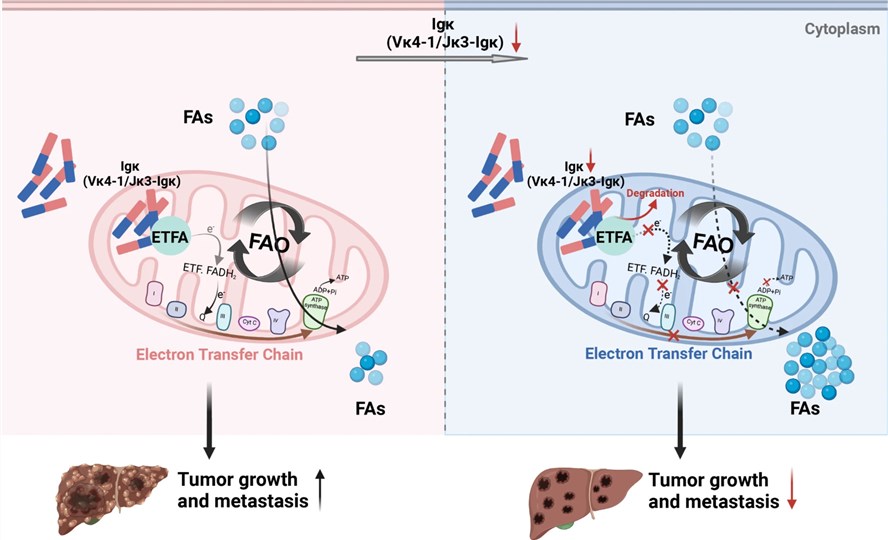 Fig.1 A working model explaining how hepatocyte-derived Igκ promotes HCC progression by stabilizing ETFA to facilitate fatty acid β-oxidation.1
knowledge of the biological implications of ETFA extends across several, interconnected domains of both metabolism and pathology:
We provide recombinant ETFA proteins designed to support studies of electron transfer flavoprotein structure and function. As the alpha subunit of the mitochondrial electron transfer flavoprotein complex, ETFA associates with ETFB and contributes to FAD-dependent electron transfer in metabolic pathways. Available ETFA proteins and constructs can support studies of ETFA–ETFB interactions, FAD-associated protein structure, electron-transfer mechanisms, metabolic pathways, binding assays, and antibody research. Product formats and construct designs may vary according to specific research requirements, with appropriate quality assessment applied based on the intended research use.
Not finding the protein product you need? Contact us to start your one-stop custom service!
Cellular model systems that are proven to be reliable are essential for dissecting ETFA-induced biology and evaluating therapeutic candidates. We offer stable cell lines for constitutive or inductive overexpression of human, mouse, or rat ETFA and of cells with reduced endogenous expression to perform loss-of-function studies. These provide a fast and reproducible basis for high throughput compound screening, fatty acid oxidation assays, amino acid metabolism studies and metabolic flux analysis which are well suited to pathological and pharmacological investigation of ETFA.
Not finding the stable cell line product you need? Contact us to start your one-stop custom service!
We provide a complete portfolio of high-affinity recombinant antibodies against ETFA, designed for optimal performance across different research applications. Generated using advanced recombinant technologies, these antibodies show strikingly superior specificity, sensitivity and batch-to-batch reproducibility as compared to conventional polyclonal antibodies. ETFA Recombinant Antibodies (WB, ELISA, FCM, IF/ICC/IHC/IP)-Expanded also serves to measure and quantify ETFA in different sample types including mitochondrial preparations, whole cell lysates or tissue sections.
Not finding the recombinant antibody product you need? Contact us to start your one-stop custom service!
In addition to our catalog products, we provide specialized custom services for protein and antibody discovery & development. With our considerable experience in mitochondrial metabolism and inborn error research, we can help you with the following:
Yes, we have established dual-stable lines where full-length ETFA and ETFB are expressed from different genomes. Every batch is supplied with a specification for mitochondrial localisation and breathing chain coupling, thus providing a reproducible cellular platform in which metabolic flux can be continuously monitored without repeated transient transfection.
Yes, it is here in a protein buffer formatted to have low endotoxin and near-physiological pH free of other carrier proteins and denaturing agents. This enables dilution directly into spectrophotometric assays, or coupled enzyme reactions, without dialysis or buffer exchange.
No, all ETFA products and services are for research use only and not intended for clinical diagnosis, prevention, treatment or cure.
Yes. With more affordable pricing levels for academic and industrial scaleup needs, we provide everything you want quickly. Submit the anticipated volume and timeline on our inquiry portal to get a customized quote.








