Creative Biolabs is offering the most comprehensive services for antibody development projects. With strict regulation and effective execution, we are dedicated to providing the most valuable solutions to complete your projects.
HighlightsCreative Biolabs is offering the most comprehensive services for antibody development projects. With strict regulation and effective execution, we are dedicated to providing the most valuable solutions to complete your projects.
HighlightsCreative Biolabs has established a broad range of platforms for developing novel antibodies or equivalents. These cutting-edge technologies enable our scientists to meet your demands from different aspects and tailor the most appropriate solution that contributes to the success of your projects.
HighlightsWith deep understanding in antibody-related realms and extensive project experience, Creative Biolabs offers a variety of references to help you learn more about our capacities and achievements, including infographic, flyer, case study, peer-reviewed publications, and all kinds of knowledge that can assist your projects. You are also welcome to contact us directly for more specific solutions.
HighlightsGet a real taste of Creative Biolabs, one of the most professional custom service providers in the world. We are committed to providing highly customized comprehensive solutions with the best quality to advance your projects.
Highlights Loading...
All listed services and products are For Research Use Only. Do Not use in any diagnostic or therapeutic applications.
Electron transfer flavoprotein dehydrogenase (ETFDH), also known as electron-transferring-flavoprotein dehydrogenase or ETF-ubiquinone oxidoreductase (ETF-QO), is encoded by the ETFDH gene on chromosome 4q32.1. The gene produces a 617-amino-acid precursor protein of approximately 67 kDa that is targeted to mitochondria and processed to a mature 64-kDa protein. ETFDH is a monomeric flavoprotein integrated into the inner mitochondrial membrane, containing one molecule of FAD and a 4Fe-4S cluster. The three-dimensional structure obtained by X-ray crystallography reveals a monomeric protein with three functional domains packed in close proximity: an FAD-binding domain, a 4Fe-4S cluster domain, and a ubiquinone (UQ)-binding domain, with the FAD in an extended conformation buried deeply within its functional domain. Two amino acids within the UQ-binding domain are highly conserved and are required for the interaction between ETFDH and coenzyme Q.
ETFDH functions as ETF:ubiquinone oxidoreductase, transferring electrons received from ETF to ubiquinone rather than serving as the terminal electron acceptor. It accepts electrons from the electron-transferring flavoprotein (ETF), a heterodimeric enzyme located in the mitochondrial matrix that receives reducing equivalents from at least nine mitochondrial flavin-containing dehydrogenases involved in fatty acid β-oxidation and amino acid metabolism. ETFDH then transfers these electrons to ubiquinone (coenzyme Q) in the inner mitochondrial membrane, thereby feeding electrons into the respiratory chain. This electron transfer step is essential for maintaining mitochondrial redox homeostasis and for coupling fatty acid oxidation to oxidative phosphorylation. ETFDH activity is dynamically regulated in response to metabolic conditions, with expression increasing in response to fatty acid treatment and under high-fat diet conditions. Biallelic mutations in ETFDH cause multiple acyl-CoA dehydrogenase deficiency (MADD), also known as glutaric acidemia type II, an autosomal recessive disorder of fatty acid and amino acid oxidation. MADD presents with a spectrum of phenotypes ranging from severe neonatal-onset forms to mild late-onset forms, with ETFDH mutations being the most common cause of the riboflavin-responsive late-onset form. Emerging evidence indicates that reduced ETFDH expression is common in human cancers, where ETF insufficiency driven by ETFDH loss selectively optimizes cancer bioenergetics and promotes tumor growth.
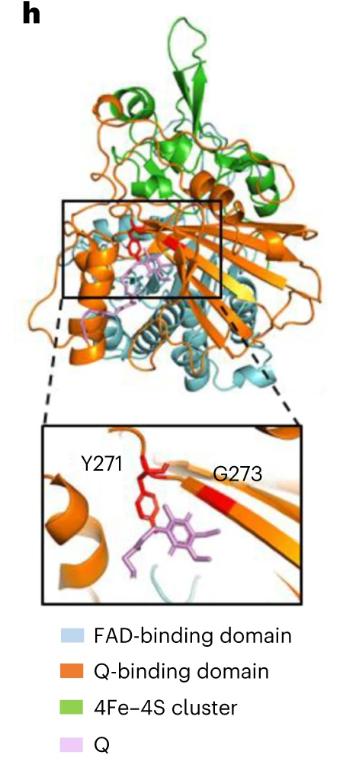 Fig. 1 ETFDH structure highlighting two highly conserved amino acids in the Q-binding domain: Y271 and G273.1
ETFDH, encoded by the ETFDH gene, functions as a mitochondrial inner membrane flavoprotein that mediates electron transfer from fatty acid β-oxidation to the respiratory chain:
Creative Biolabs provides ETFDH membrane protein products produced using optimized expression systems. These include full-length ETFDH protein that retains the native FAD-binding domain, 4Fe-4S cluster domain, and UQ-binding domain, as well as isolated domain variants. The FAD-binding domain and 4Fe-4S cluster mediate electron transfer, while the UQ-binding domain mediates coenzyme Q interaction and inner membrane association, supporting structural and interaction research; functional electron-transfer studies additionally require validated cofactor loading and an appropriate ETF–ETFDH–ubiquinone assay system. All ETFDH proteins undergo strict quality control to support consistent performance across applicable research platforms.
Not finding the protein product you need? Contact us to start your one-stop custom service!
Creative Biolabs provides custom-engineered ETFDH stable cell lines, including overexpression and knockout models. These cell lines are optimized for studies of mitochondrial electron transfer, fatty acid β-oxidation, mitochondrial redox homeostasis, and ETFDH-associated MADD mechanisms. Each cell line undergoes stringent validation to ensure stable expression profiles and consistent functional performance in diverse experimental contexts.
Not finding the stable cell line product you need? Contact us to start your one-stop custom service!
High-specificity recombinant antibodies targeting ETFDH are developed using antibody engineering techniques for research applications involving ETFDH expression and localization. These antibodies can be used in studies of ETFDH distribution in mitochondrial inner membrane fractions and may also support characterization of ETFDH-containing electron transfer complexes in combination with appropriate detection reagents.
Not finding the recombinant antibody product you need? Contact us to start your one-stop custom service!
Beyond catalog products, Creative Biolabs offers specialized custom services for ETFDH research:
ETFDH is a mitochondrial inner membrane flavoprotein that accepts electrons from the electron-transferring flavoprotein and reduces ubiquinone, the terminal step of electron transfer from fatty acid β-oxidation to the respiratory chain.
ETFDH is essential for mitochondrial electron transfer and fatty acid oxidation, and its mutations cause multiple acyl-CoA dehydrogenase deficiency (MADD), the most common cause of riboflavin-responsive late-onset MADD. It is also downregulated in multiple cancers, making it important for studies of mitochondrial metabolism and metabolic disease mechanisms.
No, all ETFDH products and services are strictly for research use only, not intended for clinical diagnosis or treatment.
Offerings include full-length ETFDH membrane proteins, domain variants, specific detection antibodies, and custom stable cell lines for mitochondrial electron transfer and fatty acid oxidation research.
ETFDH proteins may support research on electron transfer activity and ubiquinone reduction, depending on protein format and experimental context.