Creative Biolabs is offering the most comprehensive services for antibody development projects. With strict regulation and effective execution, we are dedicated to providing the most valuable solutions to complete your projects.
HighlightsCreative Biolabs is offering the most comprehensive services for antibody development projects. With strict regulation and effective execution, we are dedicated to providing the most valuable solutions to complete your projects.
HighlightsCreative Biolabs has established a broad range of platforms for developing novel antibodies or equivalents. These cutting-edge technologies enable our scientists to meet your demands from different aspects and tailor the most appropriate solution that contributes to the success of your projects.
HighlightsWith deep understanding in antibody-related realms and extensive project experience, Creative Biolabs offers a variety of references to help you learn more about our capacities and achievements, including infographic, flyer, case study, peer-reviewed publications, and all kinds of knowledge that can assist your projects. You are also welcome to contact us directly for more specific solutions.
HighlightsGet a real taste of Creative Biolabs, one of the most professional custom service providers in the world. We are committed to providing highly customized comprehensive solutions with the best quality to advance your projects.
Highlights Loading...
All listed services and products are For Research Use Only. Do Not use in any diagnostic or therapeutic applications.
Exostosin glycosyltransferase 2 (EXT2) is an integral membrane glycoprotein of 718 amino acids and the known essential catalytic subunit of the heparan sulfate (HS) co-polymerase complex. EXT2 is organized with an N-terminal single-pass transmembrane helix anchoring it in the Golgi membrane, a glucuronic acid transferase (GlcA-T) domain with a GT-B fold and a C-terminal N-acetylglucosamine transferase (GlcNAc-T) domain with a GT-A fold. Although this pseudo-bifunctional design applies some support for trans-glycosylation, thorough characterization by high-resolution cryo-electron microscopy has shown that the EXT2 GlcA-T domain is a non—catalytically inactive pseudo-enzyme—while a large portion of the contribution to HS chain extension comes from its GlcNAc-T domain. The EXT1-EXT2 heterodimer forms in a 1:1 stoichiometric ratio, with an impressive significance of interaction surface area, and complex formation is required for protein stability, Golgi retention and maximum enzymatic activity. Significantly, EXT2 localized to both the endoplasmic reticulum and Golgi when uncomplexed, but cis-Golgi cisternae hetero-oligomerized EXT2 enforced stable retention and activity.
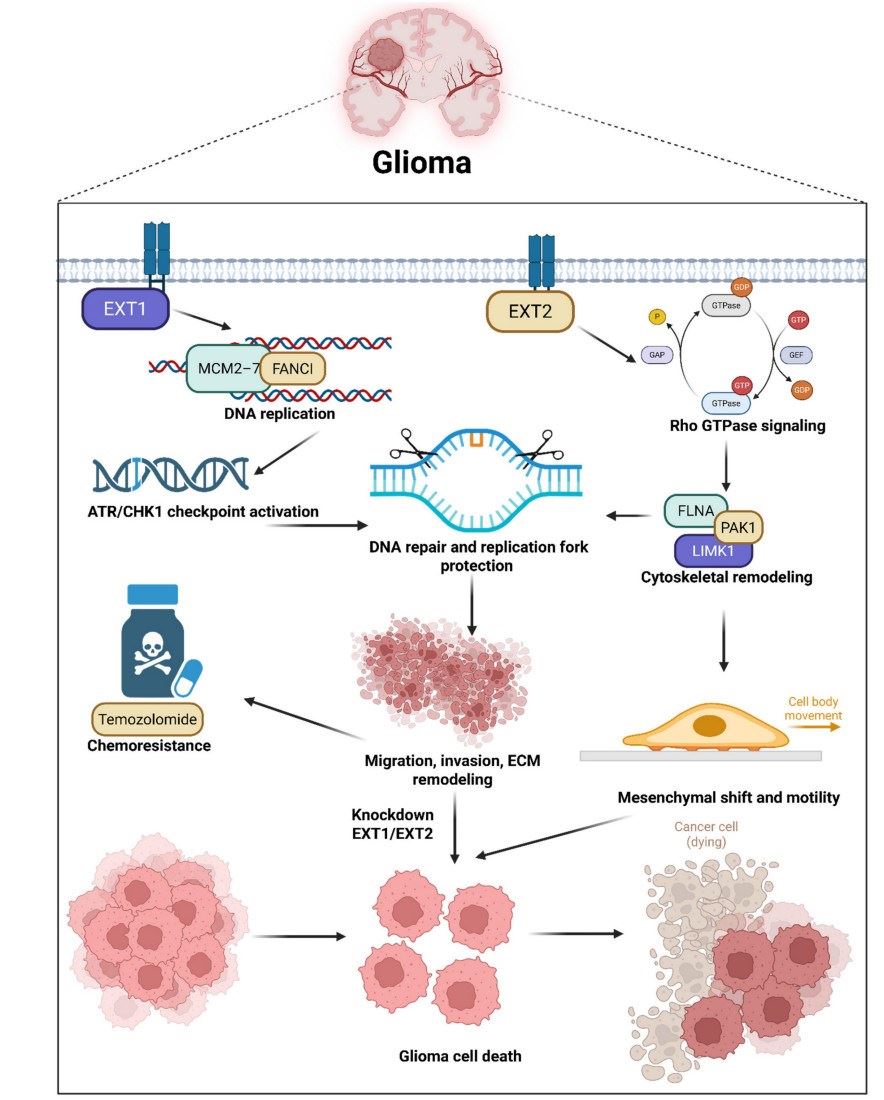 Fig.1 Schematic illustration summarizing the proposed dual-axis model of EXT1's and EXT2's functions in glioma biology.1
Functional repertories of EXT2 in diverse facets of developmental biology, tissue homeostasis and disease pathogenesis:
Our extensive portfolio of quality EXT2 membrane protein products provide important tools in the structural and functional studies of this difficult Golgi-resident glycosyltransferase. Our recombinant membrane protein technology allows for EXT2 to be produced in numerous expression systems. With the understanding that full-length EXT2 is an integral membrane protein needing correct Golgi localization to be functional, we offer both this full length construct with its true transmembrane domain and free ectodomain fragments corresponding to GlcA-T+GlcNAc-T catalytic domains. These constructs are offered with varying tag configurations (His-tag, FLAG-tag, GST-tag, Fc-tag) that can be delivered as detergent-solubilized preparations or in membrane-mimetic environments. For those researchers studying the obligate EXT1-EXT2 heterodimer, we provide co-expressed/co-purified services for yield functional complex in native-like conformation. They are subject to extensive quality control, including SDS-PAGE, Western blotting, SEC-HPLC and glycosyltransferase activity assays to guarantee suitability for your research applications.
Not finding the membrane protein product you need? Contact us to start your one-stop custom service!
Custom-engineered EXT2 stable cell lines are offered, which stably express the target constructs at high level such as wild-type (WT) EXT2 or a catalytically inactive mutant thereof, or pseudo-GlcA-T domain variants overexpressed at high levels. Perfect for drug screening, glycosyltransferase activity assays, heparan sulfate quantification studies and high-throughput screening campaigns. We offer the ability to build a cell line development platform that allows for multiple host backgrounds including HEK293, CHO-K1 and HeLa cells with either an inducible or constitutive expression system. We have established lines for co-expression of EXT1 and EXT2 for studies on heterodimeric complexes, as well as expression of patient-derived pathogenic variants found in hereditary multiple exostoses. For confirming stable expression and homogeneity through passages, each Stable cell line is validated by functional HS biosynthesis readouts as well as flow cytometry, Western blot and immunofluorescence localization assays.
Not finding the stable cell line product you need? Contact us to start your one-stop custom service!
We cover a wide catalogue of high-affinity recombinant antibodies against EXT2, designed under rigorous conditions to withstand any research application. Unlike hybridoma-derived antibodies, they are produced using cutting-edge recombinant technologies, which not only confer superior specificity but also enhanced sensitivity and consistent batch-to-batch variability. To provide broad coverage over this multi-domain glycosyltransferase, our anti-EXT2 antibodies are raised against epitopes covering the N-terminal Region, GlcA-T domain, GlcNAc-T domain and C-terminal tail. We have validated numerous applications including Western blot, IHC of bone and cartilage tissue sections, IF for localization studies in the Golgi apparatus, cell surface heparan sulfate measurements by flow cytometry and ELISA.
Not finding the recombinant antibody product you need? Contact us to start your one-stop custom service!
In addition to our catalog products, we provide tailored custom services for the discovery & development of membrane proteins and antibodies. With years of experience and our advanced, best-in-class platforms we can help you with:
No, all EXT2 products and services are research use only and not for clinical diagnosis, prevention, treatment or cure of any disease.
Yes, we have produced a set of dual-stable lines that constitutively express both full-length EXT2 and EXT1 from independent loci. We describe the release of each batch with an accompanying profile on average heparan sulfate chain length distribution as determined by gel permeation chromatography and FGF2-binding capacity giving rise to a standardized cellular platform for continuous glycosaminoglycan biosynthetic studies without sequential transient transfection.
We can discuss customized antibody discovery targeting EXT2 according to specific EXT1–EXT2 complex research requirements. Antibody design and suitability for applications such as co-immunoprecipitation, immunofluorescence, or other interaction studies can be evaluated based on the intended experimental design and supporting clone-specific data.
Recommended expression strains are mammalian (HEK293, CHO) for full length EXT2 to ensure correct membrane insertion, Golgi targeting and post-translational modifications. Insect cell systems may also have a place. While this is not the case for domains of GT-A or GT-B, these soluble domains may be expressed individually in bacteria suitable for GST fusion. Co-expression with EXT1 is highly recommended in order to obtain the functional heterodimeric complex.