Creative Biolabs is offering the most comprehensive services for antibody development projects. With strict regulation and effective execution, we are dedicated to providing the most valuable solutions to complete your projects.
HighlightsCreative Biolabs is offering the most comprehensive services for antibody development projects. With strict regulation and effective execution, we are dedicated to providing the most valuable solutions to complete your projects.
HighlightsCreative Biolabs has established a broad range of platforms for developing novel antibodies or equivalents. These cutting-edge technologies enable our scientists to meet your demands from different aspects and tailor the most appropriate solution that contributes to the success of your projects.
HighlightsWith deep understanding in antibody-related realms and extensive project experience, Creative Biolabs offers a variety of references to help you learn more about our capacities and achievements, including infographic, flyer, case study, peer-reviewed publications, and all kinds of knowledge that can assist your projects. You are also welcome to contact us directly for more specific solutions.
HighlightsGet a real taste of Creative Biolabs, one of the most professional custom service providers in the world. We are committed to providing highly customized comprehensive solutions with the best quality to advance your projects.
Highlights Loading...
All listed services and products are For Research Use Only. Do Not use in any diagnostic or therapeutic applications.
Fc fragment of IgG receptor IIa (FCGR2A) is universally known as CD32a, and the most widely expressed one among the activating low-affinity IgG Fc receptors-a type of single-pass membrane protein that mediates cellular responses to antibody recognition. It has an extracellular domain containing two immunoglobulin-like domains that bind the Fc portion of IgG with low monovalent affinities but, when clustered by antibody-coated surfaces or immune complexes, achieves high avidity. FCGR2A is unique among its activating relatives in that it has an autonomous signaling machinery: rather than teaming with accessory chains the receptor harbors within itself a potent activation motif buried at the base of its cytoplasmic tail, allowing crosslinked aggregated IgG to cause productive signaling assemblies causing phagocytosis and mediator release or antibody-dependent cellular cytotoxicity to occur. FCGR2A is present at nearly every junction of antibody and cellular immunity as its expression footprint encompasses almost the entire myeloid lineage (including monocytes, macrophages, neutrophils, and platelets). Due to its impact on antibody-mediated effector function it has become a hallmark of preclinical studies: engagement of this receptor dictates the efficiency and efficacy with which opsonized targets are eliminated, how effectively antibody-dependent cell cytotoxicity occurs and what happens after an immune complex is formed during adaptive B-cell responses. This functional polymorphism in the 131st position of the extracellular domain, changing binding preference to IgG subclasses has emerged as one of the most informative and representative examples whereby single-residue variation can redefine Fc receptor pharmacology-and a commonly applied variable within preclinical antibody effector function models. FCGR2A biology extends beyond traditional effector functions into disease settings of inflammation and proliferation where expression / engagement drive disease outcomes, and to antibody Fc engineering approaches that can purposefully alter profiles for receptor binding. In spite of this prominence, validated FCGR2A reagents are surprisingly few in number: the two Ig-like domains share substantial homology with related FcγRII receptors, constraining isoform-specific epitope selection; receptor activation is exquisitely clustering-dependent and faithful binding studies require well-folded, membrane-presented material. We have used this opportunity to build our protein, cell line and antibody platforms in an integrated manner specifically catering for this demand.
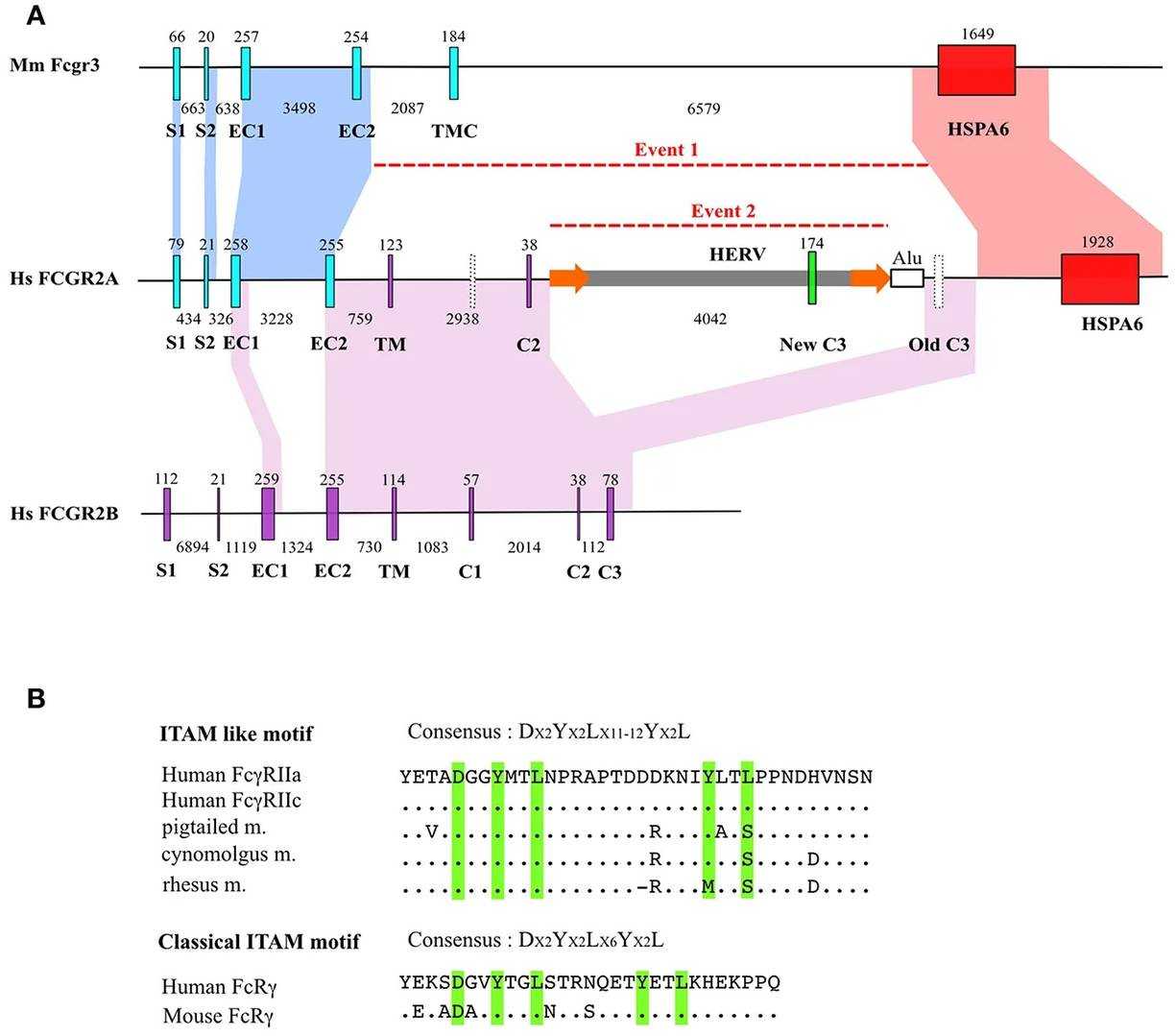 Fig.1 FCGR2A genesis.1
Investigation into FCGR2A continues to expand along multiple connected avenues:
Our FCGR2A membrane protein product line has always adhered to one core principle: we recognize that FCGR2A is a protein localized on the cell membrane, and for all products related to it, the first rule we uphold is that only when an Fc receptor retains intact binding surface and signal transduction capabilities after the purification process can the experimental data generated be sufficiently reliable. Simply put, if these two functions are lost after purification, the receptor is completely unusable. FCGR2A has two extracellular immunoglobulin-like domains. These domains, which are structurally related to immunoglobulins, must fold correctly to expose the Fc-binding interface; otherwise, no other molecules can bind to it. Its native membrane-anchored integrated state must also support it in maintaining its original orientation, without misalignment or inversion, to complete the aggregation-dependent activation process—this is the foundation for the receptor to exert its functions. For this reason, all FCGR2A products we provide are full-length, with no missing segments. These products are all produced in a customized eukaryotic expression system, which has undergone specialized optimization and transformation, with the original design purpose of preserving these strict critical structural and functional characteristics to prevent any abnormalities. Every batch of products put into production is verified one by one against core quality indicators: purity is tested via SDS-PAGE, and monodispersity, which checks whether proteins aggregate randomly, is confirmed via analytical size-exclusion chromatography, to ensure every batch meets qualification standards.
Not finding the membrane protein product you need? Contact us to start your one-stop custom service!
To conduct FCGR2A-related research, the experimental cell platform used must meet a number of requirements. First, it must be able to precisely regulate the expression density of the receptor, without unregulated fluctuations in expression levels, while ensuring the accurate presentation of the receptor on the cell surface, with correct position and orientation, and that it can normally transduce signals when the receptor aggregates. This is because the true value of an Fc receptor lies in its ability to respond to opsonized surfaces—surfaces marked with substances that can be recognized by the immune system—rather than solely relying on whether its total expression level is high enough; a sufficient level with impaired functions is useless.We can provide customized expression FCGR2A stable cell lines. In these cell lines, FCGR2A is expressed at a high level, and this state can be maintained through continuous passaging. They are prepared via sequence-optimized stable integration technology, which ensures that all cells sustain stable, uniform expression of the receptor under a reproducible and consistent cellular background. Our cell line library has a complete range of categories: it includes cell lines that can stably express wild-type FCGR2A, that is, native, unmodified FCGR2A, as well as variant strains carrying artificially engineered substitution mutations, which can support various research needs, so that suitable cells can be found for different experimental directions. Each cell clone is only delivered to users after passing rigorous comprehensive phenotypic verification, that is, after all characteristics of the cultured cells are inspected and confirmed to be qualified; we never deliver unverified cells.
Not finding the stable cell line product you need? Contact us to start your one-stop custom service!
You can use our validated recombinant antibody panel to advance your FCGR2A research projects. These antibodies are developed to support specific FCGR2A recognition in validated analytical and functional research workflows. Selected clones are evaluated for target recognition and assay performance under defined conditions. These monoclonal and recombinant antibody clones target defined FCGR2A epitopes and are assessed for recognition selectivity. Every antibody clone undergoes sequence verification and is expressed as a defined recombinant construct to support lot-to-lot consistency. This approach is intended to support reproducible performance across batches. Application suitability should be determined for the specific clone and assay based on available validation data.
Not finding the recombinant antibody product you need? Contact us to start your one-stop custom service!
Extending well beyond our standard catalog, we deliver fully customizable discovery and manufacturing solutions meticulously tailored to the sophisticated demands of FCGR2A -targeted research and precompound development:
All FCGR2A products and services are provided strictly for preclinical research. They are not designed, validated, or authorized for any use involving human subjects.
Both constitutive and inducible formats are available. Each clone ships with measured surface-density data, so receptor expression tier can be matched precisely to your experimental design.
We do. Polymorphic variants and custom substitution constructs can be produced under the same quality framework as wild-type material, supporting subclass-preference and structure-function investigations.
Yes. Clones are screened for selective FCGR2A recognition and counter-screened against related isoforms using recombinant protein panels, ensuring dependable specificity even where family members are co-expressed.