Creative Biolabs is offering the most comprehensive services for antibody development projects. With strict regulation and effective execution, we are dedicated to providing the most valuable solutions to complete your projects.
HighlightsCreative Biolabs is offering the most comprehensive services for antibody development projects. With strict regulation and effective execution, we are dedicated to providing the most valuable solutions to complete your projects.
HighlightsCreative Biolabs has established a broad range of platforms for developing novel antibodies or equivalents. These cutting-edge technologies enable our scientists to meet your demands from different aspects and tailor the most appropriate solution that contributes to the success of your projects.
HighlightsWith deep understanding in antibody-related realms and extensive project experience, Creative Biolabs offers a variety of references to help you learn more about our capacities and achievements, including infographic, flyer, case study, peer-reviewed publications, and all kinds of knowledge that can assist your projects. You are also welcome to contact us directly for more specific solutions.
HighlightsGet a real taste of Creative Biolabs, one of the most professional custom service providers in the world. We are committed to providing highly customized comprehensive solutions with the best quality to advance your projects.
Highlights Loading...
All listed services and products are For Research Use Only. Do Not use in any diagnostic or therapeutic applications.
Free fatty acid receptor 1 (FFAR1), formerly known as GPR40 in the genomic era and recognized since then for its widespread expression throughout metabolic tissues9,10 enabling them to sense what has just been delivered by their diet. It is, within the limited class of receptors tuned to free fatty acids (the simplest dietary signals) and along with fat's message too precisely identified a fairly brightly drawn territory: medium-to-long-chain fatty acids engage it; short chain ones go find other places; the expression of this receptor restricted out where fat's steering wheels feed in. It is present in dense form with pancreatic islet beta cells. It is carried by enteroendocrine cells of the small intestine. It is borne in lesser detail by a set of taste, neuronal and immune contexts. The pattern is no accident. These are the cells tasked with choosing a response to a mixed meal, and FFAR1 represents their molecular counterpart. Signaling logic links fat sensing to metabolic output with remarkable directness. When fatty acids interact with the receptor, Gq-family coupling mobilizes intracellular calcium and refines the machinery on which glucose-stimulated insulin secretion relies—the receptor does not trigger release by itself but primes it to occur at a higher rate when there is sufficient glucose available. The same engagement in enteroendocrine cells drives the secretion of incretin hormones that coordinate postprandial metabolism. The notion that fatty acid is better viewed as an amplifier rather than trigger has led investigators towards mechanistically elegant systems for characterizing how metabolic signals are integrated in the cell membrane, a paradigm shift retaining FFAR1 at the centre of many leading research programmes investigating human metabolism over 20 years. New structural work is starting to inform exactly how ligands pack within the receptor's pockets, offering atomic-level steering on a pharmacology that continues to evolve. Demand for research in islet biology, enteroendocrine signaling and metabolic integration the course of action clinical research streamlines aspects that are necessarily aside when a receptor pans into multifaceted tail programs at one time to characterize its signalling. The reagent demands are those of a canonical metabolic GPCR: the receptor's ligand environment is inherently hydrophobic, formatting and handling choices matter; orthosteric and allosteric pharmacologies coincide, widening what tool compounds need to cover; antibody work must set FFAR1 apart from its two free-fatty-acid receptor siblings. These are the very requirements the platforms below were built around.
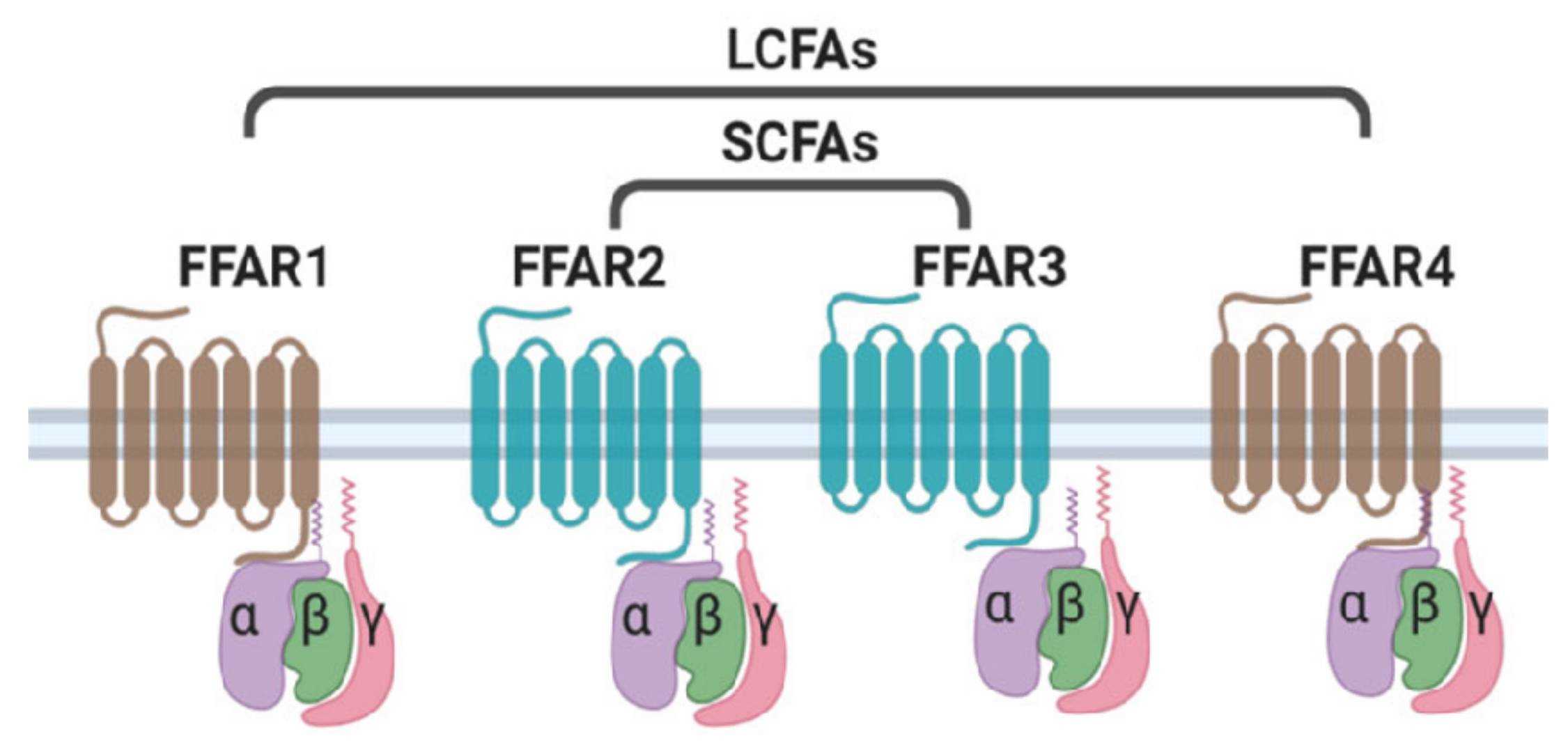 Fig.1 Ligand specificity of free fatty acid receptors.1
Multiple lines of research congregate on this receptor as:
To produce a credible and usable FFAR1, there is a core requirement that cannot be ignored from the very beginning: the environment where its ligands reside must be carefully managed, with no room for carelessness. The inherent chemical property of this receptor itself is hydrophobic, which essentially means it is inherently water-averse. If the production process, or the subsequent storage and usage format, fails to account for this core water-averse characteristic, it will quickly deviate from its intended native state, and the speed of this "alteration" is faster than that of most GPCR reagents of the same type. We produce full-length, intact FFAR1 using our specially optimized eukaryotic expression system, which is equipped with dedicated folding-assisted conditions that perfectly match the protein's own seven-transmembrane structure to help it fold into the correct shape. At the same time, we choose a membrane-bound format to preserve it, so as to maintain the stability and reproducibility of the pharmacological environment. Before each batch of products is released for delivery, two mandatory tests must be passed: one is purity testing via SDS-PAGE, and the other is monodispersity testing via analytical size-exclusion chromatography, to ensure it remains in a stable state and does not aggregate. If your research has special requirements, whether you need specific ligand conditions, specific allosteric tool formats, or presentation formats compatible with a certain type of pharmacological experiment, we can adjust the corresponding production plan to fully align with your experimental workflow—all reagents are designed to serve your experimental design, and will never restrict your experimental design in turn.
Not finding the membrane protein product you need? Contact us to start your one-stop custom service!
Cell models used for FFAR1-related research must meet two requirements simultaneously to be functional: appropriate expression density, plus normal signal transduction capability. Only when both conditions are met can stable and reliable experimental data be generated. After all, FFAR1 itself is a metabolic sensor; if it cannot properly reach the cell surface, it will not be able to transmit the detected nutrient status signals as expected, and the foundation of the entire experiment will collapse. We offer two available cell lines: one is a wild-type overexpression cell line, and the other is an engineered mutant cell line, which is sufficient to support rigorous mechanistic studies on this receptor. Furthermore, every cell clone has completed full characterization testing before it is released to you. By the time you receive it and prepare to start any experiment, the baseline behavior of this cell line has already been fully confirmed, so no unexpected situations will arise. If your project has special requirements, whether you need a specific variant background, a specific expression level, or a customized expression timeline to match your stimulation experiment protocol, our platform can adjust and adapt accordingly—the cell lines we construct are tailor-made for the specific experiments you plan to conduct, and fully serve your experimental needs.
Not finding the stable cell line product you need? Contact us to start your one-stop custom service!
In antibody-related research on FFAR1, there is another common challenge faced by this receptor family: there are two homologous sister receptors that share the basic free fatty acid receptor backbone with it. Ordinary antibody clones often cannot distinguish between these receptors, leading to cross-reactivity, meaning they bind to multiple receptors of the same family simultaneously. If these family members happen to coexist in your experimental sample, the final quantitative results will be completely disrupted and unusable. The recombinant FFAR1 antibody portfolio we have launched solves this problem at its source: first, it undergoes rigorous screening to ensure the antibody can truly and specifically distinguish FFAR1 from the other two sister receptors; afterwards, it has completed comprehensive validation across multiple experimental scenarios, including quantitative detection of cell lysates, surface staining of cells expressing this receptor, localization of receptor distribution in fixed tissues, and imaging experiments of receptor localization and internalization dynamics in living cells. All these antibodies are produced with defined, fixed sequences, so the performance of each batch remains highly stable, with no batch-to-batch fluctuations. If your project has special requirements, whether you need to conjugate different labels to the antibody, require additional validation for a specific sample type, or need to adjust the format of the antibody clone to fit your unique experimental workflow, customization is available to meet your needs—this antibody portfolio can be flexibly adjusted to fully match all the unique requirements of your experimental workflow.
Not finding the recombinant antibody product you need? Contact us to start your one-stop custom service!
Extending well beyond our standard catalog, we deliver fully customizable discovery and manufacturing solutions meticulously tailored to the sophisticated demands of FFAR1-targeted research and precompound development:
The receptor's natural agonists are hydrophobic, and assay conditions that do not account for this produce misleading behavior. Formats and protocols are designed with the ligand environment explicitly in view.
The primary pocket binds natural fatty-acid agonists, while additional sites accommodate distinct tool compounds. The two layers can be probed independently or in combination, expanding the pharmacological questions an assay can ask.
Clones are screened against related family members during selection, and off-target panel results accompany product documentation so specificity claims remain transparent.
All FFAR1 products and services are provided strictly for preclinical research. They are not designed, validated, or authorized for any use involving human subjects.