
Creative Biolabs is offering the most comprehensive services for antibody development projects. With strict regulation and effective execution, we are dedicated to providing the most valuable solutions to complete your projects.
HighlightsCreative Biolabs is offering the most comprehensive services for antibody development projects. With strict regulation and effective execution, we are dedicated to providing the most valuable solutions to complete your projects.
HighlightsCreative Biolabs has established a broad range of platforms for developing novel antibodies or equivalents. These cutting-edge technologies enable our scientists to meet your demands from different aspects and tailor the most appropriate solution that contributes to the success of your projects.
HighlightsWith deep understanding in antibody-related realms and extensive project experience, Creative Biolabs offers a variety of references to help you learn more about our capacities and achievements, including infographic, flyer, case study, peer-reviewed publications, and all kinds of knowledge that can assist your projects. You are also welcome to contact us directly for more specific solutions.
HighlightsGet a real taste of Creative Biolabs, one of the most professional custom service providers in the world. We are committed to providing highly customized comprehensive solutions with the best quality to advance your projects.
Highlights Loading...
All listed services and products are For Research Use Only. Do Not use in any diagnostic or therapeutic applications.
Fibroblast growth factor receptor 4 (FGFR4) is a receptor tyrosine kinase with specialized roles in fibroblast growth factor signaling and metabolic regulation. This family consists of a total of four receptor tyrosine kinases, all of which operate under the same core logic: they bind extracellular fibroblast growth factor (FGF) protein ligands, then translate these signals into instructions that the interior of the cell can interpret, initiate corresponding signaling programs, and drive the cell to produce matching responses. Its basic structure is identical to that of the other three members of its family—FGFR1, FGFR2, and FGFR3: all have three immunoglobulin-like domains, whose role is to accurately recognize the ligands that bind to them, that is, FGF ligands carrying signals; they also have a single transmembrane helix structure, which passes exactly through the cell's membrane to connect the extracellular recognition portion with the intracellular functional portion; the intracellular kinase domain is activated through ligand-induced receptor dimerization and trans-autophosphorylation, including phosphorylation of activation-loop tyrosines. Among all the signaling pathways that FGFR4 is involved in, the one that has been most thoroughly studied to date is the pathway connecting the intestine to the liver. After feeding, intestinal cells release the endocrine ligand FGF19. FGF19 travels through the circulation to reach liver cells, signals through the FGFR4–β-Klotho receptor complex on hepatocytes, and then triggers two core effects: on one hand, it inhibits the body from synthesizing excess bile acids, preventing problems caused by bile acid accumulation; on the other hand, it regulates the enterohepatic circulation that controls cholesterol and bile physiology, keeping this core cycle responsible for digestion and lipid metabolism maintained in a normal state.
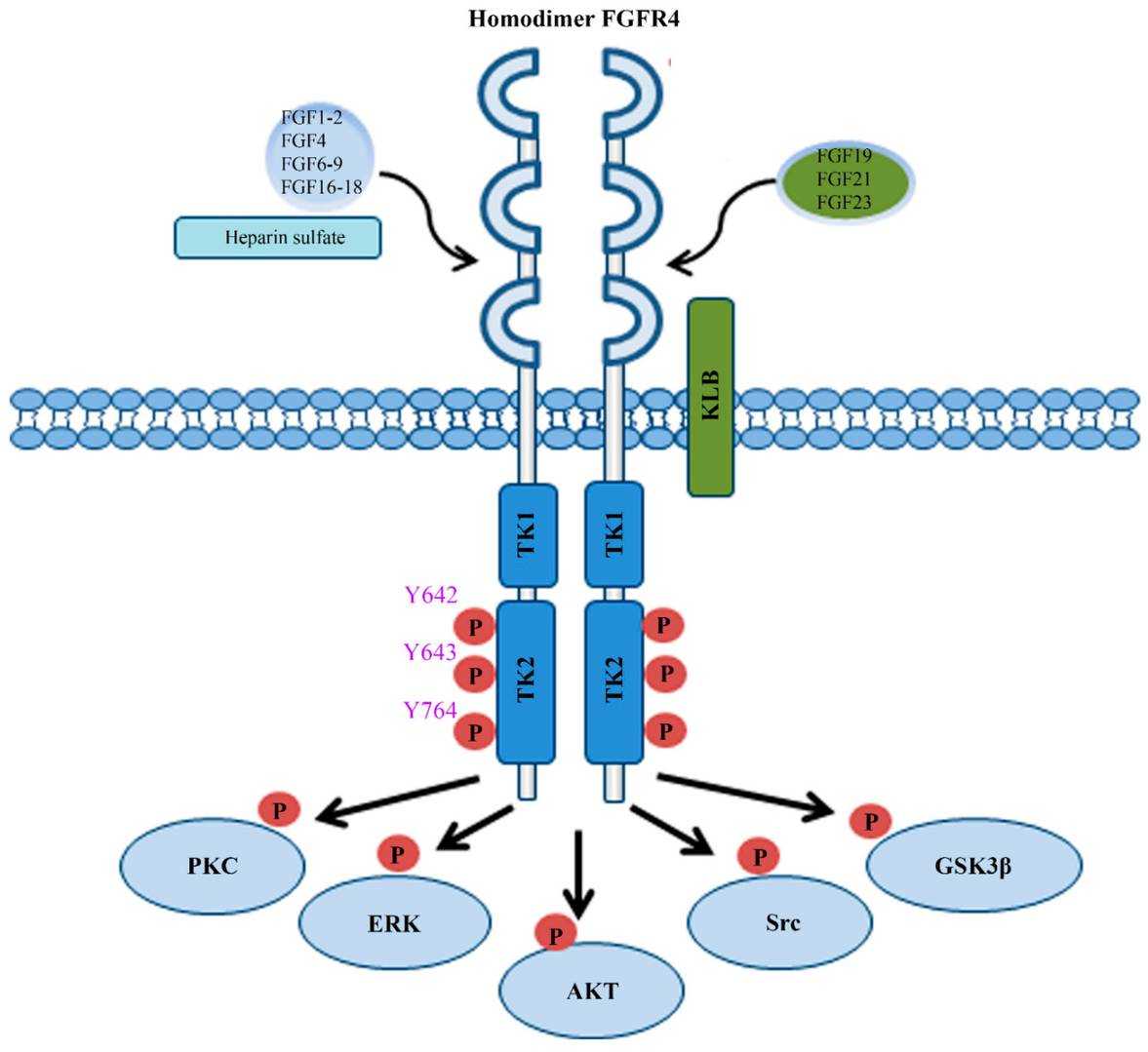 Fig.1 The FGF/FGFR4 signal axis.1
Several research currents keep converging on this receptor:
Producing FGFR4 credibly means preserving the full receptor architecture. A truncated extracellular region or a kinase-incompetent preparation will pass purity checks and fail the very experiments FGFR4 research depends on. Full-length FGFR4 comes from our optimized eukaryotic expression systems with folding support matched to the receptor-tyrosine-kinase architectures. Release testing covers purity by SDS-PAGE. If your study requires a specific variant background, a defined cofactor condition, or a presentation matched to a particular binding or kinase assay, the format can be adjusted around your protocol—the preparation follows the experimental design.
Not finding the membrane protein product you need? Contact us to start your one-stop custom service!
Cellular models for FGFR4 work turn on expression density and signaling competence working together—a receptor that reaches the surface without kinase function cannot inform either metabolism or inhibitor research. Wild-type overexpression lines and different variants let researchers separate ligand binding from phosphotransfer. Each clone is characterized before release, so the line's behavior is established before experiments begin. Should your program call for a particular variant background, a specific density tier, or an expression schedule built around your challenge protocol, the platform can be tailored to fit; the cell line is constructed to serve the experiment it will run in.
Not finding the stable cell line product you need? Contact us to start your one-stop custom service!
Antibody work on FGFR4 faces the four-sibling problem: the immunoglobulin-like domains and kinase regions are similar enough across the FGFR family that generic clones drift into cross-reactivity, corrupting quantitation in samples where multiple FGFRs co-express. The recombinant panel here is screened for genuine FGFR4 discrimination against its three siblings. Sequence-defined production keeps lot-to-lot performance steady, and where a project needs a different conjugate, validation against a specific sample type, or an adjustment in clone format to fit a particular workflow, that can be arranged on request—the panel flexes to meet the experimental design it serves.
Not finding the recombinant antibody product you need? Contact us to start your one-stop custom service!
In addition to our catalog products, Creative Biolabs specializes in custom services for membrane protein and antibody discovery & development. Using our deep knowledge and sophisticated platforms we can support you with:
Liver, skeletal muscle, pituitary, kidney, and lung carry the receptor, a disciplined pattern that reflects its specialization in metabolic and muscle biology.
All FGFR4 products and services are provided strictly for preclinical research. They are not designed, validated, or authorized for any use involving human subjects.
Four related catalytic domains share most of their chemistry, so achieving FGFR4-selective inhibition requires exploiting subtle differences—a standing challenge that makes the receptor a valued testbed.
Hepatic metabolism, muscle biology, kinase-selectivity programs, and oncology research models with FGFR4 overexpression are the standing territories of use.









