Creative Biolabs is offering the most comprehensive services for antibody development projects. With strict regulation and effective execution, we are dedicated to providing the most valuable solutions to complete your projects.
HighlightsCreative Biolabs is offering the most comprehensive services for antibody development projects. With strict regulation and effective execution, we are dedicated to providing the most valuable solutions to complete your projects.
HighlightsCreative Biolabs has established a broad range of platforms for developing novel antibodies or equivalents. These cutting-edge technologies enable our scientists to meet your demands from different aspects and tailor the most appropriate solution that contributes to the success of your projects.
HighlightsWith deep understanding in antibody-related realms and extensive project experience, Creative Biolabs offers a variety of references to help you learn more about our capacities and achievements, including infographic, flyer, case study, peer-reviewed publications, and all kinds of knowledge that can assist your projects. You are also welcome to contact us directly for more specific solutions.
HighlightsGet a real taste of Creative Biolabs, one of the most professional custom service providers in the world. We are committed to providing highly customized comprehensive solutions with the best quality to advance your projects.
Highlights Loading...
All listed services and products are For Research Use Only. Do Not use in any diagnostic or therapeutic applications.
Glucose-6-phosphatase catalytic subunit (G6PC) is a key metabolic enzyme encoded by G6PC gene, which is highly expressed in hepatocytes. G6PC is an endoplasmic reticulum integrated membrane protein, which contains nine transmembrane helices and can be stably embedded in the lipid bilayer structure of endoplasmic reticulum. The protein has a clear subcellular topological polarity, its N-terminal domain faces the endoplasmic reticulum cavity, and its C-terminal extends to the cytoplasm side, while highly conservative catalytic functional pockets are directionally distributed in the microenvironment of the cavity, ensuring the efficient catalytic reaction in the endoplasmic reticulum aqueous solution cavity. Unlike soluble enzymes in endoplasmic reticulum, G6PC relies on a complete transmembrane mosaic structure to maintain its conformational stability and catalytic activity.
G6PC is the core functional enzyme to maintain glucose homeostasis, which mediates the terminal catalytic step of gluconeogenesis and glycogen decomposition pathway, and can catalyze the dephosphorylation of glucose -6- phosphate and generate free glucose. Substrate molecules enter the endoplasmic reticulum cavity through an independent transport system, which provides a prerequisite for the catalytic reaction of G6PC. The expression level of G6PC in hepatocytes can directly regulate the overall gluconeogenesis intensity of the liver and adapt to the balance of glucose supply and demand in different physiological states. The abnormal structure or expression disorder of G6PC will directly hinder the hydrolysis process of substrate and induce the imbalance of glucose metabolism. With its unique transmembrane topology and intracavity catalytic properties, G6PC has become the core research target to analyze the function of endoplasmic reticulum enzyme and the regulation mechanism of liver metabolism.
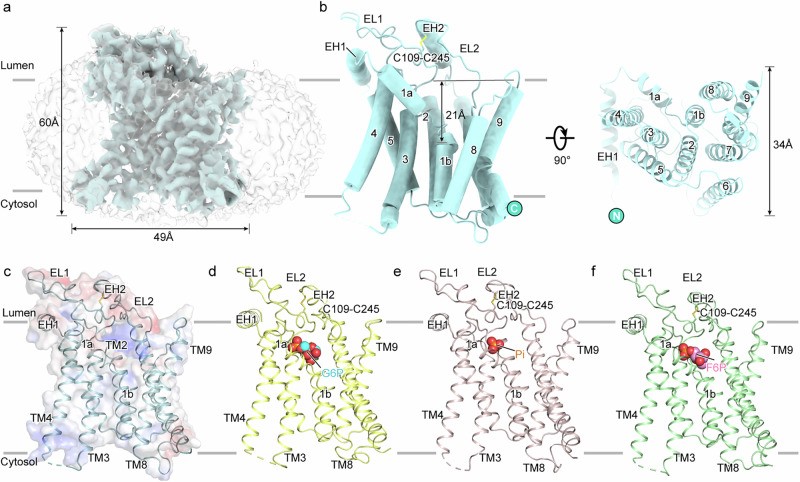 Fig. 1 Cryo‑EM‑derived three‑dimensional structure of human G6PC, illustrating nine‑transmembrane‑helix topology spanning endoplasmic reticulum membrane, with N‑terminus oriented toward ER lumen and C‑terminus facing cytosol.1
The biological functions of ER transmembrane G6PC enzyme focus on luminal substrate dephosphorylation and endogenous glucose production modulation:
Creative Biolabs offers purified G6PC protein samples produced under unified preparation workflows, including full-length G6PC constructs and partial domain variants suitable for diversified research scenarios. Intact transmembrane structural integrity is critical for retaining native luminal catalytic properties, while truncated constructs might fail to recapitulate complete substrate hydrolysis function. All protein batches undergo standardized quality control procedures to ensure consistent structural preservation. Related functional evaluation schemes adapt to simulated endoplasmic reticulum microenvironments, which support observational analysis of enzyme catalytic characteristics. Conserved structural domains and catalytic interfaces are well maintained across batches, enabling reliable comparative research on enzyme-substrate interaction mechanisms.
Not finding the Membrane Protein product you need? Contact us to start your one-stop custom service!
Creative Biolabs provides cell research models with adjustable G6PC expression levels, which are applicable to mechanistic research on ER transmembrane enzyme function and hepatic carbohydrate metabolism. These cell models support comparative analysis of enzyme localization characteristics and catalytic performance under different G6PC expression abundances. Researchers can combine conventional metabolic detection methods to observe the correlation between G6PC expression fluctuation and glucose metabolic output changes, providing reliable cellular research materials for metabolic mechanism exploration.
Not finding the stable cell line product you need? Contact us to start your one-stop custom service!
Anti-G6PC recombinant antibodies are generated via standardized production processes, suitable for detecting ER transmembrane protein subcellular localization and analyzing enzyme-associated molecular complexes within hepatic tissue samples. The antibody resources support multi-dimensional observational research on G6PC distribution characteristics and structural conformation changes in basic laboratory research systems.
Not finding the recombinant antibody product you need? Contact us to start your one-stop custom service!
Beyond catalog products, Creative Biolabs offers specialized custom services for G6PC research:
G6PC is an ER transmembrane enzyme with a lumen-oriented catalytic domain. It participates in glucose-6-phosphate dephosphorylation processes and may contribute to the regulation of hepatic glucose metabolic balance in physiological states.
G6PC structural integrity and normal expression status are closely associated with steady carbohydrate metabolism. It tends to act as a vital regulatory factor in hepatic glucose homeostasis, making it a core research object for metabolic mechanism studies.
No, all G6PC related products and services are strictly designed for basic research use only. All product development and quality evaluation standards apply exclusively to laboratory basic research, and are not applicable for clinical scenarios.
Offerings include full-length G6PC transmembrane protein samples, target-specific recombinant antibodies and tunable expression cell research models, supporting research on hexose phosphate hydrolysis and hepatic glucose production.
Laboratory analysis schemes may include glucose-6-phosphate hydrolysis assays to assess substrate dephosphorylation capacity under simulated ER luminal environments.