
Creative Biolabs is offering the most comprehensive services for antibody development projects. With strict regulation and effective execution, we are dedicated to providing the most valuable solutions to complete your projects.
HighlightsCreative Biolabs is offering the most comprehensive services for antibody development projects. With strict regulation and effective execution, we are dedicated to providing the most valuable solutions to complete your projects.
HighlightsCreative Biolabs has established a broad range of platforms for developing novel antibodies or equivalents. These cutting-edge technologies enable our scientists to meet your demands from different aspects and tailor the most appropriate solution that contributes to the success of your projects.
HighlightsWith deep understanding in antibody-related realms and extensive project experience, Creative Biolabs offers a variety of references to help you learn more about our capacities and achievements, including infographic, flyer, case study, peer-reviewed publications, and all kinds of knowledge that can assist your projects. You are also welcome to contact us directly for more specific solutions.
HighlightsGet a real taste of Creative Biolabs, one of the most professional custom service providers in the world. We are committed to providing highly customized comprehensive solutions with the best quality to advance your projects.
Highlights Loading...
All listed services and products are For Research Use Only. Do Not use in any diagnostic or therapeutic applications.
Gamma-aminobutyric acid type B receptor subunit 2 (GABBR2), also known as GABABR2, GPR51, or GPRC3B, is encoded by the GABBR2 gene on chromosome 9q22.33. The gene spans more than 350 kb and produces a 941-amino-acid protein with a signal peptide, an extended extracellular N-terminal domain characteristic of metabotropic amino acid-binding receptors, seven transmembrane domains, and an unusually long intracellular C-terminal tail. GABBR2 shares approximately 35% amino acid sequence identity with GABBR1. The protein is expressed in the central nervous system, with highest levels in the cortex, thalamus, hippocampus, amygdala, cerebellum, and spinal cord.
GABBR2 is the G protein-coupling subunit of the metabotropic GABA-B receptor, a heterodimeric complex formed by GABBR1 and GABBR2. Within this obligate heterodimer, GABBR1 contains the orthosteric ligand-binding site for GABA and baclofen, while GABBR2 mediates coupling to G proteins. The receptor is retained in the endoplasmic reticulum until the two subunits assemble, after which the complex traffics to the cell surface. GABA-B receptor activation inhibits adenylyl cyclase, stimulates phospholipase A2, activates inwardly rectifying potassium channels, and inactivates voltage-dependent calcium channels. These signaling events mediate the fine-tuning of inhibitory synaptic transmission: presynaptic GABA-B receptors inhibit neurotransmitter release, whereas postsynaptic receptors decrease neuronal excitability and contribute to late inhibitory postsynaptic potentials. Pathogenic variants in GABBR2 cause developmental and epileptic encephalopathy 59 (DEE59) and neurodevelopmental disorder with poor language and loss of hand skills, and have also been associated with Rett syndrome-like phenotypes.
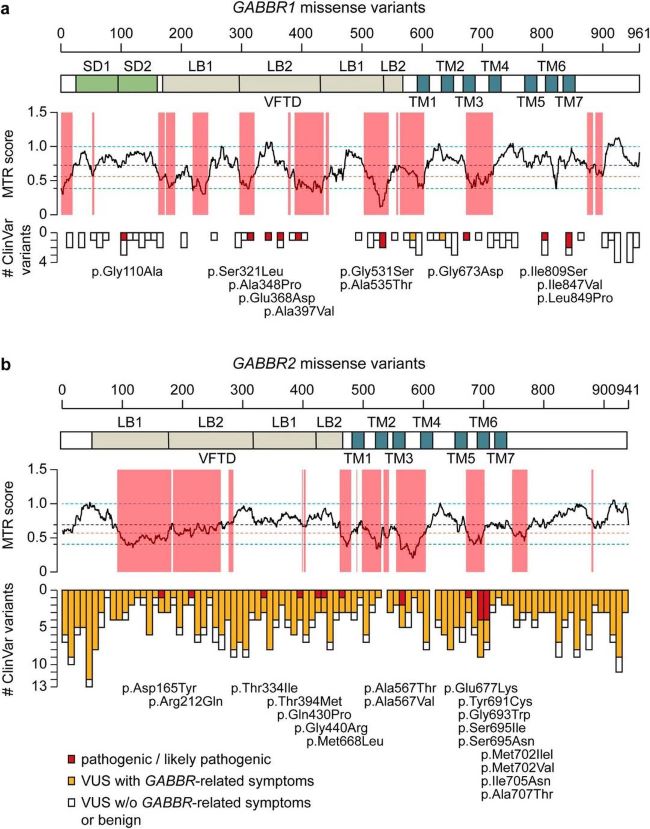 Fig. 1 GABBR1 and GABBR2 missense variants reported in the ClinVar database and the literature.1
GABBR2, encoded by the GABBR2 gene, functions as the G protein-coupling subunit of the heterodimeric GABA-B receptor that mediates inhibitory neurotransmission:
Creative Biolabs offers high-quality GABBR2 membrane protein products produced using optimized expression systems. These include full-length multi-pass transmembrane protein that retains the native extracellular N-terminal domain, seven-transmembrane region, and intracellular C-terminal tail, as well as isolated domain variants. The seven-transmembrane domain and intracellular regions mediate heterodimerization with GABBR1 and Gi/o protein coupling, making these proteins suitable for studies of GABA-B receptor assembly, G protein coupling mechanisms, and receptor pharmacology characterization. All GABBR2 proteins undergo strict quality control to support consistent performance across applicable research platforms.
Not finding the protein product you need? Contact us to start your one-stop custom service!
Creative Biolabs provides custom-engineered GABBR2 stable cell lines, including overexpression and knockdown models. These cell lines support studies of GABBR2 expression, localization and receptor assembly; functional GABA-B Gi/o signaling requires coexpression of GABBR1 or a verified endogenous GABBR1 background. Each cell line undergoes stringent validation to ensure stable expression profiles and consistent functional performance in diverse experimental contexts.
Not finding the stable cell line product you need? Contact us to start your one-stop custom service!
High-specificity recombinant antibodies targeting GABBR2 are developed using antibody engineering technologies for research applications involving GABBR2 expression and localization. These antibodies can be used in studies of GABBR2 distribution in neuronal tissues and may also support characterization of GABBR2-containing heterodimeric receptor complexes in combination with appropriate detection reagents.
Not finding the recombinant antibody product you need? Contact us to start your one-stop custom service!
Beyond catalog products, Creative Biolabs offers specialized custom services for GABBR2 research:
GABBR2 is the G protein-coupling subunit of the heterodimeric GABA-B receptor that assembles with GABBR1 and mediates Gi/o protein activation, regulating inhibitory neurotransmission and neuronal excitability.
GABBR2 is essential for GABA-B receptor signaling, and its pathogenic variants cause developmental and epileptic encephalopathy 59 and related neurodevelopmental disorders, making it important for studies of inhibitory neurotransmission and GPCR signaling.
No, all GABBR2 products and services are strictly for research use only, not intended for clinical diagnosis or treatment.
Offerings include full-length GABBR2 membrane proteins, domain variants, specific detection antibodies, and custom stable cell lines for GABA-B receptor and GPCR signaling research.
GABBR2 proteins may support studies of G protein coupling and heterodimer assembly, depending on protein format and experimental context.









