Creative Biolabs is offering the most comprehensive services for antibody development projects. With strict regulation and effective execution, we are dedicated to providing the most valuable solutions to complete your projects.
HighlightsCreative Biolabs is offering the most comprehensive services for antibody development projects. With strict regulation and effective execution, we are dedicated to providing the most valuable solutions to complete your projects.
HighlightsCreative Biolabs has established a broad range of platforms for developing novel antibodies or equivalents. These cutting-edge technologies enable our scientists to meet your demands from different aspects and tailor the most appropriate solution that contributes to the success of your projects.
HighlightsWith deep understanding in antibody-related realms and extensive project experience, Creative Biolabs offers a variety of references to help you learn more about our capacities and achievements, including infographic, flyer, case study, peer-reviewed publications, and all kinds of knowledge that can assist your projects. You are also welcome to contact us directly for more specific solutions.
HighlightsGet a real taste of Creative Biolabs, one of the most professional custom service providers in the world. We are committed to providing highly customized comprehensive solutions with the best quality to advance your projects.
Highlights Loading...
All listed services and products are For Research Use Only. Do Not use in any diagnostic or therapeutic applications.
GLCE (glucuronic acid epimerase) is a Golgi-resident integrated transmembrane epimerase encoded by GLCE gene, which is mainly located in the Golgi-lipid bilayer structure area of glycosaminoglycan synthesis cells. There are significant structural and functional differences between the protein and cytoplasmic soluble enzymes. The molecular structure contains conservative Golgi cavity catalytic domain and short cytoplasmic terminal fragment, and does not contain extracellular ligand recognition module that mediates cell surface signal transduction, so it does not have related signal activation function. Under physiological steady-state conditions, membrane-anchored GLCE can be used as a functional catalytic enzyme to mediate the rearrangement of sugar ring three-dimensional structure during the assembly of heparan sulfate polysaccharide, and it is a key functional protein for polysaccharide synthesis and modification. When the function of the epimerization modification pathway in Golgi body cavity is insufficient, the unprocessed glycan precursor chains are easy to accumulate abnormally in the microenvironment in the cavity, and GLCE can balance the metabolic turnover efficiency of the three-dimensional structure of glycan chains in each substructure region of Golgi body through stable metabolic buffering. Different functional partitions of Golgi apparatus can produce glycosaminoglycan precursors with different components, which requires the synergistic effect of various membrane-bound epimerases to maintain the overall steady state of cohesive sugar chain assembly in cell secretion system. GLCE located in Golgi membrane can continuously modify the three-dimensional configuration of polysaccharide precursors, effectively inhibit the accumulation of immature polysaccharide intermediates, and ensure the stable and orderly assembly process of intracellular heparan sulfate.
The sequence variation of GLCE gene can change its catalytic binding activity to glycan precursors, resulting in abnormal remodeling of the structure and composition pattern of heparan sulfate in cells. At present, no other Golgi-resident epimerase has been found to replicate GLCE's catalytic function of glycosyl epimerization and Golgi-body membrane anchoring characteristics at the same time. The expression level of GLCE is closely related to the process of cellular glycosaminoglycan biosynthesis, which can sensitively respond to the dynamic changes of glycan synthesis state. GLCE is an important research target for studying the function of Golgi-based resident glycan modifying enzyme and the assembly mechanism of heparan sulfate. GLCE is stably embedded in Golgi lipid bilayer, which specifically catalyzes the structural modification of polysaccharide precursor substrate, and its catalytic process will not induce continuous downstream signal cascade reaction. Different from cytoplasmic soluble catalytic enzymes, GLCE plays a dual biological function by virtue of its unique Golgi transmembrane localization, which can not only stabilize the stable structure of intracellular heparan sulfate precursor library, but also provide key support for the mature modification of proteoglycan polysaccharide chain. When the expression level of functional GLCE in cells decreased, a large amount of epimerized glycan precursors did not accumulate, and the assembly regulation and buffering capacity of heparan sulfate in cells were significantly weakened, which further confirmed the important academic value of this protein in the basic research of Golgi epimerase.
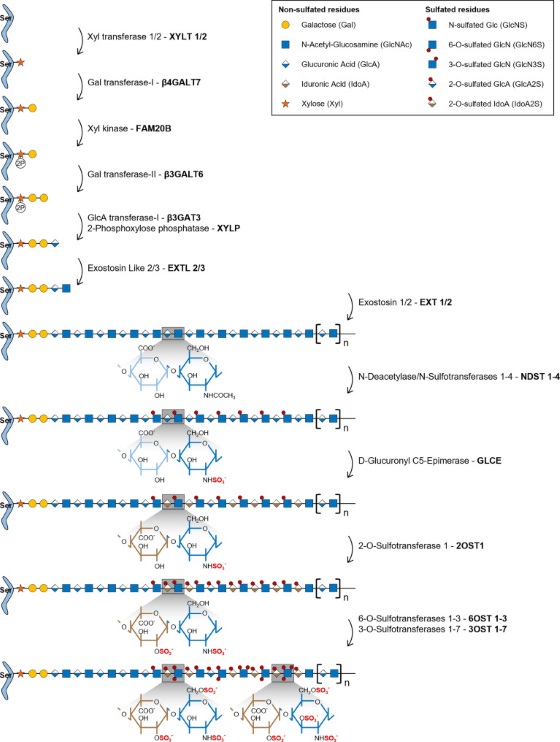 Fig. 1 Biosynthesis pathway of heparan sulfate glycosaminoglycans within the Golgi apparatus. GLCE (D‑Glucuronyl C5‑Epimerase) mediates C5‑epimerization that converts glucuronic acid to iduronic acid on glycan chains, reshaping glycan‑ring stereoconfiguration as an essential step for heparan‑sulfate chain maturation.1
The biological functions of transmembrane GLCE epimerase protein are focused on sustained regulated glycan-precursor catalysis and heparan-sulfate chain-assembly coordination:
Creative Biolabs offers purified GLCE membrane samples produced under unified preparation workflows, including full-length GLCE constructs and isolated luminal catalytic domain variants. Truncated catalytic fragments cannot support complete glycan-epimerization behaviors, while full-length constructs suit research focused on sugar-stereochemical rearrangement and Golgi membrane anchoring. All batches receive uniform quality screening. Functional relevant observation may only be carried out with full-length samples under simulated membrane microenvironment setups. Consistent structural features are preserved across batches to support comparative laboratory analysis across separate test groups. Full-length GLCE samples retain intact luminal catalytic pocket conformation after standardized purification, which supports reliable detection of weak and transient enzyme-substrate contacts for comparative functional analysis.
Not finding the Membrane potein product you need? Contact us to start your one-stop custom service!
Creative Biolabs provides adjustable GLCE expression cell research models with varied expression levels, applicable to structural observation of Golgi-resident glycan-modifying epimerases and research into glycan-precursor catalytic interaction. Sample evaluation includes sustained target expression detection and preliminary substrate-interaction observation, enabling side-by-side comparison of enzyme catalytic behaviors under differing expression abundances. These cell systems can pair with diverse laboratory analysis schemes to track changes in substrate-processing efficiency alongside shifting target protein levels.
Not finding the stable cell line product you need? Contact us to start your one-stop custom service!
Anti-GLCE recombinant antibodies are generated via standardized protein preparation workflows, compatible with routine laboratory detection techniques for Golgi-membrane localization mapping and identification of enzyme-substrate molecular complexes. The antibody series can work alongside common laboratory detection reagents to realize multi-dimensional observation of target distribution within proteoglycan-rich tissue samples.
Not finding the recombinant antibody product you need? Contact us to start your one-stop custom service!
Beyond catalog products, Creative Biolabs offers specialized custom services for GLCE research:
GLCE might act as a Golgi-resident transmembrane epimerase and participate in stereochemical rearrangement of glycan precursors during heparan-sulfate assembly.
GLCE expression status could alter intracellular unepimerized glycan-precursor concentrations and proteoglycan glycan-chain assembly capacity, serving as a major regulatory mediator of cellular heparan-sulfate biosynthesis biological processes.
No, all GLCE related products and services are strictly for research use only, and cannot be applied in clinical workflows. All material designs and functional tests are optimized exclusively for basic laboratory research scenarios, without matching clinical application standards.
Offerings include full-length GLCE membrane protein, target-specific recombinant antibodies and tunable expression cell research models, supporting research on Golgi glycan homeostasis and heparan-sulfate proteoglycan assembly.
Laboratory observation schemes may include enzyme-substrate interaction related tests to analyze catalytic-associated behaviors under simulated membrane environments.