
Creative Biolabs is offering the most comprehensive services for antibody development projects. With strict regulation and effective execution, we are dedicated to providing the most valuable solutions to complete your projects.
HighlightsCreative Biolabs is offering the most comprehensive services for antibody development projects. With strict regulation and effective execution, we are dedicated to providing the most valuable solutions to complete your projects.
HighlightsCreative Biolabs has established a broad range of platforms for developing novel antibodies or equivalents. These cutting-edge technologies enable our scientists to meet your demands from different aspects and tailor the most appropriate solution that contributes to the success of your projects.
HighlightsWith deep understanding in antibody-related realms and extensive project experience, Creative Biolabs offers a variety of references to help you learn more about our capacities and achievements, including infographic, flyer, case study, peer-reviewed publications, and all kinds of knowledge that can assist your projects. You are also welcome to contact us directly for more specific solutions.
HighlightsGet a real taste of Creative Biolabs, one of the most professional custom service providers in the world. We are committed to providing highly customized comprehensive solutions with the best quality to advance your projects.
Highlights Loading...
All listed services and products are For Research Use Only. Do Not use in any diagnostic or therapeutic applications.
G protein subunit alpha q (GNAQ) is the cytosolic, membrane-associated Gαq subunit of heterotrimeric G proteins encoded by the GNAQ gene. In the inactive state, Gαq binds GDP and associates with Gβγ at the inner leaflet of the plasma membrane. Agonist-activated Gq-coupled GPCRs promote GDP release and GTP binding; Gαq-GTP and Gβγ then regulate downstream effectors in a context-dependent manner. A principal Gαq effector is phospholipase C-β (PLCβ), which hydrolyzes phosphatidylinositol 4,5-bisphosphate to generate IP3 and DAG, thereby influencing intracellular calcium and protein kinase C signaling. Intrinsic GTP hydrolysis, accelerated by regulatory proteins such as RGS proteins, returns Gαq to the GDP-bound state and terminates signaling. GNAQ variants have been investigated in uveal melanoma and other melanocytic proliferative disorders, as well as in selected developmental and vascular abnormalities; their biological consequences depend on the variant, tissue and experimental system.
GNAQ function is governed by a GDP/GTP cycle within a membrane-associated heterotrimeric complex. GPCR-catalyzed nucleotide exchange activates Gαq, whereas intrinsic and RGS-accelerated GTP hydrolysis promotes signal termination and reassociation with Gβγ. Activated Gαq can engage PLCβ and other context-dependent effectors. Accordingly, nucleotide-binding or GTPase assays, purified Gαq-effector interaction assays and cell-based Gq signaling assays address different aspects of function and should not be treated as interchangeable evidence. Activating variants can prolong signaling in particular cellular contexts, including models used to study uveal melanoma and other GNAQ-associated disorders.
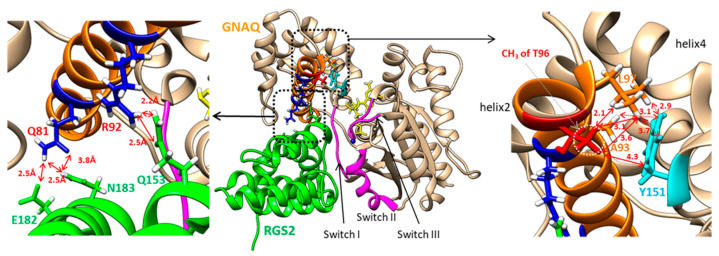 Fig. 1 Crystal structure of GNAQ-RGS2 complex, showing critical intermolecular interaction residues within Switch I/II/III domains and helical regions, with labeled atomic distances of residue contacts governing GTPase regulatory function.1
Key experimentally distinguishable aspects of GNAQ biology include receptor-coupled nucleotide cycling, effector interaction and cell-context-dependent signaling:
Creative Biolabs offers GNAQ protein constructs produced using optimized expression and purification workflows, including wild-type or mutant full-length proteins and selected effector-interaction constructs, subject to construct availability. Full-length or domain-only proteins can support nucleotide-binding, GTPase or effector-interaction studies when the relevant activity is documented in the product-specific batch data. Because isolated GNAQ does not reproduce membrane-associated GPCR-Gαqβγ coupling or a complete cellular PLCβ-calcium response, those functions should be evaluated in an appropriate reconstituted complex or validated cell-based assay. Product-specific identity, purity, aggregation state and functional test results are reported according to the applicable quality-control specification.
Not finding the membrane protein product you need? Contact us to start your one-stop custom service!
Creative Biolabs provides custom engineered GNAQ stable cell lines, including wild-type and oncogenic mutant overexpression plus gene silencing models. These cell lines are optimized for Gq calcium signaling and melanocytic tumor research. Strict clonal screening selects cell clones with constant GNAQ expression without drift during long-term culture, each batch attached with signaling baseline measurement data. Each cell line undergoes strict validation procedures to ensure steady target expression levels and uniform functional performance across multiple experimental scenarios.
Not finding the stable cell line product you need? Contact us to start your one-stop custom service!
High-specificity recombinant antibodies targeting GNAQ are developed with advanced antibody engineering workflows, without cross-reactivity against GNA11 and other Gα isoforms. These antibodies pass co-IP and intracellular immunostaining validation, formulated with neutral preservative-free buffer to fit G protein complex detection experiments. Parallel isoform cross-testing excludes off-target binding signals.
Not finding the recombinant antibody product you need? Contact us to start your one-stop custom service!
Beyond catalog products, Creative Biolabs offers specialized custom services for GNAQ research:
GNAQ is a Gq-family G alpha subunit that exchanges nucleotides upon GPCR activation to stimulate PLCβ and trigger intracellular calcium mobilization.
Activating GNAQ variants are frequent in uveal melanoma and can sustain signaling in relevant models. GNAQ is therefore studied as a disease-associated signaling node and potential therapeutic target, with conclusions dependent on the variant, model and supporting evidence.
No, all GNAQ products and services are strictly for research use only, not intended for clinical diagnosis or treatment.
Offerings including wild-type/mutant GNAQ proteins, high-specificity recombinant antibodies and custom stable cell lines for Gq signaling and melanoma research.
Validation depends on the product format. Applicable tests may include nucleotide binding or GTPase assays, PLCβ interaction assays, and cell-based Gq signaling measurements; consult the product- and batch-specific data for the tests actually performed.









