
Creative Biolabs is offering the most comprehensive services for antibody development projects. With strict regulation and effective execution, we are dedicated to providing the most valuable solutions to complete your projects.
HighlightsCreative Biolabs is offering the most comprehensive services for antibody development projects. With strict regulation and effective execution, we are dedicated to providing the most valuable solutions to complete your projects.
HighlightsCreative Biolabs has established a broad range of platforms for developing novel antibodies or equivalents. These cutting-edge technologies enable our scientists to meet your demands from different aspects and tailor the most appropriate solution that contributes to the success of your projects.
HighlightsWith deep understanding in antibody-related realms and extensive project experience, Creative Biolabs offers a variety of references to help you learn more about our capacities and achievements, including infographic, flyer, case study, peer-reviewed publications, and all kinds of knowledge that can assist your projects. You are also welcome to contact us directly for more specific solutions.
HighlightsGet a real taste of Creative Biolabs, one of the most professional custom service providers in the world. We are committed to providing highly customized comprehensive solutions with the best quality to advance your projects.
Highlights Loading...
All listed services and products are For Research Use Only. Do Not use in any diagnostic or therapeutic applications.
G protein-coupled receptor 183 (GPR183) was first discovered as a gene induced by the Epstein-Barr virus, which is why it once carried the former name EBI2. This seven-transmembrane receptor has unlocked a completely unexpected new chapter in immunology: for the first time, researchers discovered that Cholesterol Metabolites can also act as Directional Signals to guide the migration of immune cells. The natural binding substance of this receptor in the human body is oxysterol — that is, an oxidized cholesterol derivative. Among all oxysterols, the most core one is a metabolite with two hydroxyl groups. Beyond B cells, this receptor also influences the migration of Broader Leukocyte Populations, guiding subsets of helper T cells involved in barrier defense and inflammatory responses, while participating in constructing the regionalized structure of secondary lymphoid organs. It ensures different immune cells settle in their proper positions, maintaining the orderly operation of the entire immune organ. Its functions are not limited to immune tissues: the oxysterol-GPR183 pathway has also been identified in research on neuroinflammation, where abnormal receptor signaling is accompanied by the invasion of immune cells into the central nervous system. It has also emerged in various metabolism-related research scenarios, where the process of cholesterol metabolism intersects with immune activities, linking these two physiological processes of metabolism and immunity.
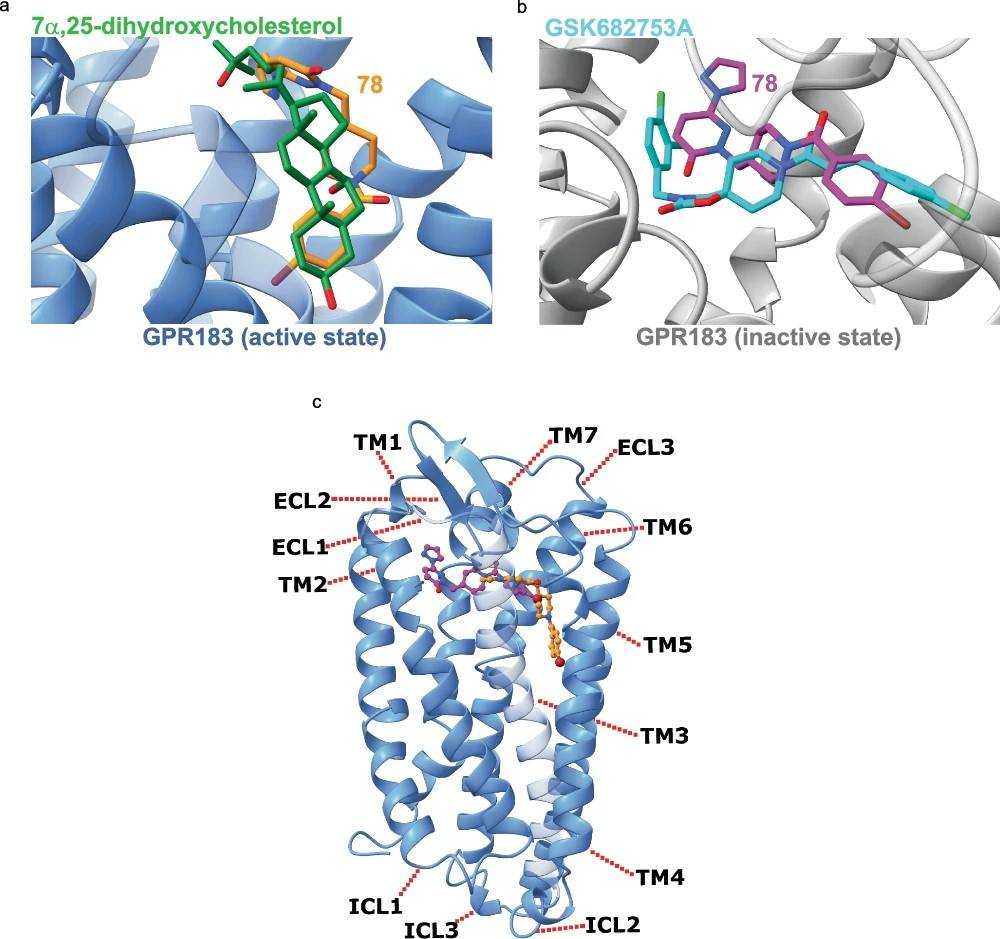 Fig.1 MD-predicted binding poses of compound 78 in the active- and inactive-like GPR183.1
Research on GPR183 continues to chart new territory along several converging directions:
All of our GPR183 membrane protein-related products are developed with one clear guiding principle: to conduct reliable research on this concentration gradient-sensing GPCR, you must never arbitrarily extract it from its native environment for use. Instead, you must carefully preserve the original cell membrane environment where it resides, as well as its own activation status—only when both conditions are maintained can the research results be valid. To meet these essential research requirements, all of the full-length GPR183 products we deliver to customers are completely intact. These products are not produced in arbitrary cells; they are prepared in a specially optimized eukaryotic expression system that has undergone unique modifications. Every batch is inspected one by one across multiple quality dimensions, and only after meeting all standards can it be delivered.
Not finding the membrane protein product you need? Contact us to start your one-stop custom service!
If you plan to conduct GPR183 research using a cell platform, that platform must also meet three strict core requirements: first, it must be able to control the expression level of the GPR183 receptor on cells, allowing adjustment to any desired level; second, it must be able to accurately place the protein in the correct position on the cell membrane, preventing mislocalization that would render it nonfunctional; third, it must retain its core function of sensing concentration gradients, so the generated cells are not inert and incapable of functioning. Why are these requirements so stringent? After all, GPR183 is a chemotaxis receptor. Its true value lies in its ability to drive cells to move along a concentration gradient, not merely in how much of it is synthesized within cells—measuring only expression levels is completely meaningless. We can provide customers with customizable cell lines that stably express high levels of GPR183. When producing these cell lines, we first optimize the GPR183 gene sequence, then integrate it stably into the cell's genome. The resulting cells from the same batch have fully consistent backgrounds, and GPR183 appears continuously and uniformly on every cell surface. It will not decrease or disappear after several passages, nor will its expression vary between cells, which would make experimental results unreproducible. Our cell line library has a complete range of categories, allowing customers to directly select a strain suitable for their research: one category includes strains that stably express wild-type GPR183, which are further divided into several fixed cell surface density tiers, so customers can select the exact density they need; another category includes variant strains carrying artificially engineered mutations, which support a wide range of different research directions. No matter which cell clone it is, it is never delivered casually. Only after comprehensive phenotypic verification confirms that all its characteristics meet requirements will it be handed over to the customer.
Not finding the stable cell line product you need? Contact us to start your one-stop custom service!
If you are advancing a GPR183 research project, you can use our recombinant antibody panel to support target-selective detection. The panel is designed for chemotactic GPCR research workflows and can support quantitative analysis in selected applications. Each antibody clone undergoes sequence verification before delivery and is produced using a defined recombinant construct to support lot-to-lot consistency. Available validation information can be matched to the intended application.
Not finding the recombinant antibody product you need? Contact us to start your one-stop custom service!
In addition to our catalog products, Creative Biolabs specializes in custom services for membrane protein and antibody discovery & development. Using our deep knowledge and sophisticated platforms we can support you with:
All GPR183 products and services are provided strictly for preclinical research. They are not designed, validated, or authorized for any use involving human subjects.
We do. Custom constructs carrying substitutions can be produced and purified under the same quality framework as wild-type material.
Both constitutive and inducible formats are available. Each clone ships with measured data, so receptor expression tier can be matched precisely to your experimental design.
Yes. Clones are screened for selective GPR183 recognition and counter-screened against related receptors using recombinant protein panels, ensuring dependable specificity even in complex expression backgrounds.









