
Creative Biolabs is offering the most comprehensive services for antibody development projects. With strict regulation and effective execution, we are dedicated to providing the most valuable solutions to complete your projects.
HighlightsCreative Biolabs is offering the most comprehensive services for antibody development projects. With strict regulation and effective execution, we are dedicated to providing the most valuable solutions to complete your projects.
HighlightsCreative Biolabs has established a broad range of platforms for developing novel antibodies or equivalents. These cutting-edge technologies enable our scientists to meet your demands from different aspects and tailor the most appropriate solution that contributes to the success of your projects.
HighlightsWith deep understanding in antibody-related realms and extensive project experience, Creative Biolabs offers a variety of references to help you learn more about our capacities and achievements, including infographic, flyer, case study, peer-reviewed publications, and all kinds of knowledge that can assist your projects. You are also welcome to contact us directly for more specific solutions.
HighlightsGet a real taste of Creative Biolabs, one of the most professional custom service providers in the world. We are committed to providing highly customized comprehensive solutions with the best quality to advance your projects.
Highlights Loading...
All listed services and products are For Research Use Only. Do Not use in any diagnostic or therapeutic applications.
G protein-coupled receptor 37 (GPR37), also known as parkin-associated endothelin-like receptor (Pael-R), is encoded by the GPR37 gene on chromosome 7q31.33. The gene spans more than 25 kb and contains two exons separated by a single intron that interrupts the coding sequence within the third transmembrane domain. The GPR37 cDNA encodes a 613-amino-acid protein with seven hydrophobic transmembrane domains, characteristic of the class A (rhodopsin-like) GPCR family. Its amino acid sequence shares approximately 40% homology with mammalian peptide-specific GPCRs in the transmembrane regions, particularly with the endothelin-B, bombesin-BB1, and bombesin-BB2 receptors. GPR37 is highly expressed in the mammalian central nervous system, with major 3.8-kb and less abundant 8-kb transcripts detected in corpus callosum, medulla, putamen, and caudate nucleus. Within the CNS, GPR37 is enriched in myelinating glia, particularly oligodendrocytes and astrocytes, and its expression is detected in white matter tracts including the corpus callosum, hippocampal fimbria, and cerebellar white matter, but is absent in unmyelinated nerve regions.
GPR37 functions as a substrate of the E3 ubiquitin ligase parkin and is involved in the pathogenesis of Parkinson's disease. When overexpressed, GPR37 tends to become unfolded and insoluble, and parkin specifically ubiquitinates the insoluble form to promote its degradation, suppressing GPR37-induced cell death. In brain tissue examined in studies of autosomal recessive juvenile Parkinson disease, the insoluble form of GPR37 accumulates, leading to endoplasmic reticulum stress and selective neuronal death. GPR37 has also been proposed as a receptor for prosaposin and its fragment prosaptide, which have been reported to promote plasma membrane association of GPR37 and stimulate G protein-mediated signaling through pertussis toxin-sensitive G proteins, including ERK phosphorylation. In oligodendrocytes, prosaposin has been reported to activate GPR37 and promote IL-6 production, driving neuroinflammation and dopaminergic neuron loss in Parkinson's disease. Beyond the CNS, GPR37 is expressed in macrophages, where its activation enhances phagocytosis, promotes anti-inflammatory macrophage polarization, and contributes to the resolution of inflammatory pain. These features make GPR37 an important research target for studies of orphan GPCR biology, parkin-mediated neuroprotection, prosaposin signaling, and myelination regulation.
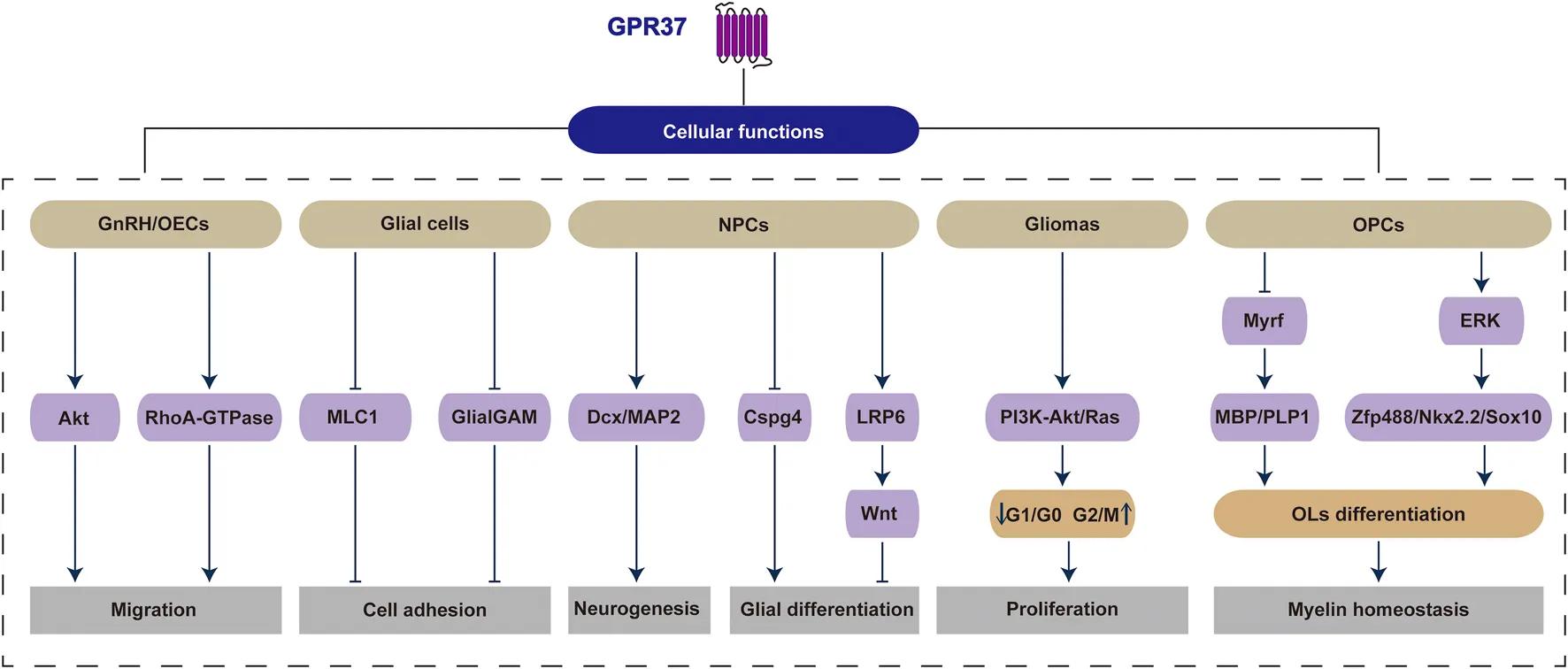 Fig. 1 GPR37 regulates a range of physiological and pathological activities within cells.1
GPR37, encoded by the GPR37 gene, functions as an orphan class A GPCR that regulates neuroprotection and myelination through parkin-dependent and prosaposin-mediated mechanisms:
Creative Biolabs offers high-quality GPR37 membrane protein products produced using optimized expression systems. These include full-length multi-pass transmembrane protein that retains the native seven-transmembrane architecture and ligand-binding pocket, as well as isolated receptor domain variants. The seven-transmembrane architecture and intracellular loops support investigation of proposed prosaposin-associated responses and G protein coupling, making these proteins suitable for studies of orphan GPCR pharmacology, prosaposin-GPR37 interactions, and parkin-mediated receptor regulation characterization. All GPR37 proteins undergo strict quality control to support consistent performance across applicable research platforms.
Not finding the protein product you need? Contact us to start your one-stop custom service!
Creative Biolabs provides custom-engineered GPR37 stable cell lines, including overexpression and knockdown models. These cell lines are optimized for studies of prosaposin signaling, parkin-mediated receptor degradation, oligodendrocyte differentiation, and GPR37-associated neuroinflammation. Each cell line undergoes stringent validation to ensure stable expression profiles and consistent functional performance in diverse experimental contexts.
Not finding the stable cell line product you need? Contact us to start your one-stop custom service!
High-specificity recombinant antibodies targeting GPR37 are developed using antibody engineering technologies for research applications involving GPR37 expression and localization. These antibodies can be used in studies of GPR37 distribution in oligodendrocytes, neurons, and macrophages and may also support characterization of GPR37-containing receptor complexes in combination with appropriate detection reagents.
Not finding the recombinant antibody product you need? Contact us to start your one-stop custom service!
Beyond catalog products, Creative Biolabs offers specialized custom services for GPR37 research:
GPR37 is an orphan class A GPCR that functions as a substrate of parkin and a receptor for prosaposin, regulating neuroprotection, oligodendrocyte differentiation, and macrophage phagocytosis.
GPR37 is involved in the pathogenesis of Parkinson's disease through parkin-mediated regulation and prosaposin-GPR37-IL-6 signaling. It also regulates myelination and inflammation resolution, making it important for studies of orphan GPCR biology and neurodegeneration.
No, all GPR37 products and services are strictly for research use only, not intended for clinical diagnosis or treatment.
Offerings include full-length GPR37 membrane proteins, receptor domain variants, specific detection antibodies, and custom stable cell lines for orphan GPCR and neuroprotective signaling research.
GPR37 proteins may support studies of ligand binding and parkin interaction, depending on protein format and experimental context.









