
Creative Biolabs is offering the most comprehensive services for antibody development projects. With strict regulation and effective execution, we are dedicated to providing the most valuable solutions to complete your projects.
HighlightsCreative Biolabs is offering the most comprehensive services for antibody development projects. With strict regulation and effective execution, we are dedicated to providing the most valuable solutions to complete your projects.
HighlightsCreative Biolabs has established a broad range of platforms for developing novel antibodies or equivalents. These cutting-edge technologies enable our scientists to meet your demands from different aspects and tailor the most appropriate solution that contributes to the success of your projects.
HighlightsWith deep understanding in antibody-related realms and extensive project experience, Creative Biolabs offers a variety of references to help you learn more about our capacities and achievements, including infographic, flyer, case study, peer-reviewed publications, and all kinds of knowledge that can assist your projects. You are also welcome to contact us directly for more specific solutions.
HighlightsGet a real taste of Creative Biolabs, one of the most professional custom service providers in the world. We are committed to providing highly customized comprehensive solutions with the best quality to advance your projects.
Highlights Loading...
All listed services and products are For Research Use Only. Do Not use in any diagnostic or therapeutic applications.
GPR39, also known as ZnR or the zinc-sensing receptor, is encoded by a gene on chromosome 2q21.2. The GPR39 gene spans about 230 kb and contains two exons separated by an intron. The first exon encodes transmembrane domains I–V (285 amino acids), and the second encodes domains VI–VII (150 amino acids). The full-length GPR39-1a protein has 435 amino acids and a calculated mass of about 52 kDa. A truncated splice variant, GPR39-1b, contains the first five transmembrane domains and has a mass of 32 kDa. GPR39 is a class A (rhodopsin-like) GPCR and belongs to the ghrelin receptor subfamily. It is expressed in peripheral tissues such as pancreas, intestine, intestinal mucosa, liver and specific brain regions.
GPR39 senses changes in extracellular Zn²⁺. Physiological concentrations of Zn²⁺ activate the receptor, which signals through Gq and G12/13 proteins and shows considerable constitutive activity. Activation leads to intracellular calcium mobilization and stimulates the ERK/MAPK and PI3K/AKT pathways. In keratinocytes, Zn²⁺-induced GPR39 activation raises intracellular Ca²⁺ and promotes epithelial repair via ERK/MAPK and PI3K/AKT signaling. GPR39 also regulates glucose homeostasis, gastrointestinal motility, hormone secretion, and cell death. It forms dynamic heteroreceptor complexes with HTR1A and GALR1 in a cell-type-dependent manner, giving rise to signaling diversity. These properties make GPR39 relevant to studies of zinc sensing, GPCR signaling, metabolic regulation, and gastrointestinal physiology.
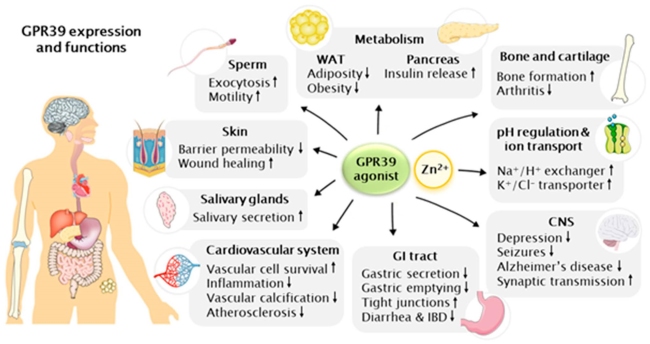 Fig. 1 A schematic illustrating GPR39 expression and functions in different tissues.1
GPR39, encoded by the GPR39 gene, functions as a zinc-sensing GPCR that regulates metabolic, gastrointestinal, and neurovascular homeostasis:
Creative Biolabs offers high-quality GPR39 membrane protein products produced using optimized expression systems. These include full-length multi-pass transmembrane protein that retains the native seven-transmembrane architecture and zinc-binding site, as well as isolated receptor domain variants. The seven-transmembrane architecture and intracellular loops mediate Zn²⁺ binding and Gq/G12/13 protein coupling, making these proteins suitable for studies of zinc-sensing receptor pharmacology, G protein coupling mechanisms, and downstream signaling characterization. All GPR39 proteins undergo strict quality control to support consistent performance across applicable research platforms.
Not finding the protein product you need? Contact us to start your one-stop custom service!
Creative Biolabs provides custom-engineered GPR39 stable cell lines, including overexpression and knockdown models. These cell lines are optimized for studies of zinc sensing, Gq/G12/13-mediated signaling, ERK/MAPK pathway activation, and GPR39-associated metabolic and gastrointestinal functions. Each cell line undergoes stringent validation to ensure stable expression profiles and consistent functional performance in diverse experimental contexts.
Not finding the stable cell line product you need? Contact us to start your one-stop custom service!
High-specificity recombinant antibodies targeting GPR39 are developed using antibody engineering technologies for research applications involving GPR39 expression and localization. These antibodies can be used in studies of GPR39 distribution in pancreatic, gastrointestinal, and neuronal tissues and may also support characterization of GPR39-containing heteroreceptor complexes in combination with appropriate detection reagents.
Not finding the recombinant antibody product you need? Contact us to start your one-stop custom service!
Beyond catalog products, Creative Biolabs offers specialized custom services for GPR39 research:
GPR39 is a zinc-sensing GPCR that responds to extracellular Zn²⁺ and signals through Gq and G12/13 proteins to regulate metabolic homeostasis, gastrointestinal function, and epithelial repair.
GPR39 is a zinc-sensing receptor with constitutive activity that regulates glucose homeostasis, intestinal ion transport, and cell survival, making it important for studies of zinc biology, metabolic regulation, and gastrointestinal physiology.
No, all GPR39 products and services are strictly for research use only, not intended for clinical diagnosis or treatment.
Offerings include full-length GPR39 membrane proteins, receptor domain variants, specific detection antibodies, and custom stable cell lines for zinc sensing and GPCR signaling research.
GPR39 proteins may support studies of zinc binding and G protein coupling, depending on protein format and experimental context.









