Creative Biolabs is offering the most comprehensive services for antibody development projects. With strict regulation and effective execution, we are dedicated to providing the most valuable solutions to complete your projects.
HighlightsCreative Biolabs is offering the most comprehensive services for antibody development projects. With strict regulation and effective execution, we are dedicated to providing the most valuable solutions to complete your projects.
HighlightsCreative Biolabs has established a broad range of platforms for developing novel antibodies or equivalents. These cutting-edge technologies enable our scientists to meet your demands from different aspects and tailor the most appropriate solution that contributes to the success of your projects.
HighlightsWith deep understanding in antibody-related realms and extensive project experience, Creative Biolabs offers a variety of references to help you learn more about our capacities and achievements, including infographic, flyer, case study, peer-reviewed publications, and all kinds of knowledge that can assist your projects. You are also welcome to contact us directly for more specific solutions.
HighlightsGet a real taste of Creative Biolabs, one of the most professional custom service providers in the world. We are committed to providing highly customized comprehensive solutions with the best quality to advance your projects.
Highlights Loading...
All listed services and products are For Research Use Only. Do Not use in any diagnostic or therapeutic applications.
GPR52 is a G protein-coupled receptor (GPCR) encoded by the orthologous human gene on chromosome 9 and has very high sequence conservation, with an enrichment in brain expression. It has a high sequence similarity to both the histamine H2 receptor and serotonin 5-HT4 receptors, but there is no known endogenous orthosteric ligand for it so remains classified as an orphan receptor. Recent structural and pharmacological studies have shown that GPR52 possesses high levels of constitutive activity under normal physiological conditions, stemming from a distinct third extracellular loop (ECL2) which folds deep into the canonical ligand-binding pocket to stabilize active conformations in the absence of exogenous agonists. With respect to Huntington's disease (HD), GPR52 has been reported as a striatal-enriched regulator of mutant huntingtin (mHTT) protein levels. In HD knock-in mice, GPR52 genetic deletion mitigates soluble and aggregated mHTT expression in the striatum with concurrent amelioration of motor deficits including open-field locomotion, rearing behavior, gait abnormalities and rotarod performance. Mechanistic studies revealed that GPR52 signals through a cAMP-dependent but PKA-independent pathway, thereby preventing proteasomal degradation of mHTT via the improper regulation of small GTPase Rab39B. The use of the newly synthesized GPR52 antagonist E7 in pharmacologic studies captures these genetic observations, decreasing mHTT levels and improving HD relevant phenotypes across several model systems (cellular, Drosophila and mouse) without affecting wild-type animals. GPR52, with this disease-specific rescue profile is exceptionally well-suited as a target for small-molecule HD therapeutics.
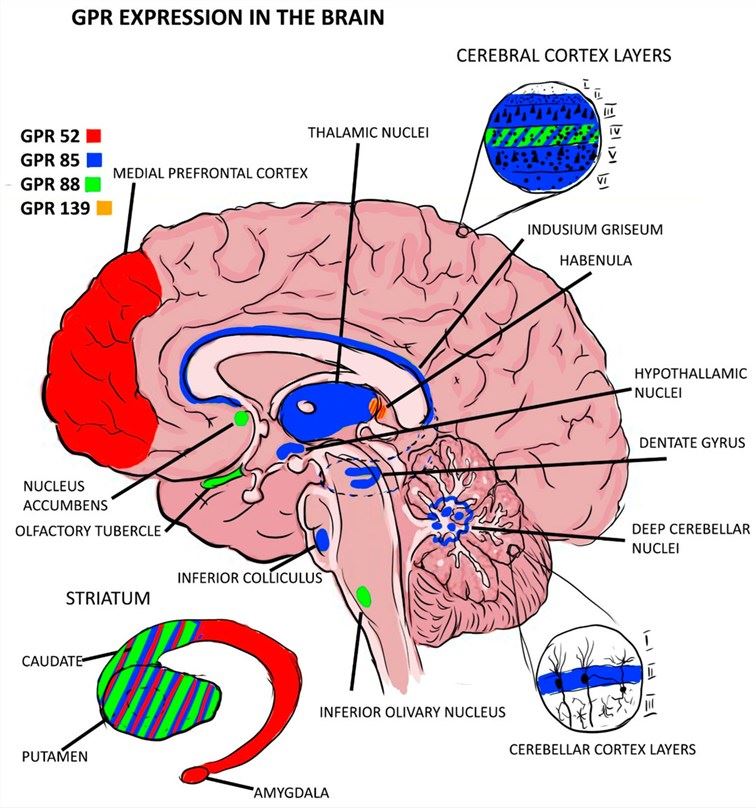 Fig.1 GPR expression in brain regions.1
The functional range of GPR52 crosses seemingly disparate therapeutic indications, an observation which mirrors its central role in striatal physiology:
The orphan status, high constitutive activity and conformation-dependent pharmacology of class A GPCRs complicates a structural and pharmacological characterization of GPR52. Designing dedicated custom GPR52 proteins for structural biology, ligand-binding studies, and therapeutic antibody development features Creative Biolabs'conformationally intact receptor preparations engineering platform. The engineering phase harnesses the knowledge generated from H2 receptor and 5-HT4 receptor templates through homology modelling, coupled with codon-optimized gene synthesis as well as proprietary detergent-screening protocols that identify constructs which support an EL2-mediated active conformation whilst maintaining a Gs-protein coupling interface at maximum yield. Each project begins with an extensive scientific consultation to ensure that the receptor architecture is aligned with your intended application, such as crystallography, cryo-EM or high-throughput compound screening.
Not finding the membrane protein product you need? Contact us to start your one-stop custom service!
Cell lines stably expressing GPR52 are valuable for agonist/antagonist screening, antibody research, and mechanism-of-action studies. Creative Biolabs provides customized GPR52 stable expression or reporting cell models designed to support consistent receptor-related studies. These models can be used for research on GPR52 signaling, including Gs-coupled cAMP responses, compound screening, and pathway modulation. The specific cell engineering strategy, expression format, and appropriate functional readouts can be determined according to the requirements of each project.
Not finding the stable cell line product you need? Contact us to start your one-stop custom service!
We also present novel high-affinity, sequence-defined antibodies against GPR52 extracellular epitopes that enable the receptor to be detected in native striatal tissue and allow for its surface localization on medium spiny neurons as well as modulation of ongoing constitutive activity. Creative Biolabs provides end-to-end recombinant antibody discovery programs against conformational and linear GPR52 epitopes, with a focus on the unique EL2 domain that fills up the ligand-binding pocket. Our antibody development pipeline encompasses immunogen design, multi-platform selection and downstream engineering to generate binders with the specificity, affinity and developability characteristics needed for research, diagnostics or therapeutic applications. With recombinant expression and clonal sequencing, we remove the batch-to-batch variability common with traditional polyclonal sera to deliver a renewable, fully characterized reagent.
Not finding the recombinant antibody product you need? Contact us to start your one-stop custom service!
By partnering with Creative Biolabs for GPR52 protein engineering, you get the benefit of a fully integrated platform that combines deep GPCR expertise with manufacturing excellence:
We can discuss customized antibody development or reporter cell models for studying GPR52 conformation and signaling according to specific research requirements. Antibody recognition properties and appropriate functional readouts, such as Gs-coupled cAMP signaling, can be evaluated based on the intended experimental design and supporting project-specific data.
Yes, we developed dual-stable lines with constitutive expression of full-length GPR52 and an independently expressed genetically encoded calcium biosensor. The agonist-evoked fluorescence responses and the inverse-agonist suppression are documented for each batch enabling a standardized cellular platform with continual compound screening in an uninterrupted manner without repeat transient transfection.
Yes, protein concentration is in a defined buffer (which has been limited for endotoxin) at physiological pH without carrier proteins and denaturing agents. The formulation enables immediate dilution into proximity-based biosensor reactions or direct immobilization on a biosensor tip without dialysis or inter-burst buffer exchange.
Yes, the immunogen is a region that has high homology between different mammalian species and consequently, detection in human brain preparations and lysates of neuronal cells from mouse or rat requires no additional reagents for samples across these 3 species.