
Creative Biolabs is offering the most comprehensive services for antibody development projects. With strict regulation and effective execution, we are dedicated to providing the most valuable solutions to complete your projects.
HighlightsCreative Biolabs is offering the most comprehensive services for antibody development projects. With strict regulation and effective execution, we are dedicated to providing the most valuable solutions to complete your projects.
HighlightsCreative Biolabs has established a broad range of platforms for developing novel antibodies or equivalents. These cutting-edge technologies enable our scientists to meet your demands from different aspects and tailor the most appropriate solution that contributes to the success of your projects.
HighlightsWith deep understanding in antibody-related realms and extensive project experience, Creative Biolabs offers a variety of references to help you learn more about our capacities and achievements, including infographic, flyer, case study, peer-reviewed publications, and all kinds of knowledge that can assist your projects. You are also welcome to contact us directly for more specific solutions.
HighlightsGet a real taste of Creative Biolabs, one of the most professional custom service providers in the world. We are committed to providing highly customized comprehensive solutions with the best quality to advance your projects.
Highlights Loading...
All listed services and products are For Research Use Only. Do Not use in any diagnostic or therapeutic applications.
G-protein coupled receptor 55 (GPR55) is, by far, one of the more interesting orphans to arise from the genome era; arguably a seven-transmembrane protein whose physiological and cellular ascribed identity has been hotly debated over almost two decades of research efforts. Located at the edge of endocannabinoid signaling, GPR55 is activated by lipid-derived signals rather than classical neurotransmitters; optimal activity may be evoked with a prominent lysophospholipid metabolite. Much of the allure surrounding this receptor rests in its dual assignment: while it has been a genomic curiosity, here is also mechanistic lightning rod; if there was a GPCR that decoded membrane lipid chemistry and transduced intracellular programs to effect coupling with multiple G protein families, their promiscuity yet another anathema which challenges pharmacologists who find the puzzle captivating. GPR55 has a strangely wide biological territory, to claim. Preclinical evidence correlates the receptor with many clinically relevant properties including bone remodeling, wherein its activity shifts the balance of bone-forming versus -resorbing cell functions; gastrointestinal physiology that hews to gut motility and inflammatory tone; metabolic regulation where lipid-sensing aligns with energy homeostasis; as well as proliferative disease investigation which map expression patterns and signaling outputs across diverse tissue contexts. The role of GPR55 itself in processing plant-based cannabinoid molecules is an ongoing, and often footnoted, area of research as the data can be completely different depending on the ligands emphasis placed by assay conditions either yielding very selective binding or activity over nothing at all — possibly making it a Rorschach test for GPCR pharmacology. GPR55's orphan-receptor past coupled with its lipid-ligand biology makes GPR55 especially punishing as a reagent target. Membrane-faithful preparations are required for reliable pharmacology; activity-state-dependent assays require antibodies that respect conformational nuance; and the rich history of contested findings in this field means reagent quality directly determines whether results will challenge or endure scrutiny. Our protein, cell line, and antibody platforms are uniquely designed to provide researchers studying GPR55 the material confidence this frontier target warrants.
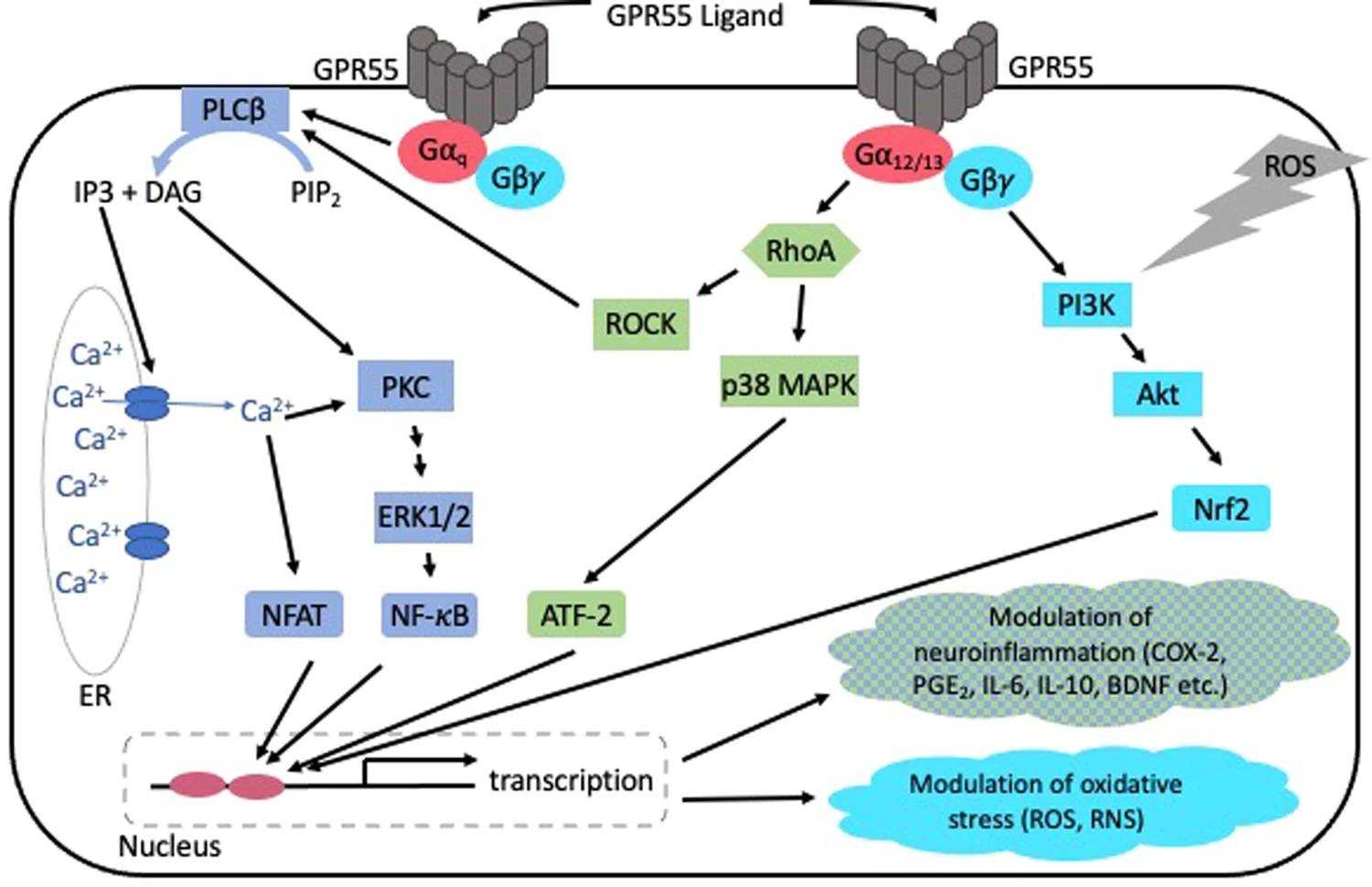 Fig.1 Simplified overview of GPR55 dependent signaling pathways and resulting effects.1
Research on GPR55 continues to evolve along multiple converging trajectories:
We have developed a complete product line of GPR55 membrane proteins, with one unshakable core standard: for these lipid-sensing GPCRs, that is, G protein-coupled receptors, only if their native cell membrane environment and activation state are retained throughout the entire preparation and handling process, without damaging their integrity, can the experimental data generated from them be sufficiently reliable, and be safely used to advance research. To meet these critical requirements, all full-length GPR55 constructs we produce, that is, protein products that are not truncated and retain all complete sequences, are prepared in an optimized eukaryotic expression system. This system has been specially designed and modified, which can not only preserve the authentic post-translational modification characteristics of this protein in vivo, without losing any of its original natural modifications, but also ensure that the protein folds into the correct shape, avoiding misfolding that would lead to loss of function. Every batch of the produced protein undergoes strict multi-dimensional quality verification: purity is confirmed via SDS-PAGE, to ensure minimal contaminating proteins and a pure target protein; monodispersity is verified by analytical size-exclusion chromatography, to ensure that the batch of protein does not aggregate, and can be uniformly dispersed in a single-molecule state, meeting experimental requirements.
Not finding the membrane protein product you need? Contact us to start your one-stop custom service!
Cell model systems used for GPR55 research must simultaneously meet several mandatory requirements, and any deficiency will render them unusable. First, the receptor expression level on the cells can be flexibly regulated, and the desired amount can be precisely controlled; second, the native topology of the cell membrane can be fully retained, exactly matching its state in native cells; third, the protein's functional response to lipid signals can be maintained normally, producing the proper reaction as soon as a signal is received. Why are these requirements so strictly enforced? After all, GPR55 is an orphan receptor, that is, a receptor for which all explicit ligands have not yet been identified. The core practical value of this type of receptor lies in its ability to transduce ligand signals, that is, to successfully transmit received signals, rather than merely being able to express large amounts of the protein itself in cells. A mere high expression level without function cannot support any meaningful research. We can provide customized clonally derived GPR55 stable cell lines, which are prepared using sequence-optimized stable integration technology. This ensures that under a standardized uniform cell background, the protein expression level on the cell surface remains stable and consistent long-term, with no significant variation between batches, and no decline in expression levels after several passages. Our cell line library mainly contains two categories, which can cover the needs of the vast majority of research projects: one category consists of cell lines expressing wild-type GPR55, that is, cells expressing native, unmodified GPR55. The surface receptor density of these cells is divided into preset different levels, with high-density, medium-density, and low-density options available for selection as needed; the other category consists of mutant cell lines carrying artificially modified replacement sites, with site substitutions pre-introduced into the GPR55 sequence, adapting to various research directions, and usable for both functional verification and mechanism exploration. Every clonal cell line is only delivered to customers after comprehensive phenotypic verification confirms that all characteristics meet the requirements, and we never casually distribute cells that have not undergone complete testing.
Not finding the stable cell line product you need? Contact us to start your one-stop custom service!
You can also use our recombinant anti-GPR55 antibody panel to support GPR55 research. The panel includes monoclonal and recombinant clones developed against defined GPR55 epitopes for target-selective detection. Each clone undergoes sequence verification and is expressed using a defined recombinant construct to support lot-to-lot consistency. Available validation information can be reviewed against the intended application before use.
Not finding the recombinant antibody product you need? Contact us to start your one-stop custom service!
Extending well beyond our standard catalog, we deliver fully customizable discovery and manufacturing solutions meticulously tailored to the sophisticated demands of GPR55-targeted research and precompound development:
If your application matches routine detection or binding workflows, catalog items are usually the fastest route. Projects involving unusual constructs, specific quality attributes, or integrated multi-component needs are generally better served by a custom arrangement. A short consultation will clarify the best path.
A concise description of your application, the format you envision, and any acceptance criteria you already hold is plenty to begin. Our team will help refine the technical details from there.
Yes, and doing so is often advantageous: coordinated specifications and unified quality frameworks reduce integration friction and keep timelines predictable.
All GPR55 products and services are provided strictly for preclinical research. They are not designed, validated, or authorized for any use involving human subjects.









