Creative Biolabs is offering the most comprehensive services for antibody development projects. With strict regulation and effective execution, we are dedicated to providing the most valuable solutions to complete your projects.
HighlightsCreative Biolabs is offering the most comprehensive services for antibody development projects. With strict regulation and effective execution, we are dedicated to providing the most valuable solutions to complete your projects.
HighlightsCreative Biolabs has established a broad range of platforms for developing novel antibodies or equivalents. These cutting-edge technologies enable our scientists to meet your demands from different aspects and tailor the most appropriate solution that contributes to the success of your projects.
HighlightsWith deep understanding in antibody-related realms and extensive project experience, Creative Biolabs offers a variety of references to help you learn more about our capacities and achievements, including infographic, flyer, case study, peer-reviewed publications, and all kinds of knowledge that can assist your projects. You are also welcome to contact us directly for more specific solutions.
HighlightsGet a real taste of Creative Biolabs, one of the most professional custom service providers in the world. We are committed to providing highly customized comprehensive solutions with the best quality to advance your projects.
Highlights Loading...
All listed services and products are For Research Use Only. Do Not use in any diagnostic or therapeutic applications.
Glycophorin B(GYPB) is a single transmembrane glycoprotein encoded by human GYP tandem repeat gene cluster. It is highly glycosylated and located in the plasma membrane of mature red blood cells, and is enriched in the glycocalyx structure on the surface of red blood cells in cooperation with glycophorin A. It is an important functional component on the surface of red blood cells. Different from GPA, which is responsible for the expression of M/N antigen, GYPB specifically mediates the expression of minor S/s polymorphic antigen in MNS blood group system, and its extracellular glycosylation structure carries differential peptide sequence, which directly determines the serological differences of blood groups among individuals. In the normal differentiation and maturation stage of red blood cells, membrane-located GYPB can participate in the construction of cell membrane skeleton, stabilize the surface sugar coating structure, shield the functional proteins in the membrane, effectively avoid the non-specific recognition and binding of autoantibodies, and maintain the physiological stability of red blood cells. In clinical allogeneic blood transfusion, maternal and infant blood group incompatibility and other scenarios, the mismatch of S/s antigens between the donor and the recipient will stimulate the body to produce specific alloantibodies, which will lead to mild and moderate hemolytic blood transfusion reaction or induce neonatal alloimmune hemolytic anemia. GPA, GPC and other erythrocyte glycoproteins do not have the specific antigen presenting ability to replace GYPB. The deletion of GYPB gene will directly lead to the complete loss of S/s antigen on the surface of erythrocyte, and at the same time destroy the structural integrity of cell membrane and reduce the stability of membrane. The allelic variation of this gene is also the core molecular marker of clinical accurate blood group matching and transfusion immune diagnosis, and it is an indispensable key target for red blood cell serological research and transfusion immune reagent development.
GYPB is firmly anchored in the lipid bilayer of red blood cells, and at the same time plays the dual functions of blood group antigen display and cell membrane scaffold, and relies on a large number of extracellular O- glycosylated sugar chains to expose S/s polymorphic peptide epitopes to mediate the specific recognition of circulating immune receptors. Its unique antigenic peptide sequence and glycosylation modification mode form a clear antigenic differentiation with GPA carrying M/N epitope, which constitutes an independent serological classification branch of MNS blood group system. GYPB-mediated cell membrane glycocalyx assembly process closely relates the mechanical stability of red blood cells to the risk of allogeneic immune recognition, and dynamically balances the survival cycle of red blood cells and blood transfusion compatibility according to antigen matching status. This protein is mainly involved in the process of erythrocyte membrane skeleton anchoring maintenance and clinical routine blood typing detection. The deficiency of GYPB expression will completely lose the S/s antigenicity of red blood cells and significantly improve the fragility of red blood cells under antibody attack. To sum up, GYPB is an important core target for the study of erythrocyte glycoprotein mechanism and the screening of transfusion immunotherapy.
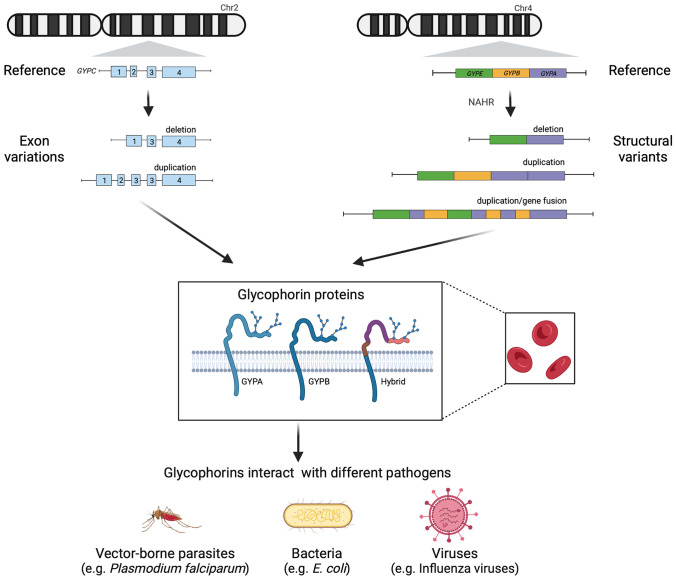 Fig. 1 Graphical Abstract Schematic: Chromosomal structural and exon variation of glycophorin gene clusters generates diverse GYPA/GYPB/GYPC hybrid erythrocyte surface proteins mediating multi-pathogen binding.1
The biological functions of GYPB are focused on S/s epitope presentation and erythrocyte membrane stabilization:
Creative Biolabs offers high-quality GYPB proteins through optimized mammalian expression systems, including full-length glycosylated red cell protein and isolated antigenic extracellular domain variants. These products retain native S/s epitope antigenicity, suitable for blood group serology and antibody screening assays. All GYPB proteins undergo strict quality control to ensure consistent performance and reliable application across hematology research platforms.
Not finding the membrane protein product you need? Contact us to start your one-stop custom service!
Creative Biolabs provides custom-engineered GYPB stable cell lines, including S/s polymorphic overexpression and blank control models. These cell lines are optimized for erythroid glycoprotein profiling and blood antigen binding functional analysis. Each cell line undergoes stringent validation to ensure stable expression profiles and consistent functional performance in diverse experimental contexts.
Not finding the stable cell line product you need? Contact us to start your one-stop custom service!
High-specificity recombinant antibodies targeting GYPB are developed via advanced antibody engineering technologies, with no cross-reactivity with GPA/GPEC glycophorins. These antibodies are validated for erythrocyte membrane immunostaining and blood group typing assay use, and can be combined with GPA detection reagents to analyze MNS antigen co-expression on red cell models.
Not finding the recombinant antibody product you need? Contact us to start your one-stop custom service!
Beyond catalog products, Creative Biolabs offers specialized custom services for GYPB research:
GYPB is an erythrocyte glycoprotein that carries polymorphic S/s antigens forming the MNS blood group system.
GYPB polymorphism underlies clinical transfusion incompatibility and neonatal hemolytic disease diagnostic markers.
No, all GYPB products and services are strictly for research use only, not intended for clinical blood typing or patient treatment.
Offerings include full-length glycosylated GYPB proteins, epitope-specific antibodies and custom stable cell lines for blood group research.
GYPB proteins are validated via S/s alloantibody binding serological functional testing.