
Creative Biolabs is offering the most comprehensive services for antibody development projects. With strict regulation and effective execution, we are dedicated to providing the most valuable solutions to complete your projects.
HighlightsCreative Biolabs is offering the most comprehensive services for antibody development projects. With strict regulation and effective execution, we are dedicated to providing the most valuable solutions to complete your projects.
HighlightsCreative Biolabs has established a broad range of platforms for developing novel antibodies or equivalents. These cutting-edge technologies enable our scientists to meet your demands from different aspects and tailor the most appropriate solution that contributes to the success of your projects.
HighlightsWith deep understanding in antibody-related realms and extensive project experience, Creative Biolabs offers a variety of references to help you learn more about our capacities and achievements, including infographic, flyer, case study, peer-reviewed publications, and all kinds of knowledge that can assist your projects. You are also welcome to contact us directly for more specific solutions.
HighlightsGet a real taste of Creative Biolabs, one of the most professional custom service providers in the world. We are committed to providing highly customized comprehensive solutions with the best quality to advance your projects.
Highlights Loading...
All listed services and products are For Research Use Only. Do Not use in any diagnostic or therapeutic applications.
HCN1, or hyperpolarization-activated cyclic nucleotide-gated potassium channel 1, is a member of a small family of ion channels whose gating logic operates completely inversely to that of the vast majority of ion channels. Nearly all other voltage-controlled channels, the commonly referred to voltage-gated channels, open when the cell membrane undergoes depolarization—put simply, they open when the membrane potential shifts in a positive direction. Only HCN1 works the opposite way: it activates only when the cell membrane hyperpolarizes, that is, when the intracellular potential becomes more negative rather than approaching a positive value. This reverse switching logic inherently shapes it into a natural metronome by design. When excitable cells that generate electrical signals, such as neurons and cardiac cells, are at their resting potential, their normal resting state, HCN1 gradually opens to allow a mixed current carrying both sodium and potassium to flow into the cell. This incoming current slowly raises the membrane potential, pushing it gradually toward a positive direction, a process known as depolarization. Once the potential reaches the triggering threshold, it initiates the cell's next electrical impulse, the action potential. The molecular structure of HCN1 combines the basic backbone common to conventional ion channels with a set of unconventional functional regulatory mechanisms. It has 6 transmembrane helices that span the cell membrane, which carry standard voltage-sensing elements, yet the regulatory direction of these sensing elements is reversed: instead of opening during membrane depolarization, they preferentially activate under hyperpolarized conditions. On the protein tail that extends into the cytoplasm, there is also a cyclic nucleotide-binding domain, which can adjust the channel's open/closed state at any time in response to changes in intracellular signals. In many tissues of the human body, naturally occurring HCN channels often exist as homo- or heterotetramers, with subunit composition varying by tissue and cellular context. This additional layer of compositional complexity is an issue that researchers must account for in advance to accurately resolve the unique behaviors of individual subtypes.
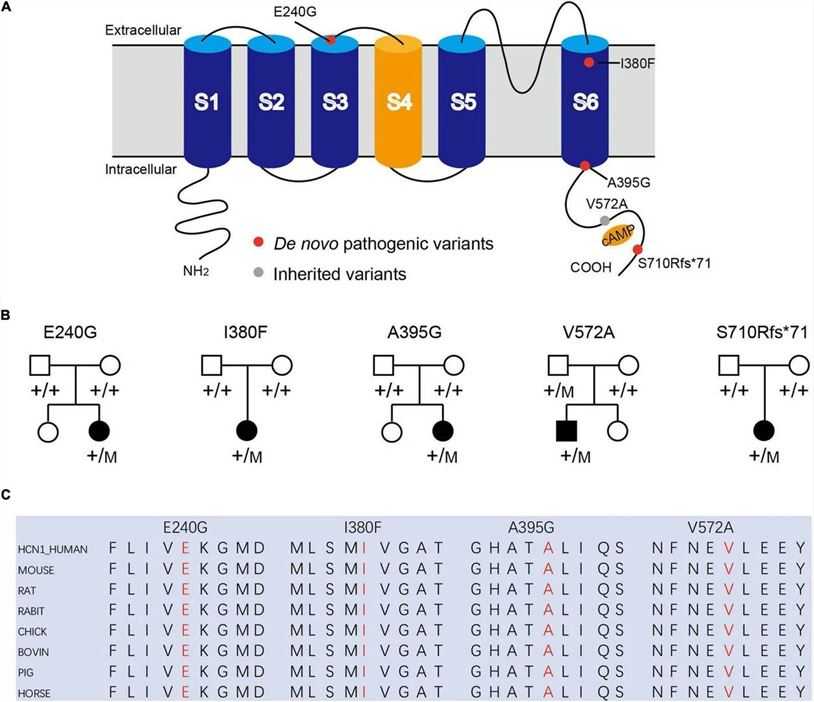 Fig.1 Mutations in HCN1 channels.1
Several research currents keep converging on this channel:
Our full-length HCN1 is isolated from an optimized eukaryotic expression system, which is equipped with supporting molecular chaperones that assist proteins in folding correctly. This system enables HCN1 to properly fold into a structure with 6 transmembrane helices, and also stabilizes its functionally regulated intracellular tail, preventing the occurrence of structural disconnection. If your research requires a specific nucleotide environment, needs the channel to stay in a particular open/closed state, or requires the preparation format to be compatible with the electrophysiology experimental equipment you are using, we can adjust the preparation to match the unique protocol of your research. Our channel preparations are inherently built to adapt to your experimental design and can be modified to align with your research needs.
Not finding the membrane protein product you need? Contact us to start your one-stop custom service!
Cellular models for HCN1 work turn on expression density and gating competence working together—a channel that reaches the surface without functional voltage machinery cannot pace anything. Wild-type overexpression lines and variants let researchers study the mechanism. Each clone is characterized before release: surface expression quantified against calibrated standards, so the line's behavior is established before experiments begin. Should your program call for a particular variant background, a specific density tier tuned to your recording configuration, or an expression schedule built around your step protocol, the platform can be tailored to fit; the cell line is constructed to serve the experiment it will run in.
Not finding the stable cell line product you need? Contact us to start your one-stop custom service!
Antibody work on HCN1 faces the isoform problem: the four HCN channels share the six-helix scaffold and substantial sequence across both membrane and regulatory regions, and generic clones drift into cross-reactivity that corrupts quantitation in samples where multiple isoforms coexist. Our recombinant panel here is screened for genuine HCN1 discrimination. Sequence-defined production keeps lot-to-lot performance steady, and where a project needs a different conjugate, validation against a specific sample type, or an adjustment in clone format to fit a particular workflow, that can be arranged on request—the panel flexes to meet the experimental design it serves.
Not finding the recombinant antibody product you need? Contact us to start your one-stop custom service!
Extending well beyond our standard catalog, we deliver fully customizable discovery and manufacturing solutions meticulously tailored to the sophisticated demands of HCN1-targeted research and precompound development:
The voltage-sensing machinery is tuned in reverse relative to canonical channels, an arrangement whose molecular implementation remains an active research question. Functional reagents are verified with this inverted gating behavior as the defining attribute.
Native channels often assemble as isoform heteromers with tissue-specific partners, a compositional layer that expression systems simplify. Both formats are informative when their respective compositions are kept explicit.
Clones are screened against all four isoforms during selection, and off-target panel results accompany product documentation so specificity claims remain transparent.
All HCN1 products and services are provided strictly for preclinical research. They are not designed, validated, or authorized for any use involving human subjects.









