Creative Biolabs is offering the most comprehensive services for antibody development projects. With strict regulation and effective execution, we are dedicated to providing the most valuable solutions to complete your projects.
HighlightsCreative Biolabs is offering the most comprehensive services for antibody development projects. With strict regulation and effective execution, we are dedicated to providing the most valuable solutions to complete your projects.
HighlightsCreative Biolabs has established a broad range of platforms for developing novel antibodies or equivalents. These cutting-edge technologies enable our scientists to meet your demands from different aspects and tailor the most appropriate solution that contributes to the success of your projects.
HighlightsWith deep understanding in antibody-related realms and extensive project experience, Creative Biolabs offers a variety of references to help you learn more about our capacities and achievements, including infographic, flyer, case study, peer-reviewed publications, and all kinds of knowledge that can assist your projects. You are also welcome to contact us directly for more specific solutions.
HighlightsGet a real taste of Creative Biolabs, one of the most professional custom service providers in the world. We are committed to providing highly customized comprehensive solutions with the best quality to advance your projects.
Highlights Loading...
All listed services and products are For Research Use Only. Do Not use in any diagnostic or therapeutic applications.
Hephaestin (HEPH), encoded by the HEPH gene located on chromosome Xq12, is a member of the mammalian multicopper ferroxidase (MCF) family that includes ceruloplasmin (CP) and zyklopen (ZP). The HEPH gene spans approximately 96 kb and encodes a protein of 1,135 amino acids. HEPH shares approximately 50% sequence identity with serum ceruloplasmin and contains six cupredoxin domains with six copper centers—three mononuclear sites in domains 2, 4, and 6, and three in the form of trinuclear clusters at the interface of domains 1 and 6. Unlike CP, which occurs in both secreted and GPI-linked forms, HEPH is a single-pass type I transmembrane protein containing a C-terminal transmembrane domain and a short cytoplasmic tail. The large extracellular/ectodomain, comprising approximately 120 kDa, contains the copper-binding domains and the ferroxidase active site. HEPH is expressed predominantly in the small intestine, with lower levels reported in the central nervous system, lungs, heart, and exocrine pancreas; unlike CP, no HEPH expression has been detected in the liver or serum. Within intestinal enterocytes, HEPH is localized to the basolateral membrane, where it functions as a key component of the iron export machinery.
HEPH functions as a plasma membrane ferroxidase that mediates the extracellular conversion of ferrous iron (Fe²⁺) into its ferric form (Fe³⁺). This enzymatic reaction—catalyzing 4 Fe²⁺ + 4 H⁺ + O₂ = 4 Fe³⁺ + 2 H₂O—is coupled to the iron export activity of ferroportin (FPN1/SLC40A1), the only known intestinal iron exporter. Ferroportin specifically exports ferrous iron from enterocytes across the basolateral membrane; HEPH then oxidizes Fe²⁺ to Fe³⁺, enabling the iron to bind to its carrier protein transferrin, which under physiological conditions only binds ferric iron. HEPH thus forms a functional complex with ferroportin and transferrin to transfer iron from cells to the circulation. The importance of HEPH in dietary iron absorption has been demonstrated through the sex-linked anemia (sla) mouse model, in which a mutation in the Heph gene results in iron deficiency and microcytic anemia. HEPH is the major multicopper ferroxidase in the small intestine and is critical for dietary iron absorption; however, knockout studies have shown that HEPH is not absolutely essential, as other mechanisms can partially compensate for its deficiency. These properties make HEPH an important research target for studies of iron metabolism, multicopper oxidase biology, basolateral iron transport, and the molecular mechanisms underlying systemic iron homeostasis.
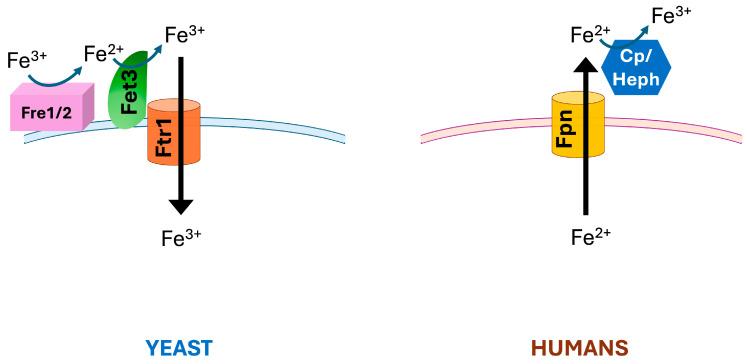 Fig. 1 The yeast and human ferroxidase–permease system.1
HEPH, encoded by the HEPH gene, functions as a membrane-bound multicopper ferroxidase that facilitates cellular iron export through oxidation-coupled transferrin loading:
Creative Biolabs offers high-quality HEPH proteins produced using optimized expression systems, including full-length type I transmembrane protein and isolated extracellular domain variants containing the cupredoxin domains and copper-binding sites. The extracellular domain mediates ferroxidase activity and ferroportin coupling, making these proteins suitable for studies of iron oxidation kinetics, multicopper oxidase mechanism, and basolateral iron transport characterization. All HEPH proteins undergo strict quality control to support consistent performance across applicable research platforms.
Not finding the protein product you need? Contact us to start your one-stop custom service!
Creative Biolabs provides custom-engineered HEPH stable cell lines, including overexpression and knockdown models. These cell lines are optimized for studies of ferroxidase activity, basolateral iron export, ferroportin-HEPH coupling, and systemic iron homeostasis. Each cell line undergoes stringent validation to ensure stable expression profiles and consistent functional performance in diverse experimental contexts.
Not finding the stable cell line product you need? Contact us to start your one-stop custom service!
High-specificity recombinant antibodies targeting HEPH are developed using antibody engineering technologies for research applications involving HEPH expression and localization. These antibodies can be used in studies of HEPH distribution in intestinal enterocytes and other tissues, and may also support characterization of HEPH-ferroportin complexes and basolateral membrane localization in combination with appropriate detection reagents.
Not finding the recombinant antibody product you need? Contact us to start your one-stop custom service!
Beyond catalog products, Creative Biolabs offers specialized custom services for HEPH research: