Creative Biolabs is offering the most comprehensive services for antibody development projects. With strict regulation and effective execution, we are dedicated to providing the most valuable solutions to complete your projects.
HighlightsCreative Biolabs is offering the most comprehensive services for antibody development projects. With strict regulation and effective execution, we are dedicated to providing the most valuable solutions to complete your projects.
HighlightsCreative Biolabs has established a broad range of platforms for developing novel antibodies or equivalents. These cutting-edge technologies enable our scientists to meet your demands from different aspects and tailor the most appropriate solution that contributes to the success of your projects.
HighlightsWith deep understanding in antibody-related realms and extensive project experience, Creative Biolabs offers a variety of references to help you learn more about our capacities and achievements, including infographic, flyer, case study, peer-reviewed publications, and all kinds of knowledge that can assist your projects. You are also welcome to contact us directly for more specific solutions.
HighlightsGet a real taste of Creative Biolabs, one of the most professional custom service providers in the world. We are committed to providing highly customized comprehensive solutions with the best quality to advance your projects.
Highlights Loading...
All listed services and products are For Research Use Only. Do Not use in any diagnostic or therapeutic applications.
Hedgehog acyltransferase HHAT is an enzyme embedded in biological membranes, belonging to the membrane-bound O-acyltransferase MBOAT superfamily. Its predicted molecular weight is approximately 60 kDa, a common unit used to describe the size of protein molecules; after undergoing N-linked glycosylation modification—the cellular process of adding specific sugar chains to the protein—its molecular weight will further increase. HHAT primarily localizes in the cell's endoplasmic reticulum, a core intracellular membrane structure responsible for protein synthesis and processing. Its core function is to add a palmitoyl group to the N-terminus of the Hedgehog (Hh) morphogen; this modification, which is equivalent to attaching a fatty acid chain to the protein, is an essential and critical step for the normal secretion of Hh ligands out of the cell, their transport within the extracellular space, and the subsequent activation of receptor-mediated signaling pathways. Structurally, HHAT crosses the lipid bilayer of the endoplasmic reticulum—the two layers of lipid molecules that form all biological membranes—via multiple predicted transmembrane segments. Its catalytic pocket faces the ER lumen, the internal space of the endoplasmic reticulum. This positioning allows it to simultaneously accommodate the Hh protein substrate to be processed and the palmitoyl-CoA donor that provides the palmitoyl group, enabling the completion of the palmitoylation reaction. Beyond this core enzymatic catalytic function, HHAT also acts as a quality control checkpoint in the cell's secretory pathway—the complete sequence of processes by which cells transport processed proteins out of the cell. Only Hh ligands that have successfully received the correct lipid modification can pass this checkpoint and be transported onward to the cell surface. Under normal physiological conditions, HHAT activity supports embryonic development, the maintenance of adult stem cell niches—the stable maintenance of the microenvironment housing stem cells in adult bodies—and tissue repair processes. Under pathological conditions, dysregulation of the Hh signaling pathway—dysregulation that can often be traced to abnormal HHAT expression or function—can cause developmental malformations, and also sustain the abnormal proliferation of transformed cells, meaning uncontrolled continuous division of cells that have become cancerous.
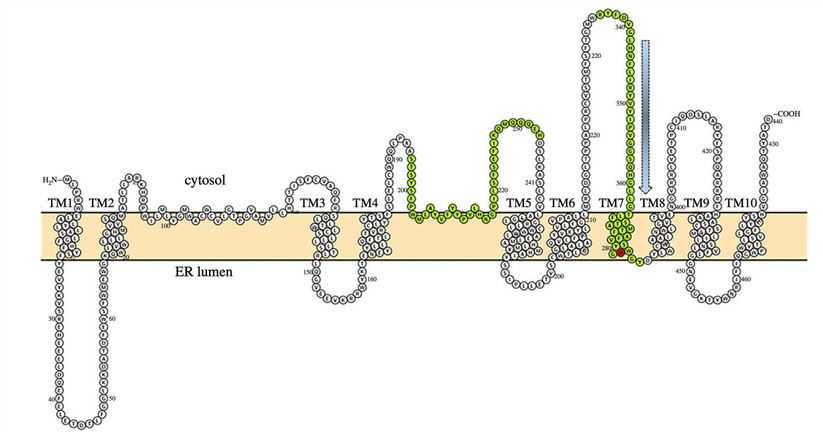 Fig.1 Predicted transmembrane topology map of Hhat.1
HHAT coordinates a wide range of cellular functions, with its role extending far beyond the basic classification of an "ordinary acyltransferase":
We have developed a complete set of full-length HHAT membrane proteins whose spatial structures are fully consistent with their native state, purpose-built to solve the core unavoidable challenges in the biochemical study of the MBOAT family. For HHAT's palmitoyltransferase activity to function properly, three conditions must all be met: the protein must be correctly embedded in the membrane structure where it naturally resides, it must retain the retention signal that keeps it in the ER, and the catalytic pocket that enables its catalytic function must remain structurally intact. To meet these strict requirements, we have intentionally integrated cutting-edge membrane protein expression technology into our production workflow, which maintains the protein's original spatial folding throughout the entire process and prevents any unintended structural deformation. Every batch of prepared protein undergoes multiple rounds of rigorous quality inspections before leaving the facility.
Not finding the membrane protein product you need? Contact us to start your one-stop custom service!
To successfully carry out signal transduction research or evaluate candidate drug compounds, researchers first need a reliable cell-based experimental platform—this platform must accurately reproduce the HHAT-mediated Hh processing process, exactly matching the real conditions in living organisms, which forms the foundation for all related research. Using advanced stable gene introduction technology, we have constructed stably performing HHAT stable cell lines. The HHAT expressed in these cells is correctly localized to the ER, its natural residence, carries glycosylation modifications fully consistent with its native state, and can produce normal functional responses when the cell's signaling pathway is stimulated, with no functional abnormalities. Our cell resources not only support sustained expression of native wild-type HHAT, but also include two additional cell lines to meet diverse research needs: one is a catalytically inactive HHAT variant, specifically designed as a mechanistic control to help researchers identify the exact effects produced by normally active HHAT through comparison. These scalable cell tools are essential core materials for researching the mechanisms of the Hh pathway, screening pathway modulators, and optimizing research reagents targeting the HHAT axis, and are applicable to all types of related research.
Not finding the stable cell line product you need? Contact us to start your one-stop custom service!
If you are advancing HHAT-related research, our monoclonal antibody panel can support target detection and characterization. The antibody sequences are defined, and clone selection is guided by HHAT-targeted recognition. Application-specific validation information can be matched to the intended workflow, including biochemical and imaging-based assays where documented. These reagents can support studies of HHAT expression, localization, and function in signal transduction and developmental biology.
Not finding the recombinant antibody product you need? Contact us to start your one-stop custom service!
Beyond our catalog offerings, we provide comprehensive, end-to-end protein design and engineering services tailored specifically for challenging membrane-associated enzymes like HHAT:
No, all of the HHAT products and services offered by Creative Biolabs are intended strictly for research use only, not for clinical diagnosis, prevention, treatment or cure of a disease.
Absolutely. We routinely produce catalytically inactive variants bearing mutations within the catalytic histidine residues, naturally occurring polymorphisms associated with modified turnover rates, and substrate-channel variants.
No. Every HHAT-related material—whether recombinant protein preparation, engineered expression system or affinity reagent—is restricted to preclinical investigation. None of these materials have been evaluated for administration to biological subjects with the intent of influencing disease progression or physiological homeostasis.
The standard offering spans three integrated categories: recombinant HHAT proteins in multiple biochemical presentations, stable expression cell lines with confirmed surface localization and activity, and epitope-mapped antibodies covering distinct structural regions of the polypeptide.