Creative Biolabs is offering the most comprehensive services for antibody development projects. With strict regulation and effective execution, we are dedicated to providing the most valuable solutions to complete your projects.
HighlightsCreative Biolabs is offering the most comprehensive services for antibody development projects. With strict regulation and effective execution, we are dedicated to providing the most valuable solutions to complete your projects.
HighlightsCreative Biolabs has established a broad range of platforms for developing novel antibodies or equivalents. These cutting-edge technologies enable our scientists to meet your demands from different aspects and tailor the most appropriate solution that contributes to the success of your projects.
HighlightsWith deep understanding in antibody-related realms and extensive project experience, Creative Biolabs offers a variety of references to help you learn more about our capacities and achievements, including infographic, flyer, case study, peer-reviewed publications, and all kinds of knowledge that can assist your projects. You are also welcome to contact us directly for more specific solutions.
HighlightsGet a real taste of Creative Biolabs, one of the most professional custom service providers in the world. We are committed to providing highly customized comprehensive solutions with the best quality to advance your projects.
Highlights Loading...
All listed services and products are For Research Use Only. Do Not use in any diagnostic or therapeutic applications.
Heat shock protein 90 alpha family class A member 1 (HSP90AA1) is an abundant cytosolic ATP dependent molecular chaperone encoded by the HSP90AA1 gene. It mainly resides in cytoplasmic compartments and forms transient multimeric assemblies with a wide range of newly synthesized or structurally unstable client polypeptides. Its protein sequence forms three major functional regions: an N terminal domain for ATP binding, a middle segment responsible for client protein recognition, and a C terminal domain that mediates homodimer formation. Homodimer represents its major biologically active assembly state. This chaperone lacks transmembrane hydrophobic segments and functions entirely within intracellular aqueous environments. Binding and hydrolysis of ATP drive large scale conformational rearrangement across the dimeric complex. Surface cavities remodel accordingly to accommodate partially folded client proteins and support progressive structural maturation. Disrupted chaperone cycle dynamics interfere with maturation pathways of multiple client groups. The intracellular pool of functional HSP90AA1 dimers provides biological buffering capacity against proteotoxic stress. Cells adjust steady state HSP90AA1 abundance when intracellular proteome status changes. Auxiliary co chaperone factors may attach to distinct surface sites of HSP90AA1 and fine tune the progression of chaperone cycles. Conserved residues within the N terminal pocket coordinate ATP occupancy and trigger domain rearrangement after nucleotide turnover.
Sequence changes located in the ATP binding pocket, client recognition surfaces or dimer contact interfaces may disturb nucleotide driven conformational cycling or reduce binding affinity toward client polypeptides. Such changes can impair intracellular polypeptide maturation workflows in biological model systems. Other cytosolic chaperone families support protein folding, yet they cannot fully reproduce the unique client maturation pattern supported by HSP90AA1 homodimer cycles. HSP90AA1 exists mainly as cytoplasmic homodimer and does not integrate into lipid bilayers under normal physiological conditions. Its dimeric structure supports two core biological roles: it undergoes ATP powered conformational changes, and it shelters metastable client polypeptides during intracellular maturation. Reduced abundance of functional HSP90AA1 dimers lowers cellular tolerance toward unstable polypeptide species. This property makes the cytosolic chaperone a valuable research target for investigations focused on intracellular protein homeostasis.
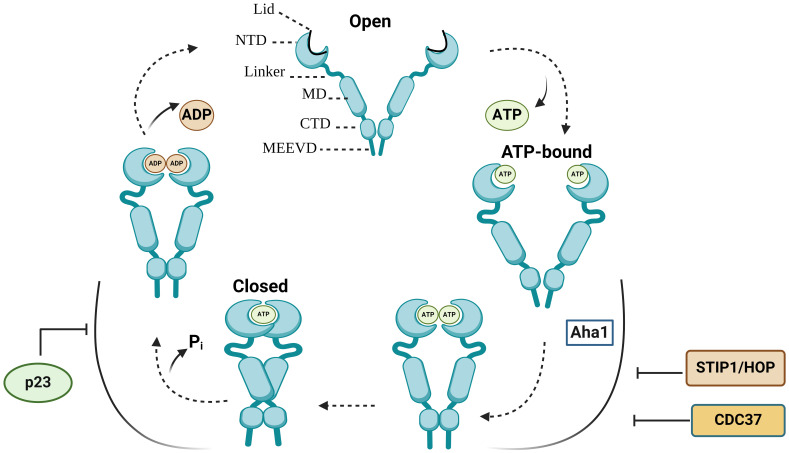 Fig. 1 Schematic representation of human HSP90AA1 homodimer chaperone conformational cycle, showing N‑terminal domain (NTD), linker, middle domain (MD), C‑terminal dimerization domain (CTD), and ATP‑driven open‑to‑closed structural transitions.1
The biological functions of cytosolic dimeric HSP90AA1 chaperone revolve around nucleotide‑controlled conformational rearrangement and transient sheltering of metastable client polypeptides:
Creative Biolabs offers purified HSP90AA1 protein samples produced under unified preparation workflows, including full length HSP90AA1 constructs and isolated single domain variants. Truncated polypeptide fragments cannot support complete nucleotide coupled dimeric cycling and full scope client polypeptide interaction activity, while full length forms suit cytosolic chaperone oriented research. All batches receive uniform quality screening. Functional assessments may only be performed under simulated cytosolic aqueous microenvironment setups. Conserved nucleotide binding pocket, client recognition and dimer interface structural features are preserved across batches to support comparative client interaction analysis between experimental groups. Full length HSP90AA1 samples retain intact dimeric assembly surfaces and nucleotide coordinating architecture post purification, supporting reliable detection of transient chaperone client assemblies in comparative functional analysis.
Not finding the Protein product you need? Contact us to start your one-stop custom service!
Creative Biolabs provides cell research models with adjustable HSP90AA1 expression levels, suitable for observation of abundant cytosolic ATP dependent chaperone and intracellular proteostasis related studies. Sample assessment covers intracellular chaperone dimer quantification and client protein co complex analysis, enabling side by side comparison of polypeptide maturation buffering capacity under varying HSP90AA1 abundances. These cell models can be paired with client protein status detection schemes to track proteostasis shifts linked to modified chaperone dosage.
Not finding the stable cell line product you need? Contact us to start your one-stop custom service!
Anti HSP90AA1 recombinant antibodies are generated via standardized workflows, compatible with cytosolic compartment localization mapping and chaperone client complex identification. The antibody series supports multi dimensional observation of HSP90AA1 distribution within intracellular cytoplasmic compartments.
Not finding the recombinant antibody product you need? Contact us to start your one-stop custom service!
Beyond catalog products, Creative Biolabs offers specialized custom services for HSP90AA1 research:
HSP90AA1 may function as an abundant cytosolic ATP‑dependent dimeric chaperone, undergoing nucleotide‑coupled conformational cycles to support transient sheltering and maturation of metastable intracellular client polypeptides.
Functional HSP90AA1 dimer abundance might shape intracellular polypeptide‑maturation buffering capacity, serving as a key mediator of cytosolic proteostasis biological processes.
No, all HSP90AA1 related products and services are strictly for research use only, and cannot be applied in clinical workflows. All material design and functional screening are optimized exclusively for basic laboratory research, without meeting clinical application criteria.
Offerings include full‑length HSP90AA1 protein, target‑specific recombinant antibodies and tunable‑expression cell research models, supporting research on cytosolic ATP‑dependent chaperone‑mediated proteostasis.
Laboratory analysis schemes may include client‑polypeptide co‑incubation assays to evaluate nucleotide‑dependent chaperone‑client complex‑formation capacity under simulated cytosolic environments.