
Creative Biolabs is offering the most comprehensive services for antibody development projects. With strict regulation and effective execution, we are dedicated to providing the most valuable solutions to complete your projects.
HighlightsCreative Biolabs is offering the most comprehensive services for antibody development projects. With strict regulation and effective execution, we are dedicated to providing the most valuable solutions to complete your projects.
HighlightsCreative Biolabs has established a broad range of platforms for developing novel antibodies or equivalents. These cutting-edge technologies enable our scientists to meet your demands from different aspects and tailor the most appropriate solution that contributes to the success of your projects.
HighlightsWith deep understanding in antibody-related realms and extensive project experience, Creative Biolabs offers a variety of references to help you learn more about our capacities and achievements, including infographic, flyer, case study, peer-reviewed publications, and all kinds of knowledge that can assist your projects. You are also welcome to contact us directly for more specific solutions.
HighlightsGet a real taste of Creative Biolabs, one of the most professional custom service providers in the world. We are committed to providing highly customized comprehensive solutions with the best quality to advance your projects.
Highlights Loading...
All listed services and products are For Research Use Only. Do Not use in any diagnostic or therapeutic applications.
Insulin-like growth factor binding protein 2 (IGFBP2) is a secreted, cysteine-rich glycoprotein with a molecular mass of approximately 36 kDa, belonging to the evolutionarily conserved IGFBP superfamily that comprises six high-affinity binding proteins. Structurally, IGFBP2 possesses a tripartite architecture: an evolutionarily conserved N-terminal domain that harbors the primary IGF-binding motif, a central flexible linker region of variable length, and a C-terminal domain containing a thyroglobulin type-1 repeat that mediates interactions with the extracellular matrix and cell-surface integrins. Synthesized predominantly in the liver, but also expressed in adipose tissue, the central nervous system, and various epithelial compartments, IGFBP2 circulates in plasma at nanomolar concentrations where it functions as the principal extracellular reservoir and modulator of insulin-like growth factor 1 (IGF-1) and IGF-2. By sequestering these potent mitogens, IGFBP2 regulates their bioavailability, tissue distribution, and receptor-mediated signaling intensity. However, IGFBP2 exerts substantial biological influence entirely independent of IGF engagement: it directly binds integrin receptors to activate focal adhesion kinase and downstream phosphoinositide 3-kinase (PI3K)/AKT survival pathways, interacts with vitronectin and fibronectin to remodel the pericellular matrix, and penetrates the nuclear compartment to modulate transcriptional programs governing cell proliferation. Clinically, elevated circulating IGFBP2 concentrations have been robustly associated with aggressive glioblastoma multiforme, metastatic prostate adenocarcinoma, pancreatic ductal carcinoma, and obesity-associated insulin resistance, establishing this secreted protein as a dual-purpose diagnostic biomarker and a druggable node in metabolic and oncological disease states.
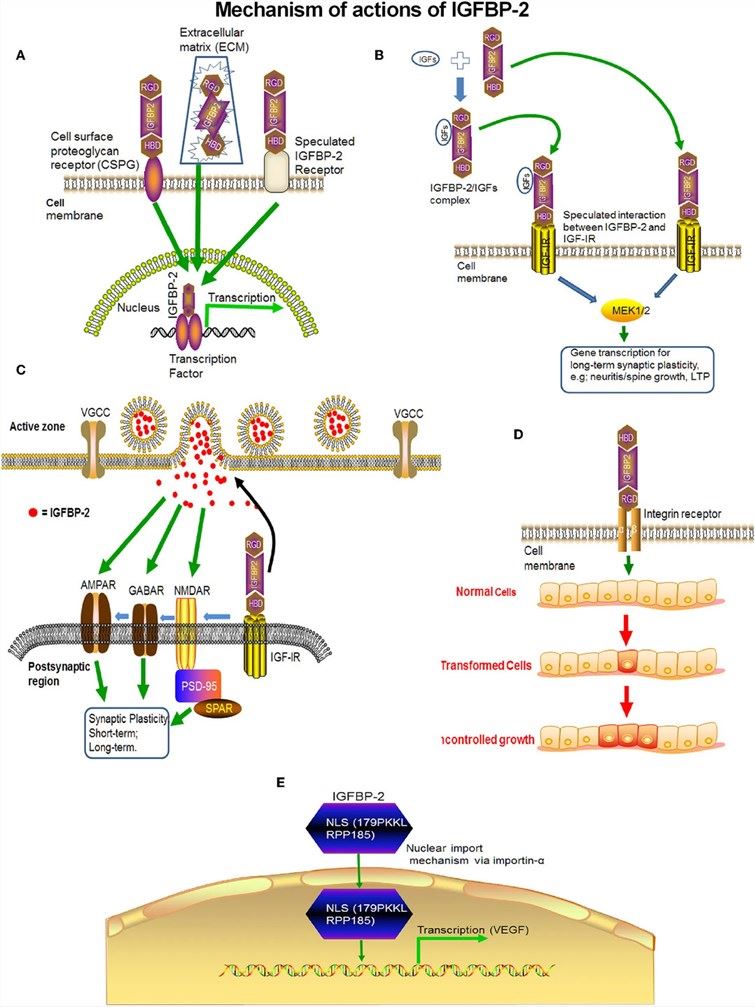 Fig.1 The probable mechanisms of action of IGFBP-2 in the CNS.1
IGFBP2 coordinates diverse physiological and pathological programs that transcend its classical role as a simple growth-factor reservoir:
We have curated a portfolio of full-length, properly folded IGFBP2 proteins designed to support endocrine research, structural biology, and related functional studies. Recognizing that the conserved cysteine-rich N- and C-terminal domains and proper disulfide architecture are important for IGFBP2 structure and IGF binding, and that the C-terminal RGD motif contributes to integrin-related interactions, our production platforms are designed to support appropriate protein folding and functional integrity. These systems can support full-length proteins as well as domain-specific constructs for studies of IGF binding, protein structure, and RGD/integrin-related mechanisms. For investigators requiring specialized constructs or isotope-labeled variants for structural studies, appropriate expression formats may also be considered according to specific research requirements.
Not finding the protein product you need? Contact us to start your one-stop custom service!
The construction of cellular platforms that faithfully recapitulate IGFBP2 secretion dynamics and autocrine/paracrine signaling loops is indispensable for dissecting its role in metabolic regulation and malignant progression. Through the synergistic application of lentiviral transduction and transposon-mediated genomic integration, we have generated a comprehensive suite of IGFBP2 stable cell lines that sustain robust, physiologically relevant expression levels, authentic secretory kinetics, and functional responsiveness to hormonal and nutrient stimuli. Our offerings extend beyond constitutive wild-type expression to include tetracycline-inducible systems that enable precise temporal control of IGFBP2 secretion, domain-truncation variants that map structure-function relationships, and phosphomimetic mutants that model post-translational regulatory states. To facilitate mechanistic interrogation of IGFBP2-driven oncogenic signaling, we have further engineered dual-reporter lines incorporating luciferase cassettes downstream of AKT, mTOR, or hypoxia-inducible factor response elements, thereby enabling real-time quantification of pathway activation in response to IGFBP2 stimulation or neutralization. Complementary loss-of-function models—achieved through shRNA-mediated knockdown or dominant-negative expression—are available for rescue experiments and synthetic lethality screening.
Not finding the stable cell line product you need? Contact us to start your one-stop custom service!
Advance your IGFBP2 research with our meticulously developed collection of sequence-defined, high-affinity monoclonal antibodies, purpose-engineered to navigate the structural complexity and multifunctional biology of this secreted binding protein. Our antibodies discriminate between the native, fully glycosylated circulating form and deglycosylated or proteolytically processed variants; they distinguish IGFBP2 from its five paralogous family members (IGFBP1 through IGFBP6) with exquisite selectivity; and they recognize both IGF-bound and IGF-free conformations to enable kinetic binding studies. These reagents have undergone exhaustive pre-validation for: sensitive Western blotting under reducing and non-reducing conditions to monitor secretion and oligomeric states, direct and sandwich ELISA formats for quantitative measurement in serum, plasma, and conditioned media, flow cytometric detection of surface-bound IGFBP2 on adherent tumor cell populations, high-resolution immunofluorescence and confocal microscopy of extracellular matrix deposition and pericellular gradients, immunohistochemistry on formalin-fixed paraffin-embedded tissue sections spanning normal and neoplastic human biopsies, and functional neutralization studies that block IGFBP2-integrin engagement and restore IGF-1 receptor accessibility. Such comprehensive analytical versatility empowers researchers to profile IGFBP2 expression across diverse pathological cohorts, monitor circulating levels during therapeutic intervention, and engineer next-generation therapeutic antibodies for oncological and metabolic indications.
Not finding the recombinant antibody product you need? Contact us to start your one-stop custom service!
Extending well beyond our standard catalog, we offer fully customizable discovery and manufacturing solutions meticulously tailored to the sophisticated demands of IGFBP2-targeted therapeutic and diagnostic development:
Certainly. We routinely produce N-terminal domain truncations that abrogate IGF binding, C-terminal domain deletions that eliminate integrin engagement, linker-region variants with altered flexibility, and cysteine-to-serine substitutions that dissect disulfide bond requirements for structural integrity. These bespoke constructs are delivered as purified recombinant proteins or as genetically stable cell lines, accompanied by full sequence verification, mass spectrometric identity confirmation, and functional characterization through ligand-binding and cell-adhesion assays.
Yes. Our mammalian expression systems in HEK293 and CHO cells ensure proper signal peptide cleavage, faithful formation of the six conserved disulfide bridges, and occupancy of N-linked glycosylation sites that govern plasma half-life and protease resistance. Each batch is analytically verified by non-reducing SDS-PAGE, intact mass spectrometry, and lectin blotting to confirm post-translational modification integrity prior to release.
Absolutely. Our monoclonal antibodies have been raised against unique epitopes within the IGFBP2 linker region and C-terminal thyroglobulin domain that exhibit minimal sequence homology with IGFBP1, IGFBP3, IGFBP4, IGFBP5, or IGFBP6. Extensive cross-reactivity testing by Western blot and ELISA confirms exquisite specificity, rendering them suitable for diagnostic quantification in complex biological matrices such as serum and cerebrospinal fluid.
Yes. We have developed robust tetracycline-inducible and cumate-inducible expression systems that enable precise, titratable control of IGFBP2 secretion levels. These systems are particularly valuable for pulse-chase experiments, synchronization of autocrine signaling events, and avoidance of adaptation artifacts that can arise from constitutive overexpression. Each inducible line is validated for dose-dependent expression, minimal basal leakage, and functional responsiveness in downstream migration and AKT phosphorylation assays.








