Creative Biolabs is offering the most comprehensive services for antibody development projects. With strict regulation and effective execution, we are dedicated to providing the most valuable solutions to complete your projects.
HighlightsCreative Biolabs is offering the most comprehensive services for antibody development projects. With strict regulation and effective execution, we are dedicated to providing the most valuable solutions to complete your projects.
HighlightsCreative Biolabs has established a broad range of platforms for developing novel antibodies or equivalents. These cutting-edge technologies enable our scientists to meet your demands from different aspects and tailor the most appropriate solution that contributes to the success of your projects.
HighlightsWith deep understanding in antibody-related realms and extensive project experience, Creative Biolabs offers a variety of references to help you learn more about our capacities and achievements, including infographic, flyer, case study, peer-reviewed publications, and all kinds of knowledge that can assist your projects. You are also welcome to contact us directly for more specific solutions.
HighlightsGet a real taste of Creative Biolabs, one of the most professional custom service providers in the world. We are committed to providing highly customized comprehensive solutions with the best quality to advance your projects.
Highlights Loading...
All listed services and products are For Research Use Only. Do Not use in any diagnostic or therapeutic applications.
When interleukin 13 receptor α2 (IL13RA2) first entered the scope of molecular biology research, it was only regarded as a simple molecular decoy. First, two basic facts must be clarified: interleukin 13 is a cytokine that transmits signals between cells, and the conventional signaling receptor, universally recognized in the field, is the molecule that specifically binds to it and is responsible for delivering the signal into the cell to trigger cellular responses. IL13RA2 binds interleukin 13 with far greater affinity than this conventional signaling receptor, yet it lacks any structure capable of signal transduction. Its only apparent function was to sequester all surrounding interleukin 13, preventing it from binding to the conventional receptor that could normally transmit signals, thereby weakening interleukin 13's effects. It was precisely because scientists discovered its exceptionally prominent ability to bind interleukin 13 that they identified its gene and cloned this subunit. Initially, it was defined as a passive regulatory molecule: the portion extending outside the cell was assembled from 3 type III fibronectin domains, while the intracellular tail was absurdly short, with no identifiable signaling elements found on it. By all appearances, it was purely a "container" for sequestration—at least, that was the consensus at the time. Research on the mechanism of action of IL13RA2 continues to advance, constantly breaking free from and updating the initial "molecular decoy" framework. Evidence now shows that it can initiate intracellular programs and activate stress response and transcription-related pathways through other coupling mechanisms, without relying on classical signal transduction tails. The soluble form shed from cell surfaces is also not useless metabolic waste; it may possess independent biological functions and exert additional effects. For researchers, this subunit combines three rare qualities: it is easily accessible, it is only expressed in specific tissues, and its mechanism of action still holds a large number of unsolved mysteries. Because it can be expressed on the surface of cancer cells, researchers can readily study it; its expression is reported to be enriched or increased in several cancer contexts, while it can also occur in selected normal tissues and inducible non-malignant settings; at the same time, too many unanswered questions remain about its mechanism of action, making it worthy of continuous in-depth investigation. However, it is also a rare tough nut to crack among research and therapeutic targets: to maintain its firm binding to interleukin 13, all its domains must fold into their correct native conformation. If folding is disrupted, it loses its ability to tightly bind interleukin 13; the full-length form on the cell surface and the shed soluble form require reagents with different specificities to be detected separately, and a single reagent cannot accurately measure both forms; to obtain accurate results across all research scenarios, validated antibodies must be used. The cross-reactivity of such antibodies with conventional interleukin 13 receptor chains must be minimized; otherwise the conventional receptor will be misidentified as IL13RA2, leading to completely unreliable measurement results.
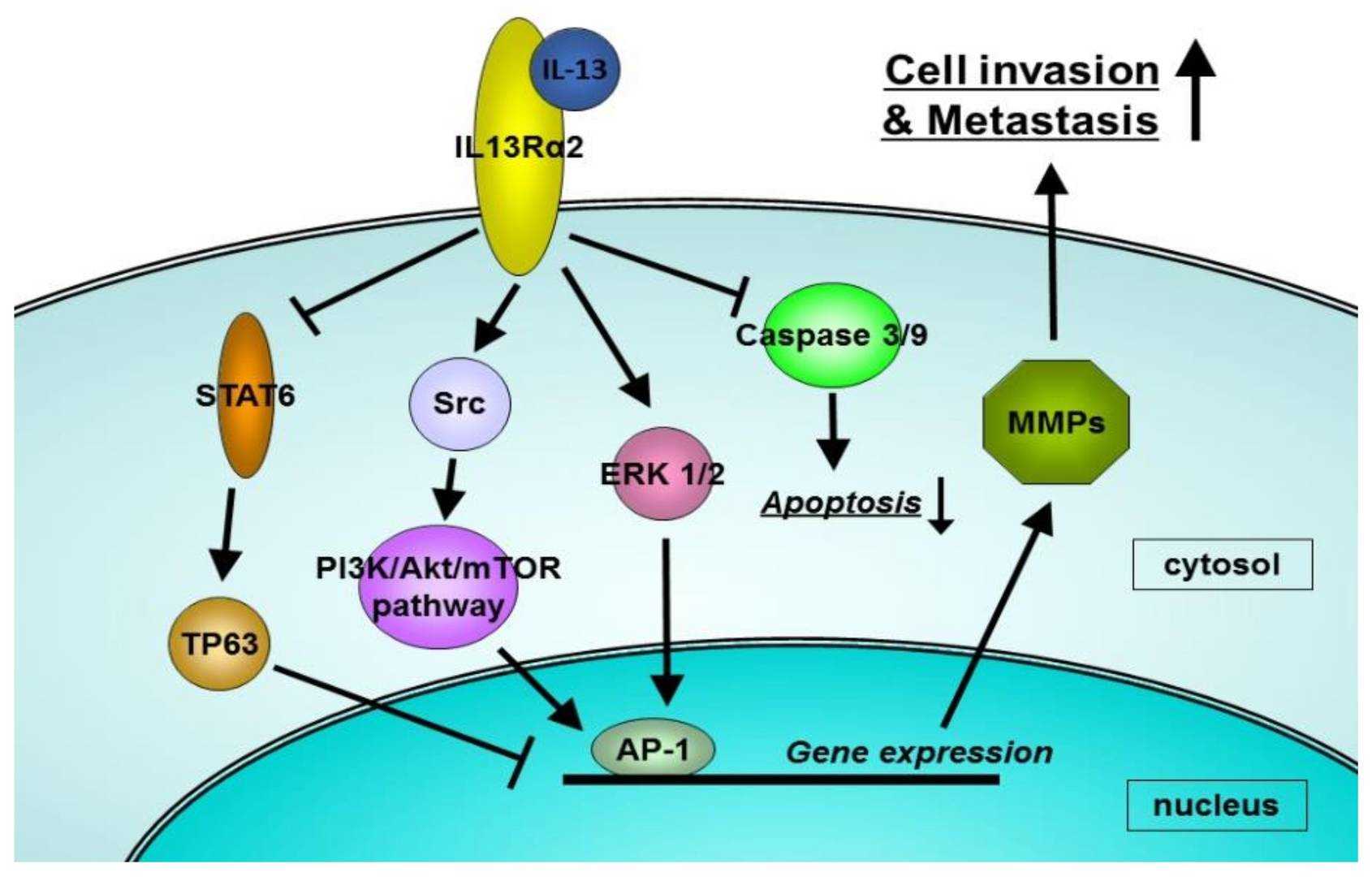 Fig.1 The schema of mechanisms by which IL-13Rα2 promotes cancer invasion of metastasis.1
Research on IL13RA2 continues to expand along several converging directions:
Our IL13RA2 membrane protein portfolio is guided by a central truth: a receptor defined by exceptional affinity must present its binding surface without compromise. IL13RA2's three fibronectin type III domains must fold and orient correctly for high-avidity cytokine engagement, and its membrane anchor must support native topology for internalization and interaction studies. Accordingly, we deliver full-length IL13RA2 preparations produced in optimized eukaryotic expression systems engineered to preserve these exacting features—IL13RA2 preparations, characterized for domain integrity. Every production lot is verified across multiple quality attributes: purity assessed by SDS-PAGE, sample homogeneity assessed by analytical size-exclusion chromatography.
Our IL13RA2 membrane protein portfolio is guided by a central truth: a receptor defined by exceptional affinity must present its binding surface without compromise. IL13RA2's three fibronectin type III domains must fold and orient correctly for high-avidity cytokine engagement, and its membrane anchor must support native topology for internalization and interaction studies. Accordingly, we deliver full-length IL13RA2 preparations produced in optimized eukaryotic expression systems engineered to preserve these exacting features—IL13RA2 preparations, characterized for domain integrity. Every production lot is verified across multiple quality attributes: purity assessed by SDS-PAGE, sample homogeneity assessed by analytical size-exclusion chromatography.
Not finding the membrane protein product you need? Contact us to start your one-stop custom service!
Cellular platforms for IL13RA2 research must combine controlled receptor density with faithful surface presentation and internalization competence, because the receptor's meaning lies in how it displays, traps, and internalizes ligand—not merely in how much of it is expressed. We provide customized, high-expressing IL13RA2 stable cell lines developed through sequence-optimized stable integration, ensuring sustained, uniform receptor presentation within reproducible backgrounds. Our collection spans lines stably overexpressing wild-type IL13RA2 and variants carrying engineered substitutions for diverse investigations. Each clone is released only after exhaustive phenotypic verification.
Not finding the stable cell line product you need? Contact us to start your one-stop custom service!
Advance your IL13RA2 program with our validated recombinant antibody panel, engineered for the form-specific and isoform-discriminating performance this target demands. These high-affinity monoclonal and recombinant clones include formats selective for the full-length membrane receptor and formats selective for the shed soluble form—each sequence-verified and validated to avoid cross-reactivity with the canonical IL-13 receptor alpha chain, whose shared cytokine-binding architecture has historically complicated selective detection. Each clone is expressed as a defined recombinant construct, eliminating the lot-to-lot variability and guaranteeing consistency across long-running studies. Validation spans the applications most relevant to IL13RA2 investigators.
Not finding the recombinant antibody product you need? Contact us to start your one-stop custom service!
Extending well beyond our standard catalog, we deliver fully customizable discovery and manufacturing solutions meticulously tailored to the sophisticated demands of IL13RA2-targeted research and early-stage compound development:
Catalog items are the fastest route when your application follows common detection or binding workflows. Custom arrangements become worthwhile when constructs, formats, or quality attributes fall outside routine specifications. A brief consultation is usually enough to identify the right path.
A short description of your application, the format you have in mind, and any acceptance criteria you already hold is sufficient. Our team will help sharpen the technical details from there.
Yes. Defined recombinant production and consistent release specifications keep performance stable across orders, so early and late data from your project remain directly comparable.
All IL13RA2 products and services are provided strictly for preclinical research. They are not designed, validated, or authorized for any use involving human subjects.