Creative Biolabs is offering the most comprehensive services for antibody development projects. With strict regulation and effective execution, we are dedicated to providing the most valuable solutions to complete your projects.
HighlightsCreative Biolabs is offering the most comprehensive services for antibody development projects. With strict regulation and effective execution, we are dedicated to providing the most valuable solutions to complete your projects.
HighlightsCreative Biolabs has established a broad range of platforms for developing novel antibodies or equivalents. These cutting-edge technologies enable our scientists to meet your demands from different aspects and tailor the most appropriate solution that contributes to the success of your projects.
HighlightsWith deep understanding in antibody-related realms and extensive project experience, Creative Biolabs offers a variety of references to help you learn more about our capacities and achievements, including infographic, flyer, case study, peer-reviewed publications, and all kinds of knowledge that can assist your projects. You are also welcome to contact us directly for more specific solutions.
HighlightsGet a real taste of Creative Biolabs, one of the most professional custom service providers in the world. We are committed to providing highly customized comprehensive solutions with the best quality to advance your projects.
Highlights Loading...
All listed services and products are For Research Use Only. Do Not use in any diagnostic or therapeutic applications.
Interleukin 17 receptor A (IL17RA) is the first discovered member of the interleukin 17 receptor family, and it also serves as a shared signaling subunit in several IL-17 receptor complexes. Its contribution depends on the specific receptor complex and ligand context rather than applying uniformly to every IL-17 family cytokine. It is a single-pass transmembrane protein, which means the entire protein only crosses the cell membrane once. The extracellular portion of the protein is constructed from III type fibronectin domains, while the intracellular tail segment contains a SEFIR domain conserved across the IL-17 receptor family. This domain can recruit pathway-specific adaptor proteins to initiate inflammation-related transcription programs, eliminating the need for most cytokine receptors to rely on common classic signaling adaptor proteins; it follows its own independent signaling pathway. All physiological activities transmitted through this intersection form the core foundation of barrier immunity. What is barrier immunity? It is the immune line of defense that the body uses to block invasion by external microorganisms and protect the integrity of the body's surfaces and cavities. IL-17 signaling prompts epithelial and stromal tissues such as those in the skin, intestines, lungs, and joints to produce antimicrobial defense substances and inflammatory mediators, which also makes IL17RA a key node in the core axis that protects the body's surfaces from microbial invasion. The entire defense line's ability to function relies entirely on this node to hold it up. Its biological role is so critical that it also brings non-negligible side effects: if this pathway, originally tasked with safeguarding the integrity of barrier tissues, remains in a sustained activated state and works continuously without rest, it will instead trigger inflammation that damages the body's own tissues. This is a typical characteristic seen in all types of autoimmune and inflammatory research: a pathway originally meant to protect the body turns into the main culprit that harms the body.
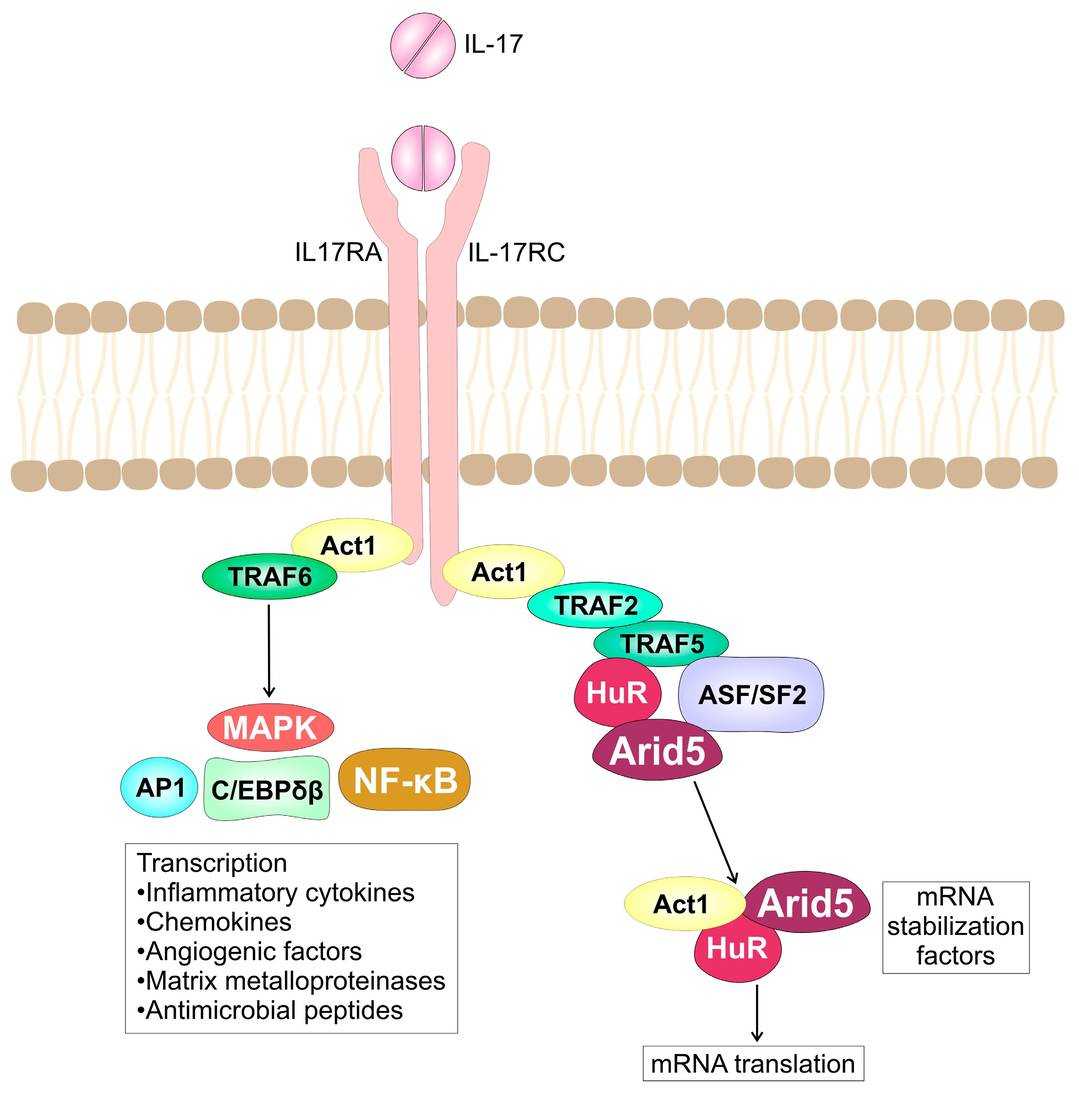 Fig.1 Interleukin-17 signaling.1
Research on IL17RA continues to deepen along several interconnected lines:
Our IL17RA membrane protein portfolio is grounded in a clear conviction: a shared gateway receptor can only be studied with confidence when its modular architecture survives preparation intact. IL17RA's fibronectin type III extracellular domains must fold correctly to present ligand-recognition surfaces, and its single-pass anchor must support native orientation for partner-chain engagement and adaptor recruitment. Accordingly, we deliver full-length IL17RA preparations produced in optimized eukaryotic expression systems engineered to preserve these exacting features. Every production lot is verified across multiple quality attributes: purity assessed by SDS-PAGE, monodispersity by analytical size-exclusion chromatography.
Not finding the membrane protein product you need? Contact us to start your one-stop custom service!
Cellular platforms for IL17RA research must combine controlled receptor density with faithful surface presentation and adaptor-pathway signaling competence, because the receptor's meaning lies in how it assembles with partners and transduces cytokine—not merely in how much of it is expressed. We provide customized, high-expressing IL17RA stable cell lines developed through sequence-optimized stable integration, ensuring sustained, uniform receptor presentation within reproducible backgrounds. Our products spans lines stably wild-type IL17RA and variants carrying engineered substitutions for diverse investigation. Each clone is released only after exhaustive phenotypic verification.
Not finding the stable cell line product you need? Contact us to start your one-stop custom service!
To advance your IL17RA research project, you may try our validated recombinant antibody portfolio. This set of antibodies is purpose-designed to maintain stable detection specificity in all analytical and functional experiments commonly used in cytokine receptor research, deliver accurate and repeatable quantitative results, and meet the experimental needs of various research projects. These high-affinity monoclonal and recombinant antibody clones are all generated against specific epitopes, and can stably and specifically recognize IL17RA under various experimental conditions without misidentifying other proteins, ensuring the basic reliability of experiments. Every antibody clone has undergone complete sequence verification, and all are produced from a fixed recombinant expression construct, completely eliminating performance variability between batches. Even for long-term research spanning several years, using different batches of the same antibody can guarantee the consistency of results, so that fluctuations in reagents will not affect experimental conclusions. Its scope of validation covers all the most common experimental scenarios for IL17RA researchers. No matter what type of experiment you plan to conduct, this set of antibodies can be adapted, eliminating the need to spend time validating the usability of antibodies yourself.
Not finding the recombinant antibody product you need? Contact us to start your one-stop custom service!
Extending well beyond our standard catalog, we deliver fully customizable discovery and manufacturing solutions meticulously tailored to the sophisticated demands of IL17RA-targeted research and compound development:
A concise description of your application, the format you envision, and any acceptance criteria you already hold is enough. Our team will help refine the technical specifics from there.
Yes. Custom format requests and integrated engagements spanning protein, cell line, and antibody needs are routine for us and are managed under unified quality frameworks.
All IL17RA products and services are provided strictly for preclinical research. They are not designed, validated, or authorized for any use involving human subjects.
Catalog items serve routine detection and binding workflows well. Custom arrangements earn their keep when constructs, formats, or quality attributes go beyond standard specifications. A brief consultation typically settles the question quickly.