Creative Biolabs is offering the most comprehensive services for antibody development projects. With strict regulation and effective execution, we are dedicated to providing the most valuable solutions to complete your projects.
HighlightsCreative Biolabs is offering the most comprehensive services for antibody development projects. With strict regulation and effective execution, we are dedicated to providing the most valuable solutions to complete your projects.
HighlightsCreative Biolabs has established a broad range of platforms for developing novel antibodies or equivalents. These cutting-edge technologies enable our scientists to meet your demands from different aspects and tailor the most appropriate solution that contributes to the success of your projects.
HighlightsWith deep understanding in antibody-related realms and extensive project experience, Creative Biolabs offers a variety of references to help you learn more about our capacities and achievements, including infographic, flyer, case study, peer-reviewed publications, and all kinds of knowledge that can assist your projects. You are also welcome to contact us directly for more specific solutions.
HighlightsGet a real taste of Creative Biolabs, one of the most professional custom service providers in the world. We are committed to providing highly customized comprehensive solutions with the best quality to advance your projects.
Highlights Loading...
All listed services and products are For Research Use Only. Do Not use in any diagnostic or therapeutic applications.
IL3RA (Interleukin 3 receptor subunit alpha) encodes the IL-3-specific alpha chain (CD123) of a type-I single-pass transmembrane cytokine receptor, predominantly detected within hematopoietic lineage cell populations and additional select vertebrate tissue compartments. This membrane anchored receptor contains a large extracellular ligand recognition module, one transmembrane helical segment, and a short cytoplasmic tail; productive signaling requires the common beta chain CSF2RB (CD131), which supports JAK2-STAT5 activation. Following biosynthesis, newly synthesized IL3RA undergoes folding and endomembrane system quality control processing. Mature receptor molecules anchor onto plasma membrane surfaces, while partial protein pools remain stored within intracellular vesicular compartments to sustain receptor maturation, membrane trafficking and physiological protein turnover. Cell surface abundance of IL3RA can be dynamically tuned to satisfy tissue specific cytokine perception and membrane signaling adaptive demands.
At cell surface membrane microenvironments, IL3RA may assemble into reversible heteromeric multiprotein receptor complexes together with shared common beta receptor subunits and extracellular cytokine binding partners. Complex stability and membrane localized receptor abundance are modulated by local biochemical microenvironments, shaping the scope of membrane based intermolecular communication. Perturbations to IL3RA structural integrity or expression magnitude may interfere with surface localized receptor partner complex organisation and shift measurable readouts derived from cytokine receptor interaction studies. Tissue microenvironments requiring interleukin 3 dependent paracrine communication rely on properly assembled multimeric receptor assemblies to sustain local membrane associated physiological homeostasis, and membrane anchored IL3RA appears to support such physiological status through cooperative interactions with adjacent receptor subunits and intracellular regulatory binding partners. Genetic sequence alterations within the IL3RA coding locus may impair protein folding, extracellular ligand binding interfaces, transmembrane region packing, and intracellular adaptor coupling capacity. Closely related type I cytokine receptor paralogues cannot fully reproduce IL3RA unique complex forming profiles and tissue distribution characteristics, even though partial functional overlap is proposed among subfamily members. Variations in IL3RA protein abundance correspond to cellular adaptive requirements for cytokine dependent membrane signaling responses, rendering this transmembrane receptor a valuable research subject for dissecting hematopoietic cytokine receptor biology and membrane associated signaling homeostasis. Without appropriate heteromeric partner subunit assembly, IL3RA containing receptor complexes are unlikely to sustain stable downstream signaling outputs. Its characteristic type I single pass transmembrane topology and multi domain extracellular ligand sensing architecture differentiate IL3RA from numerous other cell surface cytokine receptor molecules, supporting ordered spatial organisation of membrane localised receptor complexes and mediating selective reversible contacts with diversified extracellular partner moieties. Diminished functional competence of IL3RA may trigger disorganised receptor partner complex arrangement and weaken tissue level cytokine related adaptive buffering capacity, highlighting its research relevance for cytokine receptor oriented laboratory investigations.
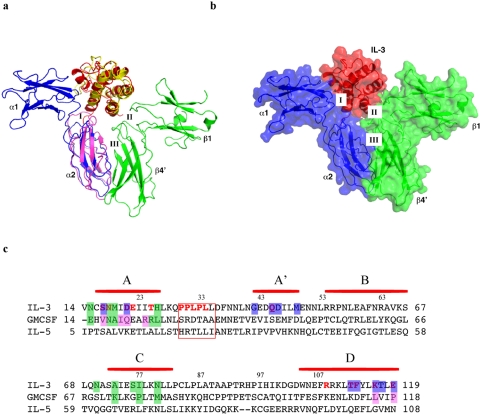 Fig. 1 Homology modeling of the IL-3 receptor extracellular complex using GM-CSF receptor structural templates, with structural and sequence comparisons. The modeled complex is not an experimentally determined IL3RA crystal or cryo-EM structure.1
The biological functions of membrane bound IL3RA interleukin 3 receptor subunit alpha protein are focused on sustained heteromeric partner complex interaction and hematopoietic membrane signaling homeostasis coordination:
Creative Biolabs offers purified IL3RA membrane protein samples generated under unified preparation workflows, including full length constructs and isolated domain truncated variants. Truncated domain fragments support domain-specific studies rather than all behaviors of the intact membrane protein, whereas full-length constructs may suit research focused on partner complex interaction and type I cytokine receptor related functional observation. All batches receive uniform quality screening. Assays that depend on intact membrane topology or full-complex function require appropriately constituted systems; isolated domains or fragments may support other defined assays according to the research objective. Consistent structural features are preserved across batches to support comparative laboratory analysis across separate test groups. Full length IL3RA samples retain intact partner interaction domain conformation after standardized purification, supporting reliable detection of weak and transient receptor partner contacts for comparative functional analysis.
Not finding the Membrane protein product you need? Contact us to start your one-stop custom service!
Creative Biolabs provides adjustable IL3RA expression cell research models with tunable target expression levels, applicable to structural observation of single pass type I cytokine receptor membrane protein and research into membrane partner molecular interaction. Sample evaluation includes sustained target protein expression detection and preliminary partner interaction observation, enabling side by side comparison of receptor binding behaviours under differing target protein abundances. These cell systems can pair with diverse laboratory analysis schemes to track changes in partner assembly efficiency alongside shifting IL3RA protein levels.
Not finding the stable cell line product you need? Contact us to start your one-stop custom service!
Anti-IL3RA recombinant antibodies are generated via standardized protein preparation workflows, compatible with routine laboratory detection techniques for plasma membrane localization mapping and identification of receptor partner molecular complexes. The antibody series can work alongside common laboratory detection reagents to realise multi dimensional observation of target protein distribution within membrane enriched sample materials.
Not finding the recombinant antibody product you need? Contact us to start your one-stop custom service!
Beyond catalog products, Creative Biolabs offers specialized custom services for IL3RA research:
IL3RA might act as a single pass type I cytokine receptor membrane protein and participate in heteromeric surface complex assembly to modulate receptor complex arrangement and hematopoietic membrane signaling homeostasis.
IL3RA expression status could alter surface receptor complex assembly efficiency and local plasma membrane coupled molecular interaction balance, serving as an important mediator of cytokine associated membrane homeostasis related biological processes.
No, IL3RA associated research reagents from Creative Biolabs are exclusively built for exploring cytokine receptor family dependent membrane regulatory mechanisms, and shall not be deployed for any clinical oriented workflows. These preparations are optimized for basic laboratory investigation and do not satisfy performance benchmarks required for clinical implementation.
Offerings include full length IL3RA membrane protein, target specific recombinant antibodies and tunable expression cell research models, supporting research on hematopoietic membrane signaling homeostasis and receptor mediated membrane partner perception.
Laboratory observation schemes may include receptor partner interaction related tests to analyse molecular binding associated behaviours under simulated plasma membrane microenvironment conditions.