
Creative Biolabs is offering the most comprehensive services for antibody development projects. With strict regulation and effective execution, we are dedicated to providing the most valuable solutions to complete your projects.
HighlightsCreative Biolabs is offering the most comprehensive services for antibody development projects. With strict regulation and effective execution, we are dedicated to providing the most valuable solutions to complete your projects.
HighlightsCreative Biolabs has established a broad range of platforms for developing novel antibodies or equivalents. These cutting-edge technologies enable our scientists to meet your demands from different aspects and tailor the most appropriate solution that contributes to the success of your projects.
HighlightsWith deep understanding in antibody-related realms and extensive project experience, Creative Biolabs offers a variety of references to help you learn more about our capacities and achievements, including infographic, flyer, case study, peer-reviewed publications, and all kinds of knowledge that can assist your projects. You are also welcome to contact us directly for more specific solutions.
HighlightsGet a real taste of Creative Biolabs, one of the most professional custom service providers in the world. We are committed to providing highly customized comprehensive solutions with the best quality to advance your projects.
Highlights Loading...
All listed services and products are For Research Use Only. Do Not use in any diagnostic or therapeutic applications.
Interleukin 4 receptor alpha (IL-4Rα), encoded by the IL4R gene and also known as CD124, is a type I transmembrane cytokine receptor subunit expressed in multiple hematopoietic and non-hematopoietic cell populations, including lymphoid, myeloid, and epithelial cells. Rather than functioning as a complete receptor on its own, IL-4Rα participates in two heteromeric receptor complexes. In the type I IL-4 receptor, IL-4 first binds IL-4Rα and promotes recruitment of the common gamma chain (γc/IL2RG). In the type II receptor, IL-4 similarly binds IL-4Rα before recruitment of IL13Rα1, whereas IL-13 follows the opposite assembly sequence, initially binding IL13Rα1 and subsequently recruiting IL-4Rα. Formation of these receptor complexes activates associated JAK-family kinases and downstream signaling pathways, prominently including STAT6, which contribute to the regulation of type 2 immune responses and related cellular programs. Through its participation in these receptor systems, IL-4Rα is involved in processes such as T-cell differentiation, B-cell responses, macrophage polarization, and epithelial responses to type 2 cytokines, making it an important research target for cytokine receptor assembly, signaling, and type 2 immune biology.
IL-4Rα functions as a shared receptor component that connects IL-4 and IL-13 signaling through distinct heteromeric receptor configurations. IL-4 engagement of IL-4Rα can initiate assembly of either the type I receptor with γc or the type II receptor with IL13Rα1, while IL-13 signaling through the type II receptor begins with binding to IL13Rα1 followed by recruitment of IL-4Rα. These assembled complexes support intracellular JAK-STAT signaling and other context-dependent pathways that regulate gene expression and cellular responses. IL-4Rα therefore contributes to the coordination of type 2 cytokine responses across immune and epithelial cell systems without independently serving as a dual IL-4/IL-13-binding receptor. Its receptor-subunit function makes IL-4Rα a useful target for research on heteromeric cytokine receptor organization, ligand-dependent signaling, immune cell differentiation, and type 2 inflammatory pathway biology.
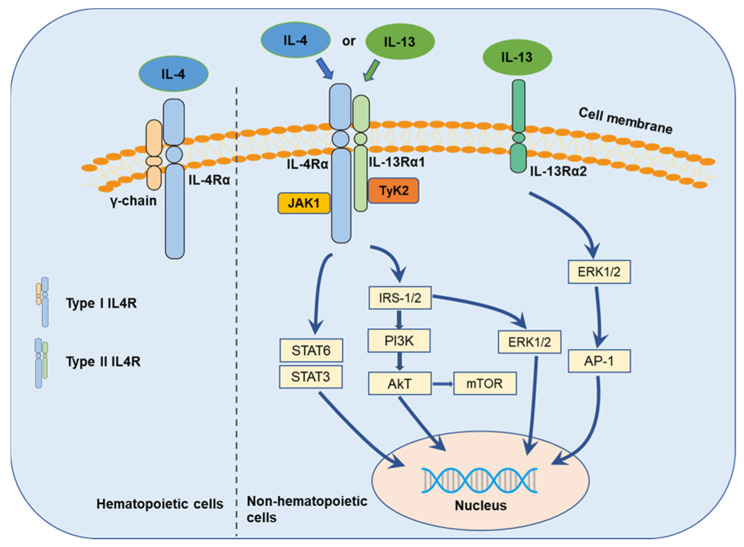 Fig. 1 Assembly and downstream signaling cascades of type I and type II IL4 receptor complexes in hematopoietic and non-hematopoietic cells upon IL-4 or IL-13 stimulation.1
IL-4Rα, encoded by the IL4R gene, functions as a shared receptor subunit in the type I and type II cytokine receptor complexes involved in IL-4 and IL-13 signaling:
Creative Biolabs offers high-quality IL4Rα proteins produced using optimized expression systems, including full-length receptor alpha subunit and isolated extracellular domain variants. The IL4Rα extracellular domain directly mediates IL-4 binding, making these proteins suitable for IL-4 receptor-ligand interaction studies and related molecular characterization. In the type II IL-4/IL-13 receptor complex, IL-13 initially binds IL13Rα1, followed by recruitment of IL4Rα; therefore, studies of IL-13 receptor-complex formation or downstream signaling require appropriate systems containing IL13Rα1 and other relevant cellular signaling components. All IL4Rα proteins undergo strict quality control to support consistent performance across applicable research platforms.
Not finding the membrane protein product you need? Contact us to start your one-stop custom service!
Creative Biolabs provides custom-engineered IL4R stable cell lines, including overexpression and blank control models. These cell lines are optimized for cytokine receptor profiling and Th2 differentiation signal functional analysis. Each cell line undergoes stringent validation to ensure stable expression profiles and consistent functional performance in diverse experimental contexts.
Not finding the stable cell line product you need? Contact us to start your one-stop custom service!
High-specificity recombinant antibodies targeting IL4R are developed using antibody engineering technologies for research applications involving IL4R expression and localization. These antibodies can be used in studies of IL4R distribution in relevant cell and tissue models and may also support characterization of IL4R-containing receptor complexes in combination with appropriate IL-4, IL-13, or related receptor-component detection reagents.
Not finding the recombinant antibody product you need? Contact us to start your one-stop custom service!
Beyond catalog products, Creative Biolabs offers specialized custom services for IL4R research:
IL4R is a heteromeric type I cytokine receptor binding IL-4/IL-13 to activate STAT signaling and drive Th2 allergic immune differentiation.
IL4R is the central receptor governing type 2 immunity, a core target for allergy and inflammatory disorder study.
No, all IL4R products and services are strictly for research use only, not intended for clinical diagnosis or treatment.
Offerings include full-length IL4R membrane glycoproteins, isoform-specific detection antibodies and custom stable cell lines for type 2 immunity research.
IL4R proteins are validated via IL-4/IL-13 ligand binding functional testing.








