
Creative Biolabs is offering the most comprehensive services for antibody development projects. With strict regulation and effective execution, we are dedicated to providing the most valuable solutions to complete your projects.
HighlightsCreative Biolabs is offering the most comprehensive services for antibody development projects. With strict regulation and effective execution, we are dedicated to providing the most valuable solutions to complete your projects.
HighlightsCreative Biolabs has established a broad range of platforms for developing novel antibodies or equivalents. These cutting-edge technologies enable our scientists to meet your demands from different aspects and tailor the most appropriate solution that contributes to the success of your projects.
HighlightsWith deep understanding in antibody-related realms and extensive project experience, Creative Biolabs offers a variety of references to help you learn more about our capacities and achievements, including infographic, flyer, case study, peer-reviewed publications, and all kinds of knowledge that can assist your projects. You are also welcome to contact us directly for more specific solutions.
HighlightsGet a real taste of Creative Biolabs, one of the most professional custom service providers in the world. We are committed to providing highly customized comprehensive solutions with the best quality to advance your projects.
Highlights Loading...
All listed services and products are For Research Use Only. Do Not use in any diagnostic or therapeutic applications.
The integrin α1 subunit, namely ITGA1, is numbered CD49a in the cluster of differentiation system, and constitutes the α subunit portion of integrin α1β1. α1β1 is one of the earliest discovered heterodimers in the integrin family; integrins all exist in pairs, with one α subunit matched with one β subunit to exert complete function, and α1β1 is one of the first such combinations discovered by humans. It is also one of the main mechanisms cells use to adhere to the collagen-rich scaffold beneath them. For cells in the human body to be fixed in the appropriate position, they rely on multiple types of adhesion methods, and the one that α1β1 participates in helps cells attach to the extracellular scaffold filled with collagen directly beneath them. Like all integrin α subunits, ITGA1 must pair with its corresponding β subunit to function, and its binding partner is unique—only the β1 subunit, and it will not bind to any other type of β subunit. The complex formed by the combination of the two is called very late antigen-1, which was first discovered on activated lymphocytes. Lymphocytes are immune cells of the human body, and activation refers to the state in which they begin to perform immune-related work. Later, it was successively confirmed that fibroblasts, endothelial cells, smooth muscle cells, and many other cell types that interact with the extracellular matrix all express this complex; it is not a molecule unique to a single type of cell. In the region of the complex that extends outside the cell, there is a unique inserted structure called the I domain, which is mainly responsible for the receptor's work of recognizing and binding ligands—that is, finding the target molecule it needs to bind to and completing the core task of adhesion, making this small structure the most critical part. The complex also has a single transmembrane helix structure, as well as a short cytoplasmic tail that remains inside the cell. These two parts can connect the cell's adhesion function with the intracellular signaling pathways and cytoskeletal system—preventing the adhesion action outside the cell from being disconnected from the activities inside the cell. Where the cell adheres to and what state it is in outside the cell can be detected by signals inside the cell, and the cell can also adjust its cytoskeletal structure to cooperate with the needs of adhesion.
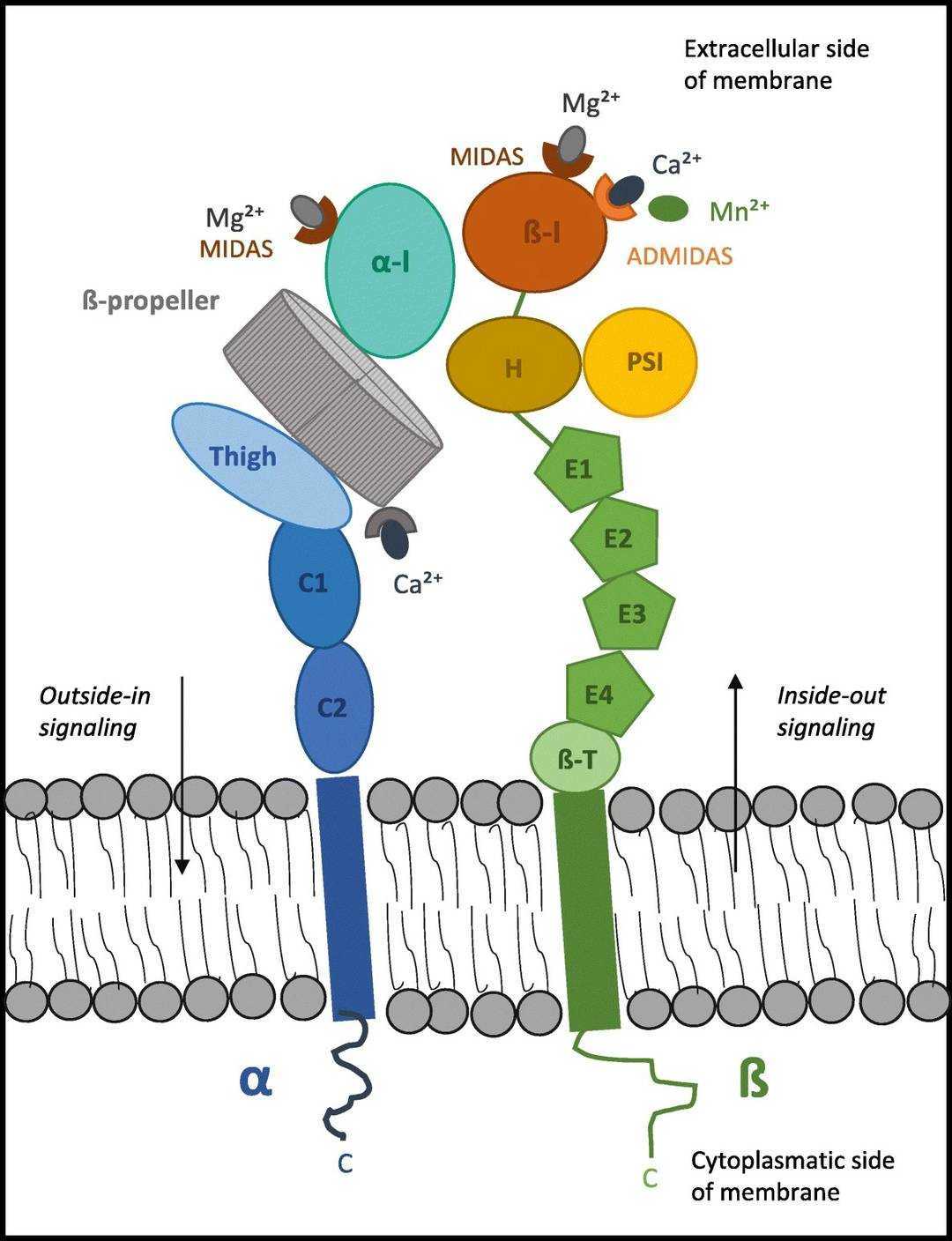 Fig.1 Representation of an αI-domain-containing integrin heterodimer and the distribution of its domains.1
Several research currents keep converging on this integrin subunit:
Producing ITGA1 credibly means preserving the I-domain architecture and the heterodimeric reality. A subunit that folds without its inserted domain, or that is assayed without its β1 partner, describes neither half of the working receptor. Full-length ITGA1 comes from our optimized eukaryotic expression systems with folding support matched to the integrin-alpha architecture. Each preparation undergoes research-grade quality-control assessment before release. If your study requires a specific variant background, a defined activation condition, or a presentation matched to a particular adhesion or binding assay, the format can be adjusted around your protocol—the preparation follows the experimental design.
Not finding the membrane protein product you need? Contact us to start your one-stop custom service!
Cellular models for ITGA1 work turn on expression density and heterodimer assembly working together—a subunit only binds collagen when it pairs with its beta partner at the surface. Wild-type overexpression lines and variants let researchers probe which surfaces carry the collagen recognition. Each clone is characterized before release, so the line's behavior is established before experiments begin. Should your program call for a particular variant background, a specific density tier, or an expression schedule built around your matrix-challenge protocol, the platform can be tailored to fit; the cell line is constructed to serve the experiment it will run in.
Not finding the stable cell line product you need? Contact us to start your one-stop custom service!
Antibody work on ITGA1 faces the alpha-subunit problem: the integrin alpha family shares its domain architecture, and generic clones drift into cross-reactivity that corrupts quantitation in samples where multiple alpha subunits pair with the same beta partner. The recombinant panel here is screened for genuine ITGA1 discrimination against its alpha siblings. Sequence-defined production keeps lot-to-lot performance steady, and where a project needs a different conjugate, validation against a specific sample type, or an adjustment in clone format to fit a particular workflow, that can be arranged on request-the panel flexes to meet the experimental design it serves.
Not finding the recombinant antibody product you need? Contact us to start your one-stop custom service!
In addition to our catalog products, Creative Biolabs specializes in custom services for membrane protein and antibody discovery & development. Using our deep knowledge and sophisticated platforms we can support you with:
Yes. Formats can be custom, and multi-component engagements are integrated, with specifications adhered to through common quality frameworks.
A brief description of the application, the format envisioned, and any acceptance criteria already in mind is sufficient. Technical details can be refined together from there.
All ITGA1 products and services are provided strictly for preclinical research.
Catalog items work well for standard detection or binding workflows. Custom production makes sense when constructs, formats, or quality attributes step beyond routine specifications. A short consultation is usually enough to decide.









