
Creative Biolabs is offering the most comprehensive services for antibody development projects. With strict regulation and effective execution, we are dedicated to providing the most valuable solutions to complete your projects.
HighlightsCreative Biolabs is offering the most comprehensive services for antibody development projects. With strict regulation and effective execution, we are dedicated to providing the most valuable solutions to complete your projects.
HighlightsCreative Biolabs has established a broad range of platforms for developing novel antibodies or equivalents. These cutting-edge technologies enable our scientists to meet your demands from different aspects and tailor the most appropriate solution that contributes to the success of your projects.
HighlightsWith deep understanding in antibody-related realms and extensive project experience, Creative Biolabs offers a variety of references to help you learn more about our capacities and achievements, including infographic, flyer, case study, peer-reviewed publications, and all kinds of knowledge that can assist your projects. You are also welcome to contact us directly for more specific solutions.
HighlightsGet a real taste of Creative Biolabs, one of the most professional custom service providers in the world. We are committed to providing highly customized comprehensive solutions with the best quality to advance your projects.
Highlights Loading...
All listed services and products are For Research Use Only. Do Not use in any diagnostic or therapeutic applications.
Integrin subunit alpha 6 (ITGA6) is the anchoring half of the integrin pair that glues epithelial tissues to their basement membranes. As one subunit of a heterodimeric adhesion receptor, ITGA6 contributes the ligand-selective head that recognizes laminin—the meshwork protein underlying every epithelial sheet—while its partner beta subunit supplies the cytoplasmic connection to the cell's structural machinery. The pairing is flexible: matched with beta 1, the heterodimer mediates dynamic adhesion and cell migration over laminin surfaces; matched with beta 4, it assembles into the stable, rivet-like junctions that pin epithelial cells to their substrate. Few adhesion molecules carry this much architectural responsibility across this many tissue contexts. The biology downstream is structural to the core. In skin and other barrier epithelia, the beta 4 partnership builds the hemidesmosomes that keep the outermost tissue layers attached under mechanical stress—disrupt these, and blistering follows. In glandular epithelia, the alpha 6-containing heterodimers organize tissue polarity and anchor stem-cell compartments to their niche positions. And in proliferative disease research, ITGA6 has become a recurring character: the receptor appears on migrating, invasive cells across numerous cancer research models, where it helps malignant populations leave their tissue of origin and colonize new territory. Its expression tracks with stem-like states in several tissue contexts, adding another reason the subunit draws sustained attention.
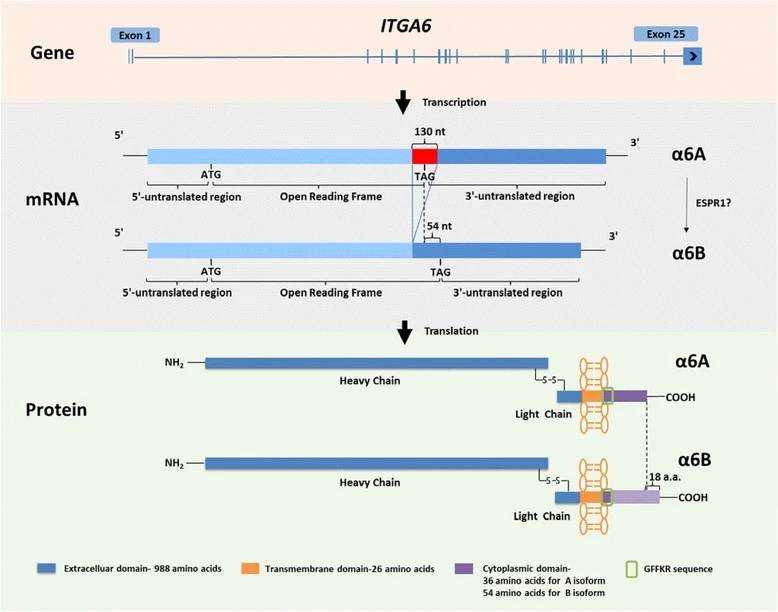 Fig.1 Schematic depiction of ITGA6 gene and mRNA and protein of two identified α6 cytoplasmic variants.1
Several research currents keep flowing through this subunit:
To prepare ITGA6, first its identity as the integrin α6 subunit must be distinguished from the functional α6β1 and α6β4 heterodimeric receptors. ITGA6 itself must be correctly processed so that its heavy and light chains fold and remain properly associated, while receptor-level functional studies require the appropriate β partner. If this cannot be achieved, its binding activity with laminin will not match its original function in organisms, making it unusable for experiments, and the resulting data will be unreliable. The pairing partner for assembly must also be clearly specified. Even if the processing of ITGA6 itself is done correctly, if the wrong partner is selected, the experiment will still fail. Some experiments only require the independent expression of the α6 subunit, while others require it to assemble with the β1 or β4 subunit to restore the original recognition structure in organisms, ensuring it can function identically to its native state. The protein expression platform we have selected is specifically designed to support the processing requirements of complex proteins such as integrins. If your experiment requires a different fusion tag, adjustment to the buffer system, or the use of co-expressed binding subunits not included in standard products, custom modifications can be made. You only need to share the specific requirements of your experiment with us, and we can modify the protein to fit your needs, so you do not have to adapt to off-the-shelf products.
Not finding the membrane protein product you need? Contact us to start your one-stop custom service!
Whether a cell model used to study ITGA6 is reliable depends entirely on two core conditions: whether the density of ITGA6 on the cell surface is sufficient, and whether there are usable partner subunits. If either of these two conditions fails, the entire cell model becomes unusable, and all experimental data obtained will be incorrect. We have prepared different cell lines that perfectly match various experimental needs, so you do not need to spend effort modifying them yourself.. Every cell clone undergoes comprehensive identification before delivery, to clarify all characteristics that may affect experiments. If your research requires a specific genetic variation background, a rare subunit combination, or a receptor density level not listed in our standard catalog, our platform can make adjustments to meet your needs. All cell lines are customized to address the specific questions of your experiment, and you will never have to adapt your work to fit off-the-shelf catalog products.
Not finding the stable cell line product you need? Contact us to start your one-stop custom service!
To develop antibodies targeting ITGA6, the first hurdle to cross is a core barrier of the integrin family. Many of the α subunits in this family have extremely high similarity in their extracellular amino acid sequences. Antibodies produced using conventional antibody cloning technologies cannot accurately identify the sole target, and they easily trigger cross-reactivity with other homologous proteins beyond the target—meaning that while the original goal was only to capture ITGA6, other structurally similar subunits are also captured together. If multiple types of integrins happen to coexist in the tissue under study, this unintended cross-reactivity will disrupt all subsequent quantitative detection results. The measured values will be contaminated, and cannot accurately reflect the true ITGA6 content in the sample. The recombinant antibody portfolio introduced in this article has undergone specialized screening, and can accurately distinguish true ITGA6 without misidentifying other homologous proteins. Every clone has passed multiple rounds of rigorous validation, and can meet the needs of different experimental scenarios: including quantitative detection of cell lysates, cell surface staining of cells that express this receptor, localization and distribution analysis of fixed samples, and dynamic imaging of the live cell adhesion process. All use cases meet requirements, and the antibodies can stably identify their target across any type of experiment. These antibodies are produced using defined amino acid sequences, so the performance of every production batch remains stable. There will be no cases where one batch produces strong experimental results while the next batch deviates drastically, which avoids the common issue of batch-to-batch variability in experiments. If your research project has special requirements—such as switching to a different clone format, adjusting the labeling method, or conducting additional validation for a specific sample type—all adjustments can be made on demand. This antibody portfolio can adapt to the unique requirements of any research design, and is not constrained by fixed parameters.
Not finding the recombinant antibody product you need? Contact us to start your one-stop custom service!
Extending well beyond our standard catalog, we deliver fully customizable discovery and manufacturing solutions meticulously tailored to the sophisticated demands of ITGA6-targeted research and compound development:
Yes. Custom formats and integrated multi-component engagements are routine, with unified quality frameworks keeping specifications aligned.
Yes. The scientific team stays reachable for assay guidance and troubleshooting for as long as the materials are in use.
All ITGA6 products and services are provided strictly for preclinical research. They are not designed, validated, or authorized for any use involving human subjects.
Catalog items work well for standard detection or binding workflows. Custom production makes sense when constructs, formats, or quality attributes step beyond routine specifications. A short consultation is usually enough to decide.









