
Creative Biolabs is offering the most comprehensive services for antibody development projects. With strict regulation and effective execution, we are dedicated to providing the most valuable solutions to complete your projects.
HighlightsCreative Biolabs is offering the most comprehensive services for antibody development projects. With strict regulation and effective execution, we are dedicated to providing the most valuable solutions to complete your projects.
HighlightsCreative Biolabs has established a broad range of platforms for developing novel antibodies or equivalents. These cutting-edge technologies enable our scientists to meet your demands from different aspects and tailor the most appropriate solution that contributes to the success of your projects.
HighlightsWith deep understanding in antibody-related realms and extensive project experience, Creative Biolabs offers a variety of references to help you learn more about our capacities and achievements, including infographic, flyer, case study, peer-reviewed publications, and all kinds of knowledge that can assist your projects. You are also welcome to contact us directly for more specific solutions.
HighlightsGet a real taste of Creative Biolabs, one of the most professional custom service providers in the world. We are committed to providing highly customized comprehensive solutions with the best quality to advance your projects.
Highlights Loading...
All listed services and products are For Research Use Only. Do Not use in any diagnostic or therapeutic applications.
Integrin subunit alpha E (ITGAE), more commonly known as CD103 (cluster of differentiation 103) is a specific adhesion subunit that will entrap single tissues-resident immune cells to their tissue native neighborhoods where they collectively perform most of their best work. Most integrin alpha subunits pair with several beta partners, but ITGAE holds onto a single partner — beta 7 — until the end, then sticks one ligand almost exclusively: E-cadherin (Right), the difference maker in anchoring epithelial cells to each session. The arrangement is telling. That integrin, which binds the very molecule that anchors an epithelial sheet together is a receptor built to retain lymphocytes within that same epithelium — and thus has become the famous biology of ITGAE. Cells that express this receptor make up one of the most heavily studied populations in immunology. Tissue-resident memory T cells—long-lived sentinels residing in skin, gut, lung, and other barrier tissues—are sustained through ITGAE-mediated adhesion to stay anchored in those locales as the defining surface marker of this lineage. Gut intraepithelial lymphocytes express it abundantly and embed themselves between epithelial cells where they constantly survey the barrier. This signature is observed in the regulatory T-cell populations of multiple tissue contexts. In tumor research settings, ITGAE-positive immune infiltrates have attracted special an attention: their presence in epithelial tumors seems associated with local immunity control; also the receptor's function to retain these cells within tissue makes it a mechanistic variable of cancer researches programs.
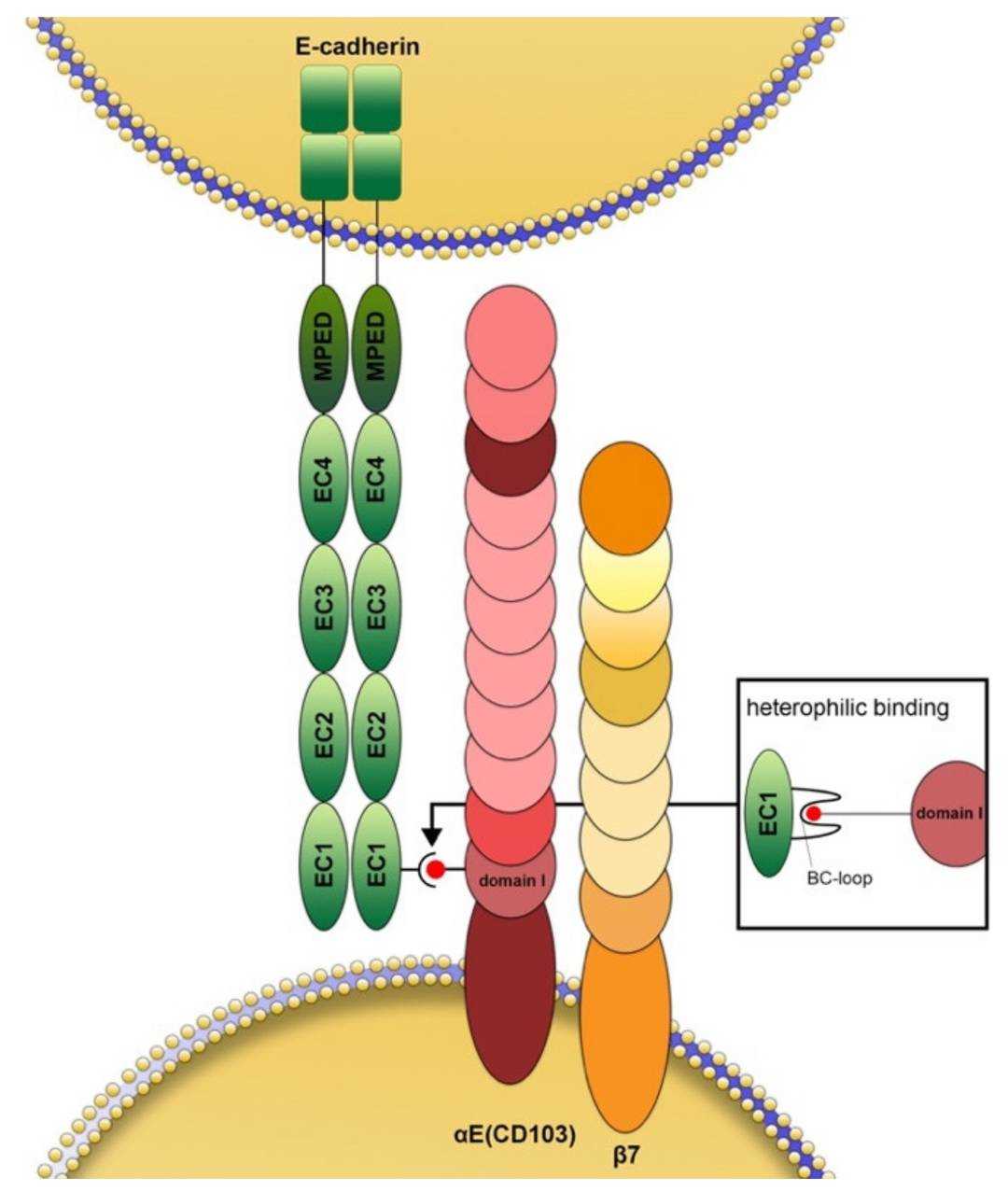 Fig.1 Schematic structure and interaction of CD103 with E-cadherin.1
A few research themes keep pulling investigators toward this receptor:
Producing ITGAE credibly starts with its heterodimeric reality. The alpha E subunit must arrive correctly processed—heavy and light chains linked, folding intact, the E-cadherin binding face undisturbed—and many experiments require it co-assembled with beta 7 to reproduce native recognition geometry. Our expression systems are chosen for integrin-class processing competence, with activation-state control and divalent-cation handling matched to the target's requirements. Each preparation undergoes research-grade quality-control and functional characterization appropriate to the intended format before release. If your experiment calls for a different tag placement, a specific activation-state lock, or a partner configuration outside the standard formats, adjustments can be arranged around your protocol—the format follows the experiment, not the reverse.
Not finding the membrane protein product you need? Contact us to start your one-stop custom service!
Cellular models for ITGAE work turn on surface density and partner availability. Wild-type overexpression lines supply defined alpha E densities; lines co-expressing beta 7 reproduce native heterodimer display for retention and adhesion assays; silenced lines remove the receptor cleanly for loss-of-function studies. Inducible formats decouple receptor appearance from downstream adhesion and migration readouts. Each clone is characterized before release, so the line's behavior is established before experiments begin. Should your program call for a particular variant background, an unusual density tier, or a co-expression configuration built around your assay design, the platform can be tailored accordingly; the cell line is constructed to serve the experiment it will run in.
Not finding the stable cell line product you need? Contact us to start your one-stop custom service!
Antibody work on ITGAE has to clear two hurdles. The first is family discrimination: related integrin alpha subunits share enough extracellular sequence that generic clones drift into cross-reactivity, and in mixed-cell samples that drift corrupts quantitation. The second is performance across real sample types: tissue-resident populations are studied in lysates, on surfaces, in fixed sections, and by imaging—clones must hold up across all four. The recombinant panel here is screened for genuine ITGAE selectivity and validated accordingly, with different formats available. Sequence-defined production keeps lot-to-lot behavior steady, and where a project needs a different conjugate, a custom validation against a particular sample type, or an adjustment in clone format to suit a specific workflow, that can be arranged on request—the panel is built to flex around the experimental design it serves.
Not finding the recombinant antibody product you need? Contact us to start your one-stop custom service!
Extending well beyond our standard catalog, we deliver fully customizable discovery and manufacturing solutions meticulously tailored to the sophisticated demands of ITGAE-targeted research and compound development:
ITGAE products and services are only for research use, preclinical. None is designed, validated or approved for a human-use purpose.
Yes. Formats can be custom and multi-component engagements are integrated, with specifications adhered to through common quality frameworks.
A brief description of the application, the format envisioned, and any acceptance criteria already in mind is sufficient. Technical details can be refined together from there.
Catalog items work well for standard detection or binding workflows. Custom production makes sense when constructs, formats, or quality attributes step beyond routine specifications. A short consultation is usually enough to decide.









