
Creative Biolabs is offering the most comprehensive services for antibody development projects. With strict regulation and effective execution, we are dedicated to providing the most valuable solutions to complete your projects.
HighlightsCreative Biolabs is offering the most comprehensive services for antibody development projects. With strict regulation and effective execution, we are dedicated to providing the most valuable solutions to complete your projects.
HighlightsCreative Biolabs has established a broad range of platforms for developing novel antibodies or equivalents. These cutting-edge technologies enable our scientists to meet your demands from different aspects and tailor the most appropriate solution that contributes to the success of your projects.
HighlightsWith deep understanding in antibody-related realms and extensive project experience, Creative Biolabs offers a variety of references to help you learn more about our capacities and achievements, including infographic, flyer, case study, peer-reviewed publications, and all kinds of knowledge that can assist your projects. You are also welcome to contact us directly for more specific solutions.
HighlightsGet a real taste of Creative Biolabs, one of the most professional custom service providers in the world. We are committed to providing highly customized comprehensive solutions with the best quality to advance your projects.
Highlights Loading...
All listed services and products are For Research Use Only. Do Not use in any diagnostic or therapeutic applications.
ITGAL (Integrin subunit alpha L) encodes a single-pass transmembrane glycoprotein belonging to the integrin superfamily, predominantly detectable across diverse leukocyte-related cell populations alongside limited expression in other tissue compartments. This membrane-embedded alpha-subunit possesses a large extracellular region containing characteristic I-domain architecture critical for partner recognition, a transmembrane helix segment, and a cytoplasmic tail capable of establishing physical contacts with intracellular cytosolic adaptor assemblies. Predominantly localised to plasma-membrane and cell-surface compartments, minor ITGAL protein fractions also reside within intracellular vesicular and endomembrane pools associated with protein trafficking, surface delivery, molecular recycling and protein turnover processes. ITGAL can assemble with complementary membrane-resident subunits to form heterodimeric integrin complexes that support cell-surface molecular crosstalk linked to immune-associated cellular adaptive status. Insufficient intact ITGAL protein availability may compromise physiological surface-partner complex assembly and disturb downstream membrane-dependent cellular adaptive behaviours. Dynamic immune-related tissue microenvironments impose variable demands for integrin-mediated cell-surface adhesion activities, requiring properly organised heteromeric integrin assemblies to sustain multicellular tissue physiological equilibrium. Membrane-anchored ITGAL cooperates with adjacent surface-localised molecular partners to mitigate abnormal complex rearrangement and stabilise plasma-membrane functional configurations.
Genetic sequence alterations within ITGAL coding locus may impair structural stability of plasma-membrane-localized heteromeric integrin-partner assemblies and modify measurable outputs from cell-surface molecular-interaction events. Closely related integrin-alpha-family paralogues cannot fully reproduce the complete functional spectrum of ITGAL during heteromeric surface-complex formation and stable membrane embedding. Variations in ITGAL protein abundance often align with cellular adaptive demands for leukocyte-related surface-adhesion molecular events, rendering this single-pass transmembrane integrin-alpha subunit a valuable research subject for exploring integrin-superfamily biology and immune-cell-surface-membrane-homeostasis dynamics. Predominantly distributed at plasma-membrane alongside minor intracellular vesicular membrane fractions, ITGAL participates in heteromeric integrin-complex assembly and will not sustain persistent downstream functional outputs without adequate partner-driven conformational triggering. Its I-domain-containing multi-modular transmembrane architecture distinguishes this glycoprotein from many other cell-surface adhesion-associated components; these structural features support maintenance of surface-complex spatial arrangement and enable selective physical contacts with membrane-resident binding counterparts. Diminished functional competence of ITGAL may disrupt orderly surface-partner complex assembly and weaken endogenous cellular adaptive buffering capacity, further reinforcing its research value for integrin-targeted laboratory investigations.
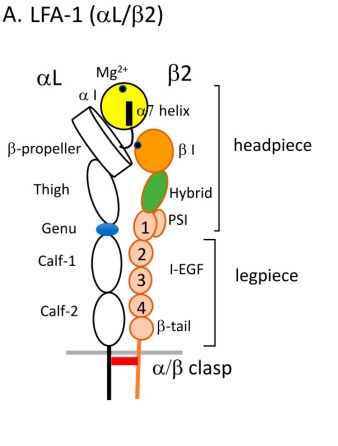 Fig. 1 Schematic modular domain representation of human ITGAL (α L) single pass transmembrane integrin glycoprotein subunit, depicting extracellular I domain, β propeller, thigh and calf 1/calf 2 modules, single pass transmembrane segment and cytoplasmic tail that support heterodimeric integrin complex assembly at immune cell plasma membrane compartments.1
The biological functions of transmembrane ITGAL integrin-alpha-L protein are focused on sustained heteromeric partner-complex interaction and immune-cell-membrane-homeostasis coordination:
Creative Biolabs offers purified ITGAL membrane samples generated under unified preparation workflows, including full-length integrin constructs and isolated domain-truncated variants. Truncated domain fragments cannot support complete surface-partner-complex assembly behaviours, whereas full-length constructs suit research focused on partner-complex interaction and plasma-membrane anchoring-related functional observation. All batches receive uniform quality screening. Function-oriented observation may only be performed using full-length samples under simulated plasma-membrane microenvironment setups. Consistent structural features are preserved across batches to support comparative laboratory analysis across separate test groups. Full-length ITGAL samples retain intact partner-interaction-domain conformation after standardized purification, supporting reliable detection of weak and transient integrin-partner contacts for comparative functional analysis.
Not finding the Membrane potein product you need? Contact us to start your one-stop custom service!
Creative Biolabs provides adjustable ITGAL expression cell research models with tunable target-expression levels, applicable to structural observation of single-pass transmembrane integrin-alpha-L subunit and research into membrane-partner molecular interaction. Sample evaluation includes sustained target-protein expression detection and preliminary partner-interaction observation, enabling side-by-side comparison of binding behaviours under differing target-protein abundances. These cell systems can pair with diverse laboratory analysis schemes to track changes in partner-assembly efficiency alongside shifting ITGAL protein levels.
Not finding the stable cell line product you need? Contact us to start your one-stop custom service!
Anti-ITGAL recombinant antibodies are generated via standardized protein preparation workflows, compatible with routine laboratory detection techniques for plasma-membrane localization mapping and identification of integrin-partner molecular complexes. The antibody series can work alongside common laboratory detection reagents to realise multi-dimensional observation of target-protein distribution within membrane-enriched sample materials.
Not finding the recombinant antibody product you need? Contact us to start your one-stop custom service!
Beyond catalog products, Creative Biolabs offers specialized custom services for ITGAL research:
ITGAL might act as a single-pass transmembrane integrin-alpha-L subunit and participate in heteromeric surface-complex assembly to modulate integrin-complex arrangement and immune-cell-membrane homeostasis.
ITGAL expression status could alter membrane-partner-complex assembly efficiency and local plasma-membrane-coupled molecular-interaction balance, serving as an important mediator of leukocyte-adhesion-associated biological processes.
No, ITGAL-associated research reagents from Creative Biolabs are exclusively built for exploring integrin-family-dependent cell-surface regulatory mechanisms, and shall not be deployed for any clinical-oriented workflows. These preparations are optimized for basic laboratory investigation and do not satisfy performance benchmarks required for clinical implementation.
Offerings include full-length ITGAL membrane protein, target-specific recombinant antibodies and tunable-expression cell research models, supporting research on immune-cell-membrane homeostasis and integrin-mediated membrane-partner perception.
Laboratory observation schemes may include integrin-partner-interaction related tests to analyse molecular-binding associated behaviours under simulated plasma-membrane environments.









