
Creative Biolabs is offering the most comprehensive services for antibody development projects. With strict regulation and effective execution, we are dedicated to providing the most valuable solutions to complete your projects.
HighlightsCreative Biolabs is offering the most comprehensive services for antibody development projects. With strict regulation and effective execution, we are dedicated to providing the most valuable solutions to complete your projects.
HighlightsCreative Biolabs has established a broad range of platforms for developing novel antibodies or equivalents. These cutting-edge technologies enable our scientists to meet your demands from different aspects and tailor the most appropriate solution that contributes to the success of your projects.
HighlightsWith deep understanding in antibody-related realms and extensive project experience, Creative Biolabs offers a variety of references to help you learn more about our capacities and achievements, including infographic, flyer, case study, peer-reviewed publications, and all kinds of knowledge that can assist your projects. You are also welcome to contact us directly for more specific solutions.
HighlightsGet a real taste of Creative Biolabs, one of the most professional custom service providers in the world. We are committed to providing highly customized comprehensive solutions with the best quality to advance your projects.
Highlights Loading...
All listed services and products are For Research Use Only. Do Not use in any diagnostic or therapeutic applications.
Integrin subunit beta 2 (ITGB2), encoded by the ITGB2 gene on chromosome 21q22.3 and also known as CD18, is a cell surface adhesion receptor that serves as the common beta subunit of the β2 integrin family. The gene spans approximately 43 kb and contains 17 exons, encoding a 769-amino-acid protein with a molecular mass of around 85 kDa. The central region of the β2 subunit (residues 125–385) adopts an I-domain-like fold—referred to as the β2 I-domain—which is essential for ligand binding and heterodimer formation. Within this region, a highly conserved von Willebrand factor type A domain (residues 124–364) contains contact sites between α and β subunits and is required for proper processing of the subunit precursor. ITGB2 is a type I transmembrane glycoprotein expressed predominantly in the hematopoietic system, with high levels found on leukocytes including neutrophils, monocytes, lymphocytes, and macrophages. ITGB2 pairs non-covalently with four distinct α subunits—CD11a (αL), CD11b (αM), CD11c (αX), and CD11d (αD)—encoded by the ITGAL, ITGAM, ITGAX, and ITGAD genes. These pairings generate four heterodimeric integrin receptors: LFA-1 (αLβ2/CD11a-CD18), Mac-1 (αMβ2/CD11b-CD18), p150,95 (αXβ2/CD11c-CD18), and αDβ2 (CD11d-CD18).
Through these heterodimeric complexes, ITGB2 mediates leukocyte adhesion, transmigration, and signaling during immune responses. The β2 integrins recognize inflammatory cues and bind to a range of ligands, including ICAM1 (CD54), ICAM2 (CD102), ICAM3 (CD50), ICAM4, the iC3b fragment of complement component C3, and fibrinogen. Upon ligand engagement, β2 integrins establish firm adhesion of leukocytes to the vascular endothelium; signaling through these integrins then triggers the transport of attached leukocytes across the blood vessel wall to sites of infection or injury. Through these interactions, ITGB2 supports neutrophil transmigration, immunological synapse formation, phagocytosis, and erythrophagocytosis. ITGB2 is also involved in integrin-mediated signaling pathways including the Rap1 signaling pathway and integrin signaling pathway. Inherited mutations in ITGB2 that disrupt β2 integrin expression result in leukocyte adhesion deficiency type I (LAD-I), a primary immunodeficiency characterized by severe recurrent infections and impaired wound healing. At least 90 mutations in the ITGB2 gene have been identified in LAD-I patients. These properties make ITGB2 an important research target for studies of leukocyte adhesion and trafficking, integrin-mediated signaling, immune cell function, and the molecular basis of leukocyte adhesion deficiencies.
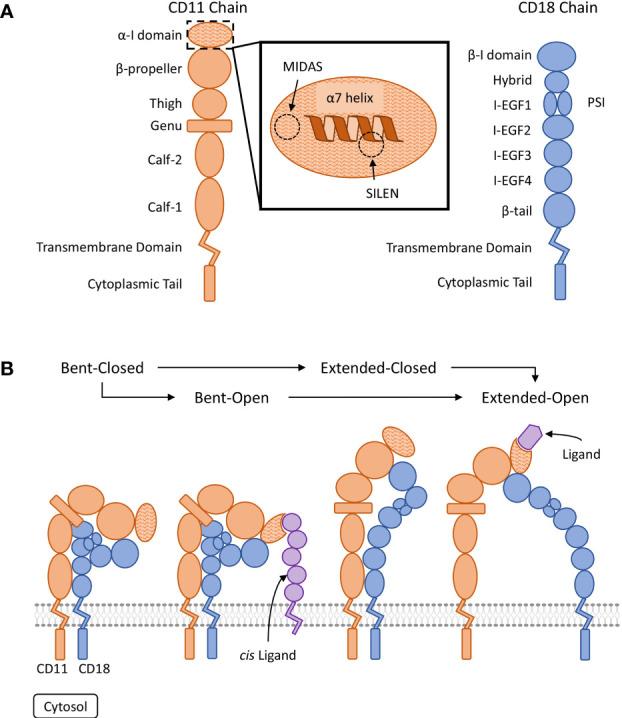 Fig. 1 Visual representation of β2 integrin structure and conserved regulatory conformations.1
ITGB2, encoded by the ITGB2 gene, functions as the common beta subunit of the β2 integrin family, mediating leukocyte adhesion and signaling through heterodimer formation:
Creative Biolabs offers high-quality ITGB2 membrane protein products produced using optimized expression systems. These include full-length type I transmembrane protein that retains the native membrane-spanning domain and extracellular βI domain, as well as isolated extracellular domain variants containing the βI domain and I-domain-like fold. The extracellular domain mediates α subunit heterodimerization and ligand binding, making these proteins suitable for studies of integrin assembly, ligand-receptor interactions, and signaling characterization. All ITGB2 proteins undergo strict quality control to support consistent performance across applicable research platforms.
Not finding the protein product you need? Contact us to start your one-stop custom service!
Creative Biolabs provides custom-engineered ITGB2 stable cell lines, including overexpression and knockdown models. These cell lines are optimized for studies of leukocyte adhesion, transmigration, integrin signaling, and immune cell function. Each cell line undergoes stringent validation to ensure stable expression profiles and consistent functional performance in diverse experimental contexts.
Not finding the stable cell line product you need? Contact us to start your one-stop custom service!
High-specificity recombinant antibodies targeting ITGB2 are developed using antibody engineering technologies for research applications involving ITGB2 expression and localization. These antibodies can be used in studies of ITGB2 distribution on leukocyte surfaces and may also support characterization of β2 integrin heterodimers and ligand-binding interactions in combination with appropriate detection reagents.
Not finding the recombinant antibody product you need? Contact us to start your one-stop custom service!
Beyond catalog products, Creative Biolabs offers specialized custom services for ITGB2 research:








