
Creative Biolabs is offering the most comprehensive services for antibody development projects. With strict regulation and effective execution, we are dedicated to providing the most valuable solutions to complete your projects.
HighlightsCreative Biolabs is offering the most comprehensive services for antibody development projects. With strict regulation and effective execution, we are dedicated to providing the most valuable solutions to complete your projects.
HighlightsCreative Biolabs has established a broad range of platforms for developing novel antibodies or equivalents. These cutting-edge technologies enable our scientists to meet your demands from different aspects and tailor the most appropriate solution that contributes to the success of your projects.
HighlightsWith deep understanding in antibody-related realms and extensive project experience, Creative Biolabs offers a variety of references to help you learn more about our capacities and achievements, including infographic, flyer, case study, peer-reviewed publications, and all kinds of knowledge that can assist your projects. You are also welcome to contact us directly for more specific solutions.
HighlightsGet a real taste of Creative Biolabs, one of the most professional custom service providers in the world. We are committed to providing highly customized comprehensive solutions with the best quality to advance your projects.
Highlights Loading...
All listed services and products are For Research Use Only. Do Not use in any diagnostic or therapeutic applications.
Integrin subunit beta 6 (ITGB6) is an integral transmembrane integrin subunit encoded by the ITGB6 gene, co-localized with alpha integrin chains on plasma membrane surfaces across epithelial somatic cell groups. Unlike soluble cytoplasmic proteins without hydrophobic helical segments, ITGB6 carries one conserved transmembrane helix and large extracellular domains dedicated to extracellular matrix molecular binding. It appears to function as a matrix-binding transmembrane subunit to mediate cell-matrix communication signals under physiological tissue conditions.
Excess unbound extracellular matrix molecules readily disrupt balanced cell-matrix contact without integrin-mediated buffering, and ITGB6 maintains moderate binding equilibrium to stabilize matrix interaction levels in varied tissue microenvironments. Distinct tissue compartments produce unique matrix molecular mixtures, requiring coordinated integrin subunit complexes to sustain steady cell-matrix adhesion within organ tissues. Membrane-localized ITGB6 may continuously associate with extracellular matrix partners to limit excessive binding signal accumulation and preserve tissue matrix equilibrium. Conserved cysteine-rich extracellular motifs of ITGB6 maintain stable heterodimer assembly with alpha integrin chains, a feature that avoids unpaired subunit degradation and impaired matrix signal transmission across epithelial tissue populations.
ITGB6 may mediate intracellular cytoskeletal signaling triggered by extracellular matrix binding events. Sequence variants within the ITGB6 gene shift matrix ligand binding affinity and correlate with disrupted cell-matrix interaction states. No other beta integrin subunit fully recapitulates ITGB6’s dual capacity for matrix molecular recognition and cytoplasmic cytoskeletal signal relay at plasma membranes. Shifts in ITGB6 expression levels likely correspond to tissue matrix remodeling status, rendering the subunit a suitable research target for integrin structural biology and cell-matrix signal analysis.
ITGB6 localizes to plasma membrane outer leaflets to bind extracellular matrix molecules without translocating into intracellular organelle lumens. Its integral membrane topology distinguishes it from soluble cytoplasmic proteins, with dual potential roles in sustaining cell-matrix signal balance and mediating tissue matrix remodeling cues. ITGB6-associated cytoskeletal signaling may adjust intracellular structural messenger concentrations and modify cellular matrix adhesion activity. Reduced functional ITGB6 elevates unregulated matrix binding signal levels and diminishes extracellular molecular response capacity, making ITGB6 a research subject for basic integrin transmembrane subunit studies.
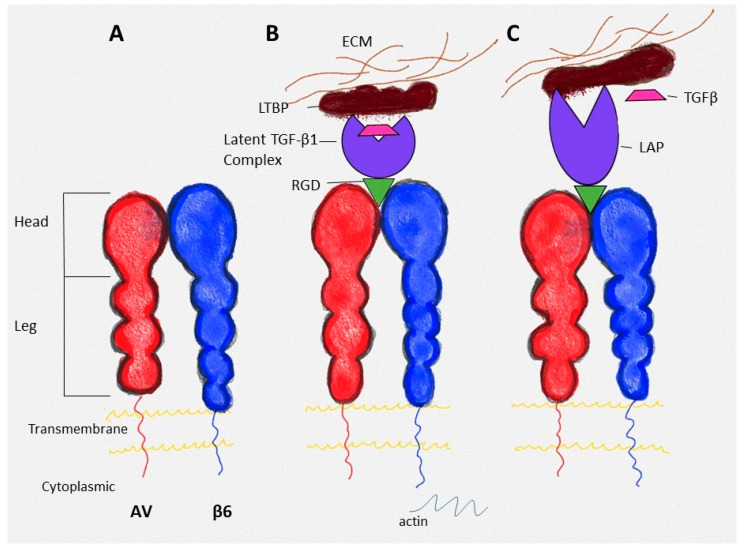 Fig. 1 Schematic representation of ITGAV‑ITGB6 (αvβ6) integrin structure and its functional process in latent TGF‑β1 complex binding and activation.1
The biological functions of integral membrane ITGB6 integrin subunit are focused on sustained extracellular matrix binding and cytoplasmic cytoskeletal signal cascade transmission:
Creative Biolabs offers purified ITGB6 membrane protein samples produced under unified preparation workflows, including full-length ITGB6 constructs and isolated extracellular matrix-binding domain variants. Truncated subunit fragments cannot support complete matrix ligand recognition and cytoskeletal signal coupling activity, while full-length constructs fit research focused on integrin-matrix interaction and heterodimer conformational analysis. All batches receive uniform quality screening. Functional assessments may only be performed on full-length membrane subunit under simulated lipid bilayer microenvironment setups. Consistent extracellular domain structural features are preserved across batches to support comparative laboratory analysis between experimental groups. Full-length ITGB6 membrane samples retain intact matrix ligand-binding pocket conformation after standardized purification, which supports reliable detection of weak and transient matrix-subunit binding events in comparative membrane functional analysis.
Not finding the Membrane Protein product you need? Contact us to start your one-stop custom service!
Creative Biolabs provides cell research models with adjustable ITGB6 expression levels, suitable for structural observation of transmembrane integrin subunits and research into extracellular matrix ligand interaction processing. Sample assessment covers sustained target membrane expression detection and preliminary matrix-subunit interaction analysis, enabling side-by-side comparison of subunit conformational behavior under varying membrane expression abundances. These cell models can be paired with diverse laboratory analysis schemes to track shifts in matrix ligand response efficiency alongside changing target membrane protein levels.
Not finding the stable cell line product you need? Contact us to start your one-stop custom service!
Anti-ITGB6 recombinant antibodies are generated via standardized protein preparation workflows, compatible with routine laboratory detection techniques for plasma membrane localization mapping and identification of matrix-subunit complexes. The antibody series works with common laboratory detection reagents to support multi-dimensional observation of target membrane distribution within tissue samples.
Not finding the recombinant antibody product you need? Contact us to start your one-stop custom service!
Beyond catalog products, Creative Biolabs offers specialized custom services for ITGB6 research:
ITGB6 may act as an integral transmembrane integrin subunit and participate in transmembrane transmission of extracellular matrix molecular signals.
ITGB6 expression status may alter membrane matrix ligand response capacity and intracellular cytoskeletal messenger cascade output, serving as a key mediator of tissue cell-matrix remodeling biological processes.
No, all ITGB6 related products and services are strictly for research use only, and cannot be applied in clinical workflows. All material design and functional screening are optimized exclusively for basic laboratory research, without meeting clinical application criteria.
Offerings include full-length ITGB6 membrane protein, target-specific recombinant antibodies and tunable expression cell research models, supporting research on integrin-matrix ligand interaction and cell-matrix signal transduction.
Laboratory analysis schemes may include extracellular matrix ligand binding assays to assess its matrix molecule recognition capacity under simulated lipid bilayer environments.








