
Creative Biolabs is offering the most comprehensive services for antibody development projects. With strict regulation and effective execution, we are dedicated to providing the most valuable solutions to complete your projects.
HighlightsCreative Biolabs is offering the most comprehensive services for antibody development projects. With strict regulation and effective execution, we are dedicated to providing the most valuable solutions to complete your projects.
HighlightsCreative Biolabs has established a broad range of platforms for developing novel antibodies or equivalents. These cutting-edge technologies enable our scientists to meet your demands from different aspects and tailor the most appropriate solution that contributes to the success of your projects.
HighlightsWith deep understanding in antibody-related realms and extensive project experience, Creative Biolabs offers a variety of references to help you learn more about our capacities and achievements, including infographic, flyer, case study, peer-reviewed publications, and all kinds of knowledge that can assist your projects. You are also welcome to contact us directly for more specific solutions.
HighlightsGet a real taste of Creative Biolabs, one of the most professional custom service providers in the world. We are committed to providing highly customized comprehensive solutions with the best quality to advance your projects.
Highlights Loading...
All listed services and products are For Research Use Only. Do Not use in any diagnostic or therapeutic applications.
Inositol 1,4,5-trisphosphate receptor type 1 (ITPR1), encoded by the ITPR1 gene on chromosome 3p26.1 and also known as IP3R1 or InsP3R1, is an intracellular ligand-gated calcium channel that mediates calcium release from the endoplasmic reticulum (ER). The gene spans approximately 354 kb and contains 62 exons, encoding a large tetrameric channel protein. ITPR1 is a member of the inositol 1,4,5-trisphosphate receptor family, which also includes ITPR2 and ITPR3. The protein contains an N-terminal MIR (protein mannosyltransferase, IP3R and RyR) domain with a beta-trefoil fold, characterized by 12 beta strands folded into three similar trefoil subdomains (alpha, beta, and gamma) that give an overall structure with pseudo-3-fold symmetry. ITPR1 is localized predominantly to the ER membrane, the perinuclear region, and secretory vesicle membranes. It is enriched in the brain, particularly in Purkinje cells of the cerebellum, and shows ubiquitous expression across other tissues including thyroid and brain.
ITPR1 functions as the primary intracellular channel that releases calcium from ER stores in response to inositol 1,4,5-trisphosphate (IP₃). Upon IP₃ binding, ITPR1 undergoes conformational changes that switch the channel from a closed state to an open state, allowing calcium ions to flow from the ER lumen into the cytoplasm. Channel activity is regulated by cytosolic calcium in a biphasic manner—low concentrations activate the channel, while higher concentrations inhibit it—giving rise to calcium oscillations. ATP increases the open probability of ITPR1 by synergizing with IP₃ and calcium, and the channel is inhibited by calmodulin (CALM1) in a calcium-dependent manner. Beyond calcium release, ITPR1 participates in ER stress-induced apoptosis through activation of the CAMK2 complex, and forms a complex with HSPA9 and VDAC1 that facilitates calcium transport from the ER lumen to the mitochondria intermembrane space, providing calcium for the mitochondrial calcium uniporter (MCU). ITPR1 also regulates epithelial secretion of electrolytes and fluid through interaction with AHCYL1, and modulates fertilization and egg activation by tuning the frequency and amplitude of calcium oscillations. Mutations in ITPR1 cause spinocerebellar ataxia type 15 (SCA15) and type 29 (SCA29), as well as Gillespie syndrome, linking the channel to cerebellar function and calcium signaling in the nervous system. These properties make ITPR1 a valuable research target for studies of intracellular calcium signaling, ER calcium channel biology, calcium oscillation dynamics, and the molecular basis of cerebellar ataxias.
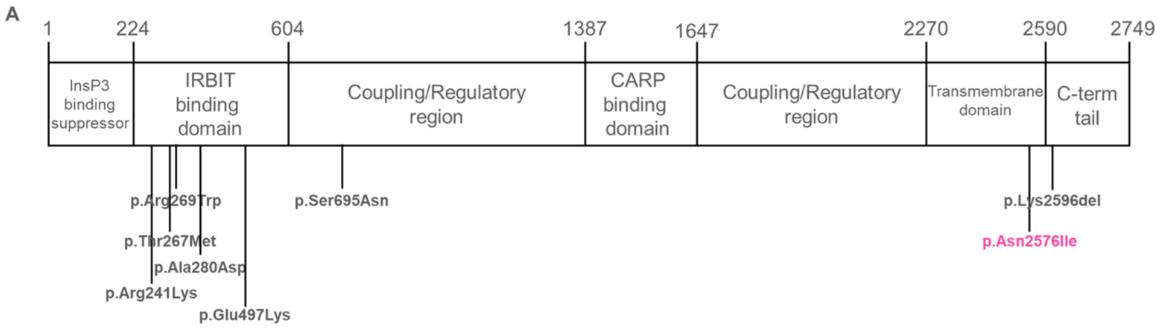 Fig. 1 Schematic of variant positions within ITPR1 functional domains. Most variants localize to the IRBIT domain, suggesting impaired IP₃-induced Ca²⁺ release.1
ITPR1, encoded by the ITPR1 gene, functions as a ligand-gated intracellular calcium channel that mediates calcium release from the ER and regulates diverse cellular processes:
Creative Biolabs offers high-quality ITPR1 membrane protein products produced using optimized expression systems. These include full-length multi-pass transmembrane protein that retains the native channel architecture and IP₃-binding domain, as well as isolated cytosolic domain variants containing the MIR domain and IP₃-binding core. The MIR domain and ligand-binding core mediate IP₃ recognition and channel gating, making these proteins suitable for studies of IP₃ binding, channel gating mechanisms, and ER calcium release characterization. All ITPR1 proteins undergo strict quality control to support consistent performance across applicable research platforms.
Not finding the protein product you need? Contact us to start your one-stop custom service!
Creative Biolabs provides custom-engineered ITPR1 stable cell lines, including overexpression and knockdown models. These cell lines are optimized for studies of intracellular calcium signaling, IP₃-mediated ER calcium release, calcium oscillation dynamics, and ER-mitochondria calcium transfer. Each cell line undergoes stringent validation to ensure stable expression profiles and consistent functional performance in diverse experimental contexts.
Not finding the stable cell line product you need? Contact us to start your one-stop custom service!
High-specificity recombinant antibodies targeting ITPR1 are developed using antibody engineering technologies for research applications involving ITPR1 expression and localization. These antibodies can be used in studies of ITPR1 distribution in neuronal and non-neuronal cells and may also support characterization of ITPR1-containing signaling complexes in combination with appropriate detection reagents.
Not finding the recombinant antibody product you need? Contact us to start your one-stop custom service!
Beyond catalog products, Creative Biolabs offers specialized custom services for ITPR1 research:
ITPR1 is an IP₃-gated intracellular calcium channel that primarily mediates Ca²⁺ release from the endoplasmic reticulum into the cytoplasm to initiate intracellular calcium signaling.
ITPR1 is a significant research target because it is the primary IP₃-gated ER calcium channel, and its mutations are linked to spinocerebellar ataxias and Gillespie syndrome, making it key for studies of intracellular calcium signaling and cerebellar function.
No, all ITPR1 products and services are strictly for research use only, not intended for clinical diagnosis or treatment.
Offerings include full-length ITPR1 membrane proteins, cytosolic domain variants, specific detection antibodies, and custom stable cell lines for calcium signaling and ER channel research.
ITPR1 proteins are validated via IP₃ binding assays, calcium release assays, and relevant functional characterization in applicable research platforms.









