Creative Biolabs is offering the most comprehensive services for antibody development projects. With strict regulation and effective execution, we are dedicated to providing the most valuable solutions to complete your projects.
HighlightsCreative Biolabs is offering the most comprehensive services for antibody development projects. With strict regulation and effective execution, we are dedicated to providing the most valuable solutions to complete your projects.
HighlightsCreative Biolabs has established a broad range of platforms for developing novel antibodies or equivalents. These cutting-edge technologies enable our scientists to meet your demands from different aspects and tailor the most appropriate solution that contributes to the success of your projects.
HighlightsWith deep understanding in antibody-related realms and extensive project experience, Creative Biolabs offers a variety of references to help you learn more about our capacities and achievements, including infographic, flyer, case study, peer-reviewed publications, and all kinds of knowledge that can assist your projects. You are also welcome to contact us directly for more specific solutions.
HighlightsGet a real taste of Creative Biolabs, one of the most professional custom service providers in the world. We are committed to providing highly customized comprehensive solutions with the best quality to advance your projects.
Highlights Loading...
All listed services and products are For Research Use Only. Do Not use in any diagnostic or therapeutic applications.
Potassium calcium-activated channel subfamily M alpha 1 (KCNMA1) is sometimes referred to as Slo1, MaxiK or also the BK channel α-subunit, it encodes a large-conductance, voltage and calcium-gated potassium channel in the human genome, located on chromosome 10q22. 3. Two regulator of K+ conductance (RCK) domains, RCK1 and RCK2, are contained in the intracellular C-terminus and assemble into a tetrameric gating ring that senses cytosolic Ca2+ and Mg2+ concentrations. KCNMA1 is broadly expressed in excitable and non-excitable tissues, including vascular (e.g. VSMC) and visceral smooth muscle, hippocampal and cerebellar neurons, cochlear outer hair cells, pancreatic β-cells, renal epithelium cells, inner ear supporting cells), amongst others. KCNMA1 pathogenic variants are now known to cause a range of neurological channelopathies which can be referred as KCNMA1-linked channelopathy. Somatic mutations in KCNMA1 are involved in cancer development including cervical carcinoma and glioma, where mutant BK channel activity is associated with increased cell proliferation and migration.
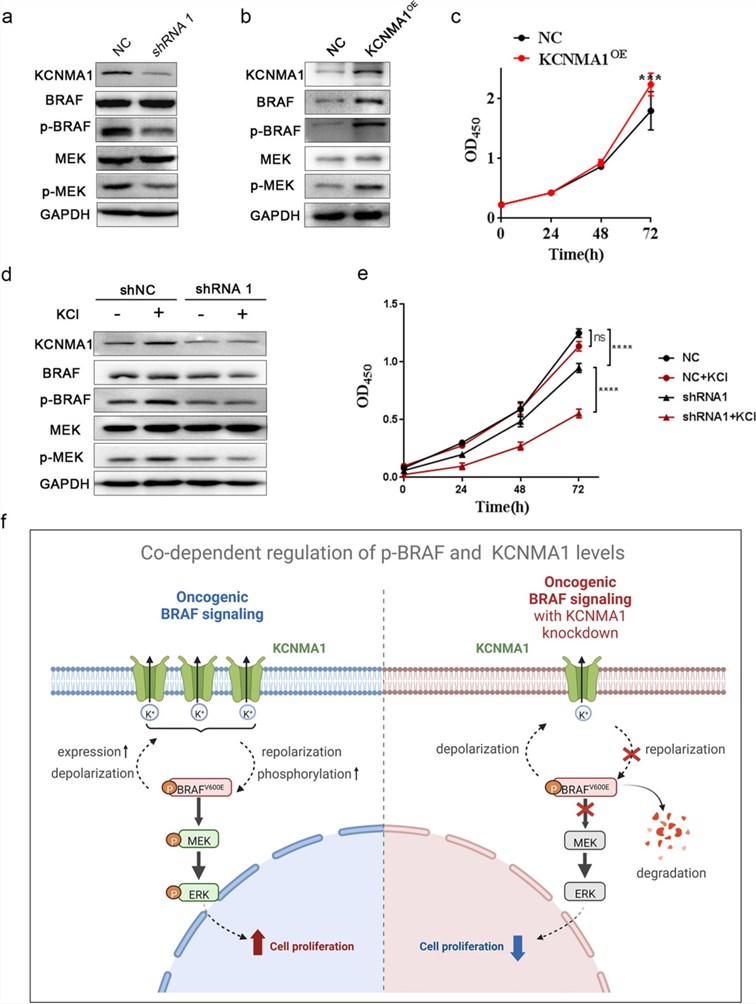 Fig.1 The mechanisms of co-dependency of p-BRAF and KCNMA1.1
KCNMA1 possesses a functional repertoire across a wide array of the physiological system due to its unparalleled ability in converting electrical and chemical signals into membrane hyperpolarization:
The architecture of KCNMA1 presents challenges for structural and biophysical investigations due to the size, large hydrophobic core, and dependence on membrane lipid environment for native conformation. Creative Biolabs — an innovative solution to this problem based on a custom KCNMA1 protein design platform that consistently produces conformationally intact channel preparations for diverse applications in research. The projects come to life via an engineering team that combines cryo-EM–guided structural insights, codon-optimized gene synthesis and high-throughput expression screening to identify constructs with maximum yield while maintaining voltage-sensor integrity and gating-ring function. A technical consultation sets the trajectory for each engagement, so that your protein architecture maps onto your intended application.
Not finding the membrane protein product you need? Contact us to start your one-stop custom service!
Electrophysiologically validated cellular models expressing functional plasma-membrane KCNMA1 are essential for patch-clamp recording, high-throughput screening, and mechanism-of-action studies. Using optimized transduction and selection protocols, Creative Biolabs engineers custom KCNMA1 stable cell lines that rapidly express homogenous, long-term channel expression with maintained biophysical properties. Using lentiviral delivery, transposon-mediated integration and targeted knock-in methodologies we aim to provide precise genetic control with our cell engineering platform. Following a monoclonal purification step in which several clones are selected for clonal purity, lines undergo detailed phenotypic characterization ensuring not only surface density, but functional response to voltage steps and Ca2+ elevations within the physiologically relevant range. Doing this differentiates you from the usual transient expression systems that suffer from variability and allows to give measurable throughputs for longitudinal studies or compound screening campaigns.
Not finding the stable cell line product you need? Contact us to start your one-stop custom service!
Since native channels can be notoriously difficult to characterize, sequence-defined antibodies with high-affinity targeting the KCNMA1 extracellular epitopes will enable detection of this channel in native tissues, mapping of its subcellular distribution and modulation of surface expression as well. Creative Biolabs has provided end-to-end recombinant antibody discovery programs for extracellular loops and conformational KCNMA1 epitopes. Connecting the dots between immunogen design, multi-platform selection and downstream engineering our antibody development pipeline is optimized to deliver antibodies with the specificity, affinity and developability profiles necessary for research use. This renewable, fully characterized reagent delivers reproducible performance across experiments and sites by removing the batch-to-batch variability associated with traditional polyclonal sera through recombinant expression and clonal sequencing.
Not finding the recombinant antibody product you need? Contact us to start your one-stop custom service!
In addition to typical catalog products, Creative Biolabs provides sophisticated discovery services covering a wide range of KCNMA1 research needs. These sophisticated capabilities are intended for investigators chasing mechanistic insights that require custom reagents, challenging assay architectures or multi-component integrated workflows:
No. This is specifically designed to be used for research purposes only.
Yes, we offer a number of complex-selective antibodies that recognize an intracellular C- terminal epitope that is only accessible upon assembly with auxiliary subunits (e.g., KCNMB1 or 26). These reagents allow for both co-immunoprecipitation and immunofluorescence detection of the functional holocomplex in fixed cells or membrane preparations with weak signals against unpartnered alpha subunits that are in a separate conformational state.
Yes, certain clones have mostly confirmed their specificity to somatic, axonal or contractile tissue types when validated on lightly fixed neuronal and smooth muscle tissue. Validation incorporates peptide competition and recombinant antigen controls to ensure epitope specificity in diverse tissue contexts.
Yes, both our recombinant proteins and stable cell lines contain well-founded pathogenic substitutions in the voltage-sensor domain, calcium bowl or RCK domains. They allow efficient comparisons of voltage-dependent activation, sensitivity to calcium and susceptibility to toxins against corresponding wild-type benchmarks in genetically-tractable cellular contexts.