Creative Biolabs is offering the most comprehensive services for antibody development projects. With strict regulation and effective execution, we are dedicated to providing the most valuable solutions to complete your projects.
HighlightsCreative Biolabs is offering the most comprehensive services for antibody development projects. With strict regulation and effective execution, we are dedicated to providing the most valuable solutions to complete your projects.
HighlightsCreative Biolabs has established a broad range of platforms for developing novel antibodies or equivalents. These cutting-edge technologies enable our scientists to meet your demands from different aspects and tailor the most appropriate solution that contributes to the success of your projects.
HighlightsWith deep understanding in antibody-related realms and extensive project experience, Creative Biolabs offers a variety of references to help you learn more about our capacities and achievements, including infographic, flyer, case study, peer-reviewed publications, and all kinds of knowledge that can assist your projects. You are also welcome to contact us directly for more specific solutions.
HighlightsGet a real taste of Creative Biolabs, one of the most professional custom service providers in the world. We are committed to providing highly customized comprehensive solutions with the best quality to advance your projects.
Highlights Loading...
All listed services and products are For Research Use Only. Do Not use in any diagnostic or therapeutic applications.
Leukocyte-associated immunoglobulin-like receptor 1 (LAIR1), numbered CD305, with a molecular weight ranging from 32 to 40 kDa, is a type I transmembrane glycoprotein and a core member of the immunoglobulin superfamily. Its structure is not concentrated in a single location within the cell, but spans both the internal and external spaces of the cell, with each structural segment assigned a clear, distinct function that does not interfere with others. LAIR1 is widely expressed on various cells of hematopoietic origin, all of which are core participants in the body's immune work, including natural killer cells, T lymphocytes, B lymphocytes, monocytes, dendritic cells, eosinophils, and platelets, all of which are directly involved in immune system activities and drive the occurrence of immune responses. Its core identity on these cells is a potent immunosuppressive checkpoint, equivalent to installing a regulatable molecular brake on each immune cell, which can limit excessive activation of immune cells and prevent the body from suffering accidental damage. If the expression and regulation of LAIR1 go wrong, the body will in turn develop a series of pathological conditions, with failures falling into two main categories. One is that in the tumor microenvironment, immune cells in this environment continuously and excessively upregulate the expression of LAIR1. The overabundance and over-sensitivity of these brakes will promote local immunosuppression in the tumor, allowing cancer cells to easily evade the surveillance of the immune system and proliferate wildly in the body. The other category is that malfunctions in LAIR1's own regulatory mechanism can also induce various autoimmune diseases and chronic inflammations. In the final analysis, this abnormal function is a problem with the immune system's brakes—either they are too sensitive, and normal immune work is halted as soon as it starts, preventing the immune system from performing its role; or they fail completely, the brakes cannot be applied at all, leading to uncontrolled immune responses that turn to attack the body's own normal tissues.
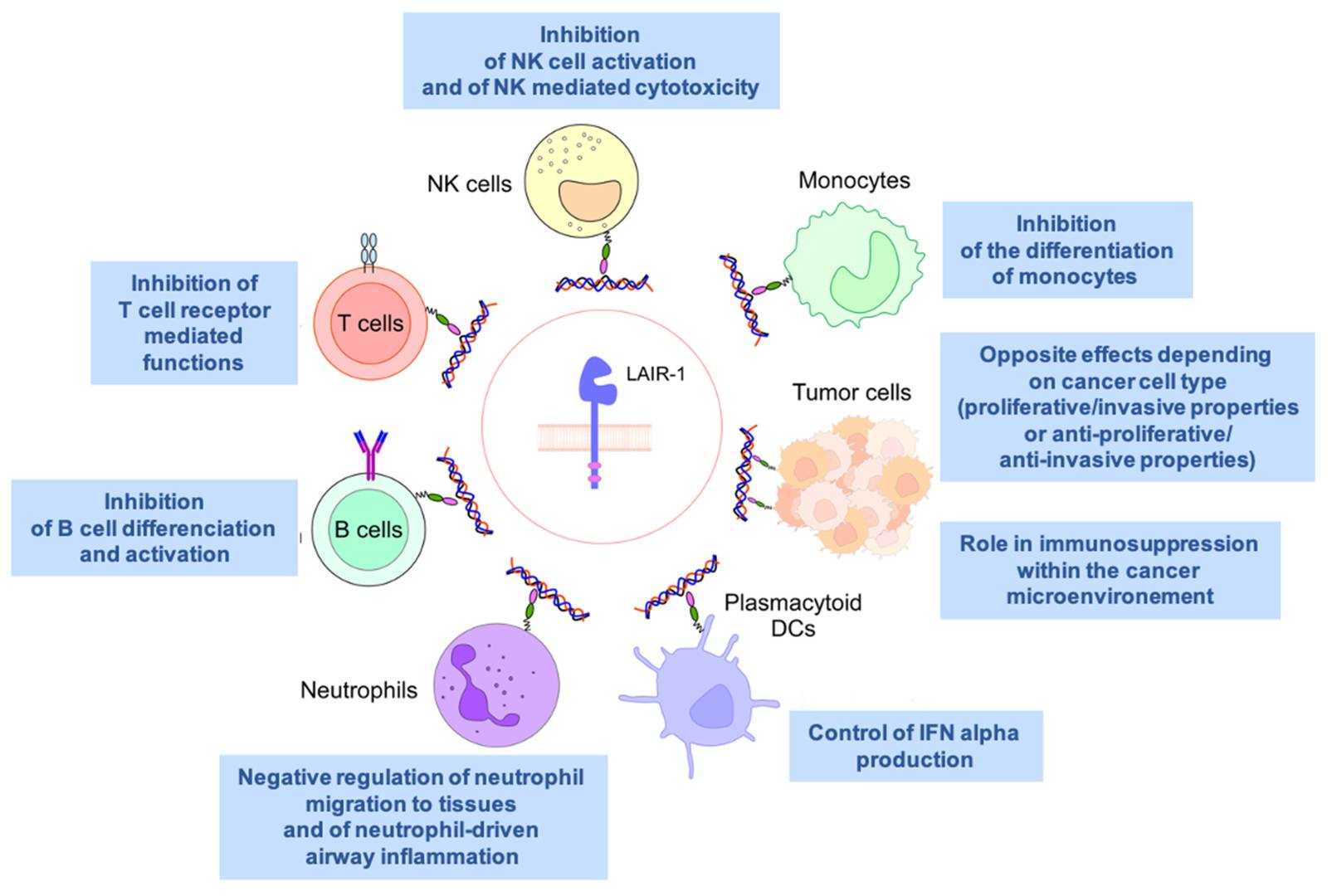 Fig.1 Summary of LAIR1 expression and functions in normal leucocytes, plasmacytoid dendritic (pDCs) cells, and tumor cells.1
LAIR1 regulates multiple immune programs, far beyond what a simple collagen receptor can summarize:
We have elaborately developed a full set of high-quality full-length LAIR1 membrane proteins, designed to preserve research-relevant structural features of the native receptor. This set of proteins is specifically designed to solve the inherent, unavoidable challenges in the biochemical research of inhibitory receptors of the immunoglobulin superfamily. When conducting biochemical research on such receptors, many common laboratory-prepared proteins are either incompletely truncated, or fail to maintain their natural spatial morphology, making them completely unsuitable for reliable functional experiments. Our set of proteins was developed precisely to address these widespread, bottlenecking problems. Our production process supports LAIR1-focused biochemical and functional research, with format selection guided by the intended application. Each batch undergoes research-grade quality assessment and appropriate characterization before release.
Not finding the membrane protein product you need? Contact us to start your one-stop custom service!
To carry out immunoregulation research, or evaluate candidate drug compounds, the first priority is to build a cell system that conforms to physiological states and can accurately reproduce the endogenous LAIR1 inhibitory signal—this is the foundation of all research. If the LAIR1 in the cells cannot transmit signals normally as it does in native cells, the results obtained, whether for mechanism testing or drug screening, will be untenable. We have used cutting-edge technology to construct stable LAIR1 stable cell lines. In these cells, LAIR1 can consistently maintain its natural cell membrane localization, without mislocalizing to the cytoplasm or other locations, and it can also generate a normal functional response when exposed to collagen, which is completely consistent with the reaction in native cells. Our cell lines include not only basic wild-type expression strains, but also relevant mutant strains, naturally occurring variant strains, and research systems integrated with reporter genes, which can cover the vast majority of your research scenarios. Every cell line undergoes rigorous identification: first, we verify that the gene integration is correct, confirming that the LAIR1 sequence is stably inserted into the cell's genome and will not be lost randomly; then we detect the surface expression level to confirm that the amount of LAIR1 on the membrane meets experimental requirements; finally, we verify normal function through multiple different activity experiments, so the cell lines are ready to use immediately upon receipt. These cell models, which allow flexible adjustment of culture scale, can be used for small-scale testing or large-scale compound screening, and are core tools for conducting mechanism of action research, screening lead regulatory compounds, and optimizing research reagents targeting the LAIR1 axis.
Not finding the stable cell line product you need? Contact us to start your one-stop custom service!
If you are advancing LAIR1-related research, you may wish to try another set of our rigorously developed monoclonal antibodies—they have defined sequences and high affinity, and are custom-designed specifically for the unique structural and functional complexity of this inhibitory immune receptor. Unlike many universal antibodies that either bind weakly or cannot adapt to various types of experiments, all these antibodies have completed pre-testing and verification, and can be used for: quantitative Western blotting experiments under reducing and non-reducing conditions, direct and sandwich ELISA experiments, flow cytometry analysis of perforated immune cell populations, as well as high-resolution immunofluorescence and confocal microscopy experiments, covering almost all the common detection experiments you use. Such wide experimental compatibility helps researchers characterize LAIR1 expression in various biological scenarios; reliable detection results can be obtained for both cell samples and tissue samples, and they can also adapt to various basic immunology research needs, allowing you to select research antibodies that fully meet your experimental requirements.
Not finding the recombinant antibody product you need? Contact us to start your one-stop custom service!
Beyond our catalog offerings, we provide comprehensive, end-to-end protein design and engineering services tailored specifically for challenging membrane-associated enzymes like LAIR1:
No. Every material directed against LAIR1—encompassing recombinant protein preparations, stable expression systems, and affinity reagents—is designated exclusively for preclinical investigation.
Absolutely. We have generated different mutants. These are provided as either recombinant membrane proteins or as stable cell lines.
Yes. The antibody panel has been functionally validated for specific recognition of the target when it resides alongside its membrane-proximal partners within stabilized cellular fractions. These binders show negligible cross-reactivity with unrelated immunomodulatory receptors, permitting confident delineation of specific association networks.
The standard offering spans three integrated categories: recombinant LAIR1 proteins in multiple biochemical presentations, stable expression cell lines with confirmed surface localization and activity, and epitope-mapped antibodies covering distinct structural regions of the polypeptide.