
Creative Biolabs is offering the most comprehensive services for antibody development projects. With strict regulation and effective execution, we are dedicated to providing the most valuable solutions to complete your projects.
HighlightsCreative Biolabs is offering the most comprehensive services for antibody development projects. With strict regulation and effective execution, we are dedicated to providing the most valuable solutions to complete your projects.
HighlightsCreative Biolabs has established a broad range of platforms for developing novel antibodies or equivalents. These cutting-edge technologies enable our scientists to meet your demands from different aspects and tailor the most appropriate solution that contributes to the success of your projects.
HighlightsWith deep understanding in antibody-related realms and extensive project experience, Creative Biolabs offers a variety of references to help you learn more about our capacities and achievements, including infographic, flyer, case study, peer-reviewed publications, and all kinds of knowledge that can assist your projects. You are also welcome to contact us directly for more specific solutions.
HighlightsGet a real taste of Creative Biolabs, one of the most professional custom service providers in the world. We are committed to providing highly customized comprehensive solutions with the best quality to advance your projects.
Highlights Loading...
All listed services and products are For Research Use Only. Do Not use in any diagnostic or therapeutic applications.
The LDLR gene is located in the 19p13.2 region of the human chromosome and encodes the low-density lipoprotein receptor (LDLR), a member of the LDL receptor family of cell surface receptors. LDLR is a single-pass type I transmembrane glycoprotein, organized into five functional regions: an N-terminal ligand-binding domain containing seven cysteine-rich LDL-A repeats that coordinate calcium ions, an EGF-precursor homology domain with a six-bladed β-propeller, a serine/threonine-rich O-linked glycosylation region, a single transmembrane helix, and a cytoplasmic tail bearing an NPXY motif for clathrin-mediated internalization. Its molecular weight is approximately 95 kDa and it is expressed across virtually all cell types, with the liver accounting for roughly 70% of the total body LDLR pool. As the primary mechanism for clearing low-density lipoprotein from the circulation, LDLR binds apolipoprotein B-100 on LDL particles at the plasma membrane at neutral pH, undergoes clathrin-mediated endocytosis, and releases the bound lipoprotein in acidic endosomes through a pH-dependent conformational switch involving the β-propeller domain. The receptor then recycles to the cell surface while LDL is delivered to lysosomes for cholesterol release. This process plays a central role in maintaining cellular and systemic cholesterol homeostasis. LDLR expression is transcriptionally regulated by the SREBP pathway in response to intracellular cholesterol levels, and post-translationally modulated by PCSK9, which binds the receptor and redirects it toward lysosomal degradation instead of recycling. The LDLR gene is highly polymorphic, with numerous genetic variants distributed across all 18 exons that can affect receptor synthesis, ligand binding, internalization, or recycling. Therefore, LDLR is regarded as a fundamental molecular model for studying receptor-mediated endocytosis and cholesterol metabolism. Its functional analysis provides valuable tools for understanding the regulatory mechanisms of lipid transport, the structure-function relationships of modular receptor proteins, and the molecular basis of genetic variation affecting receptor activity.
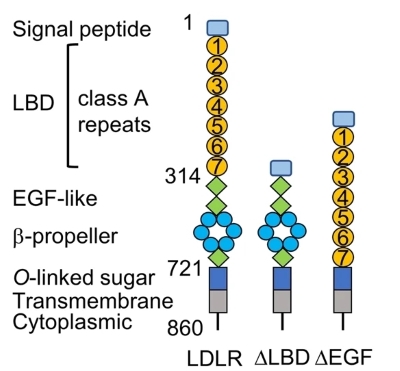 Fig. 1 A schematic presentation of full-length LDLR and its truncated mutants that lack the ligand binding domain (∆LBD) and epidermal growth factor like domain (∆EGF).1
The functional spectrum of LDLR encompasses multiple layers of regulatory activity in cholesterol metabolism and is continuously being elucidated:
Creative Biolabs offers a comprehensive series of high-quality LDLR membrane protein products designed to support structural and functional investigations of receptor-mediated endocytosis and cholesterol metabolism. Built upon the independently developed MemDX™ recombinant membrane protein technology platform, LDLR proteins can be prepared through multiple expression systems, including virus-like particles (VLP) and in vitro prokaryotic expression systems, among others. These rigorously characterized protein products, which include MemDX™ recombinant human LDLR membrane protein (as virus-like particles) and human LDLR proteins derived from diverse expression systems, are suitable for ELISA, antibody screening and identification, ligand binding experiments, and functional research, equipping investigators with dependable reagents for analyzing LDLR-mediated lipoprotein recognition and endocytic trafficking mechanisms.
Not finding the membrane protein product you need? Contact us to start your one-stop custom service!
Constructing a robust cell model is crucial for investigating LDLR function in receptor-mediated endocytosis and cholesterol uptake. As a plasma membrane receptor that undergoes constitutive clathrin-mediated internalization and recycling, the cell-surface abundance and trafficking kinetics of LDLR directly determine the efficiency of lipoprotein clearance and cellular cholesterol acquisition. Alterations in LDLR expression, ligand-binding capacity, or recycling efficiency may lead to significant changes in cellular lipid homeostasis. Creative Biolabs offers customized LDLR membrane protein stable transfection cell models, covering wild-type and various functionally characterized forms. These models stably express the target protein on the plasma membrane, and are suitable for studies on fluorescent LDL uptake assays, receptor trafficking and recycling kinetics, ligand-binding measurements, and quantitative assessment of cholesterol regulatory pathways, providing a reliable and reproducible platform for exploring the molecular mechanism, structure-function relationship, and regulatory role of LDLR in cholesterol metabolism. Our technology ensures correct protein localization and plasma membrane integrity, facilitating your research.
Not finding the stable cell line product you need? Contact us to start your one-stop custom service!
Creative Biolabs offers highly specific recombinant antibodies targeting LDLR, produced using advanced recombinant antibody technology. Compared to traditional antibodies, these recombinant antibodies demonstrate superior performance in terms of specificity, sensitivity, and batch-to-batch consistency. They can also be modified and labeled in various ways. Our LDLR recombinant antibodies support a wide range of applications, including Western Blot, ELISA, flow cytometry, immunofluorescence, immunocytochemistry, immunohistochemistry, and immunoprecipitation, and can be used to detect differences in LDLR expression levels in various tissues or cell sources, analyze its plasma membrane localization and intracellular trafficking patterns, and conduct related research such as lipoprotein binding analysis and endocytic pathway investigation. These antibodies provide reliable detection tools for the structural analysis, functional study of LDLR, and the investigation of its role in receptor-mediated endocytosis and cholesterol homeostasis.
Not finding the recombinant antibody product you need? Contact us to start your one-stop custom service!
In addition to the standard products, Creative Biolabs also offers professional customized services for LDLR. LDLR is a modular multi-domain receptor whose distinct structural regions mediate ligand binding, pH-dependent conformational switching, and intracellular trafficking. These structural features present specific requirements in aspects such as membrane protein expression, antigen design, and functional characterization. Leveraging our technology platform, we can assist you in completing the following customized projects:
LDLR functions as the primary cell-surface receptor for clearing low-density lipoprotein from the circulation through receptor-mediated endocytosis. Its N-terminal ligand-binding domain recognizes apolipoprotein B-100 on LDL particles at neutral pH, and its cytoplasmic NPXY motif directs the receptor-ligand complex into clathrin-coated pits for internalization. In the acidic environment of endosomes, a pH-dependent conformational change in the β-propeller domain displaces the bound lipoprotein, allowing LDLR to recycle to the cell surface while LDL is delivered to lysosomes for cholesterol release. LDLR serves as a fundamental model for studying receptor-mediated endocytosis, modular protein architecture, and cholesterol homeostatic regulation.
LDLR possesses a well-characterized modular domain architecture in which discrete structural regions mediate ligand recognition, pH-responsive conformational switching, and intracellular trafficking. Investigating LDLR provides insights into the molecular mechanisms of clathrin-mediated endocytosis, the structural basis of ligand-receptor interactions, and the regulatory networks controlling cholesterol metabolism including the SREBP transcriptional pathway and PCSK9-mediated post-translational regulation. The receptor's central role in lipoprotein clearance and its highly polymorphic nature make it a valuable system for studying the relationship between protein structure, trafficking dynamics, and cellular lipid homeostasis.
Not applicable. All LDLR products and services provided by Creative Biolabs are for research purposes only and cannot be used for any clinical diagnosis, prevention, treatment or cure of any disease.
We offer a variety of product types, including recombinant LDLR membrane proteins, stable cell models expressing LDLR, high-quality recombinant LDLR antibodies, as well as comprehensive customized services.








