Creative Biolabs is offering the most comprehensive services for antibody development projects. With strict regulation and effective execution, we are dedicated to providing the most valuable solutions to complete your projects.
HighlightsCreative Biolabs is offering the most comprehensive services for antibody development projects. With strict regulation and effective execution, we are dedicated to providing the most valuable solutions to complete your projects.
HighlightsCreative Biolabs has established a broad range of platforms for developing novel antibodies or equivalents. These cutting-edge technologies enable our scientists to meet your demands from different aspects and tailor the most appropriate solution that contributes to the success of your projects.
HighlightsWith deep understanding in antibody-related realms and extensive project experience, Creative Biolabs offers a variety of references to help you learn more about our capacities and achievements, including infographic, flyer, case study, peer-reviewed publications, and all kinds of knowledge that can assist your projects. You are also welcome to contact us directly for more specific solutions.
HighlightsGet a real taste of Creative Biolabs, one of the most professional custom service providers in the world. We are committed to providing highly customized comprehensive solutions with the best quality to advance your projects.
Highlights Loading...
All listed services and products are For Research Use Only. Do Not use in any diagnostic or therapeutic applications.
Leukocyte immunoglobulin-like receptor subfamily B member 4 (LILRB4) is a type I transmembrane glycoprotein and an inhibitory member of the leukocyte immunoglobulin-like receptor (LILR) family. In contrast to most LILRB family members that contain four Ig-like domains, LILRB4 carries only two extracellular Ig-like domains and is not primarily characterized as a classical MHC class I-binding receptor. Instead, LILRB4 binds several non-MHC ligands, including apolipoprotein E (APOE) and fibronectin, which can regulate its inhibitory signaling. LILRB4 is primarily expressed in myeloid-lineage cells, including monocytes, macrophages, dendritic cells, and myeloid-derived suppressor cells (MDSCs), while expression has also been reported in endothelial cells, osteoclast-lineage cells, and mast-cell progenitors. The LILRB4 gene is polymorphic, with multiple single nucleotide polymorphisms (SNPs) reported, although the functional significance of many variants remains incompletely defined. Beyond its implications in cancer, LILRB4 has also been implicated in the regulation of NAFLD through SHP-1-mediated TRAF6 inhibition, atherosclerosis through suppression of NF-κB signaling, and cardiac remodeling, indicating broader roles in inflammatory and metabolic regulation.
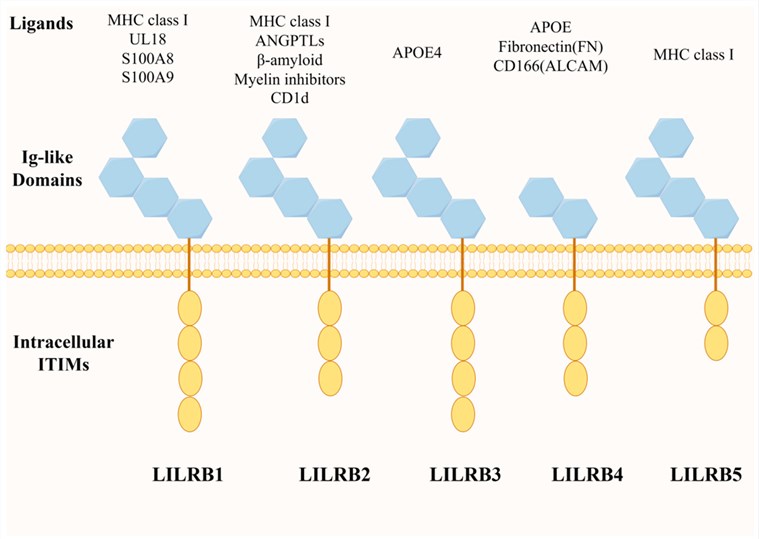 Fig.1 LILRB family member structures and their ligand molecules.1
Functional contributions of LILRB4 in several scenarios include: innate immunity, adaptive immune regulation and tumor microenvironment modulation that correspond to the versatile nature of its molecular interactions:
Creative Biolabs provides a variety of LILRB4 protein products designed to support studies of the structure and function of this immune checkpoint receptor. Different research formats, including full-length membrane-associated LILRB4 and soluble extracellular domain (ECD) constructs, can be considered according to specific experimental requirements. Appropriate expression, purification, and formulation strategies are selected based on the protein format and intended application. These LILRB4 protein preparations can support applications such as antibody development and characterization, ligand-binding studies, and biochemical or biophysical analysis of receptor interactions. Species-specific LILRB4 proteins and other construct formats may also be available depending on individual product specifications. For mammalian-expressed proteins, appropriate folding and post-translational modifications can be evaluated using relevant characterization methods. These research-use LILRB4 proteins provide suitable materials for investigating receptor-ligand interactions and supporting antibody and immune checkpoint research.
Not finding the membrane protein product you need? Contact us to start your one-stop custom service!
It is thus crucial to develop appropriate cellular models for studying LILRB4. Creative Biolabs offers tailored cell models with stable expression or regulation of LILRB4 according to specific project requirements. These stable cell lines can provide useful tools for drug screening, ligand-binding studies, immune cell functional studies, and investigation of LILRB4 biology and pharmacology. Our cell engineering experience supports the selection of suitable host cells, expression strategies, and construct designs while minimizing unnecessary alterations to the experimental system. LILRB4 expression and cellular characteristics can be assessed using appropriate methods, such as flow cytometry, Western blotting, or other project-specific functional readouts. Depending on the research objective, LILRB4 overexpression, knockdown, or reporter-based cell models can also be evaluated for feasibility. These customized cellular resources can support antibody screening, receptor signaling studies, and other research applications related to LILRB4-mediated immune regulation.
Not finding the stable cell line product you need? Contact us to start your one-stop custom service!
With a portfolio that handles all of your high-affinity recombinant antibodies targeting LILRB4, we help ensure you are set up to meet the stringent requirements for many essential laboratory applications. They have greater specificity, sensitivity and batch-to-batch consistency than polyclonal antibodies—they are generated using advanced recombinant technologies. We offer verified LILRB4 recombinant antibodies for Western Blotting (WB), ELISA, Flow Cytometry (FCM), Immunofluorescence (IF), Immunocytochemistry (ICC), Immunohistochemistry IHC and Immunoprecipitation IP; enabling specific detection and quantification of LILRB4 in a variety of sample types including bone marrow aspirates, peripheral blood mononuclear cells, tumor biopsies and formalin-fixed paraffin-embedded FFPE tissue sections.
Not finding the recombinant antibody product you need? Contact us to start your one-stop custom service!
In addition to catalog products, Creative Biolabs also offers custom membrane protein and antibody discovery & development services. With our extensive experience and advanced platforms, we can help you with:
Products we offer include onestop solutions of recombinant LILRB4 membrane proteins in various forms such as VLPs, mammalian membrane extracts, D1-only, D2-only and full-length ECD-Fc fusions; stable cell lines expressing LILRB4 including OVexpressing cell lines and GFP reporter cells; high-affinity recombinant LILRB4 antibodies against different epitopes (D1 domain, D2 domain, stalk region, cytoplasmic tail); fully custom protein engineering and antibody discovery services. Products (for mouse, rat, etc.) are available.
Yes, we do offer conformation-selective antibodies that target an extracellular epitope exposed following apolipoprotein E–induced receptor clustering and Ig-like domain rearrangement.
Yes, we have established dual-stable lines constitutively expressing both full-length LILRB4 and SHP-1 from independent loci. Each batch is released with documentation of apolipoprotein E–stimulated ITIM phosphorylation and downstream ERK attenuation, providing a standardized cellular platform for uninterrupted mechanistic and pharmacological studies without repeated transient transfection.
Yes, the protein is in a determination buffer that has been monitored for industrial endotoxin at physiological pH and devoid of carrier proteins or primary amines. This allows for direct integration into surface plasmon resonance or bio-layer interferometry immobilization workflows without dialysis or buffer exchange.