Creative Biolabs is offering the most comprehensive services for antibody development projects. With strict regulation and effective execution, we are dedicated to providing the most valuable solutions to complete your projects.
HighlightsCreative Biolabs is offering the most comprehensive services for antibody development projects. With strict regulation and effective execution, we are dedicated to providing the most valuable solutions to complete your projects.
HighlightsCreative Biolabs has established a broad range of platforms for developing novel antibodies or equivalents. These cutting-edge technologies enable our scientists to meet your demands from different aspects and tailor the most appropriate solution that contributes to the success of your projects.
HighlightsWith deep understanding in antibody-related realms and extensive project experience, Creative Biolabs offers a variety of references to help you learn more about our capacities and achievements, including infographic, flyer, case study, peer-reviewed publications, and all kinds of knowledge that can assist your projects. You are also welcome to contact us directly for more specific solutions.
HighlightsGet a real taste of Creative Biolabs, one of the most professional custom service providers in the world. We are committed to providing highly customized comprehensive solutions with the best quality to advance your projects.
Highlights Loading...
All listed services and products are For Research Use Only. Do Not use in any diagnostic or therapeutic applications.
Lysophosphatidic acid receptor 1 (LPAR1), historically identified through the endothelial differentiation gene family as EDG2, is the founding and most ubiquitously expressed member of the lysophosphatidic acid receptor family—a group of GPCRs that read one of the simplest membrane-derived signaling molecules known. Its ligand requires no synthesis beyond the routine turnover of membrane lipids: a phosphate headgroup on a single fatty-acid chain, released by cells under everyday physiological conditions and in massive quantities during tissue disturbance. When LPA reaches LPAR1, the receptor can couple to multiple G-protein families, including Gi/o, Gq/11, and G12/13 and sets in motion a familiar but powerful signaling signature—cytoskeletal contraction, junctional tightening, and proliferative rewiring—that has made this axis one of the most heavily studied lipid-signaling systems in cell biology. The reach of LPAR1 across physiology is remarkable. In the nervous system, the receptor guides the formation of neuronal processes and shapes the migration paths of developing cells. In wounded tissue, LPA-LPAR1 signaling recruits and remodels cells to close the breach—an essential repair program that, when chronically engaged, morphs into the fibrotic scarring studied in numerous tissue contexts. In the vascular compartment, the receptor influences barrier integrity and the movements of endothelial and smooth muscle cells. And across proliferative disease research, LPAR1 has surfaced as a recurring actor in invasion, survival, and migration programs that malignant cells exploit in model systems.
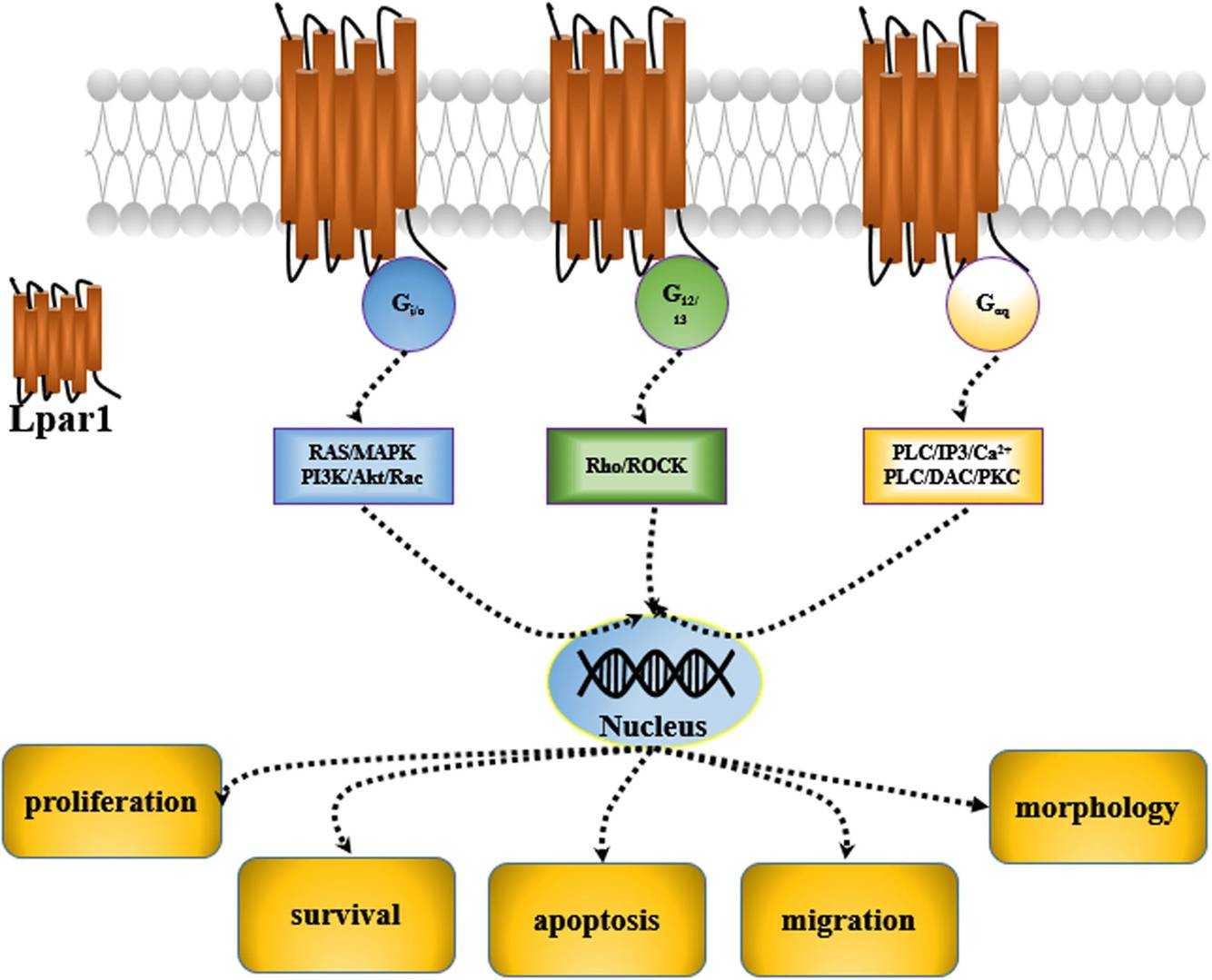 Fig.1 LPA signaling causes G proteins to play different roles in the CNS.1
Research on LPAR1 continues to expand along several converging paths:
Our LPAR1 membrane protein portfolio is anchored in an uncompromising principle: a lipid-ligand GPCR can only be trusted when its membrane context and activation state survive preparation intact. LPAR1's ligand pocket, G protein coupling surface, and conformational dynamics are all conditioned by native lipid surroundings and proper seven-transmembrane architecture. To honor these demands, we deliver full-length LPAR1 preparations produced in optimized eukaryotic expression systems engineered to retain authentic post-translational features and correct folding. Every production lot is verified across multiple quality attributes: purity assessed by SDS-PAGE, monodispersity by analytical size-exclusion chromatography.
Not finding the membrane protein product you need? Contact us to start your one-stop custom service!
We now provide customized stable LPAR1 cell lines. A large number of LPAR1 can be stably produced in the cells to meet experimental needs. The preparation method of this set of cell lines also matches the requirements: the relevant sequences of LPAR1 are first optimized, and the optimized sequences are then stably integrated into the cell's genome, unlike those that are only transiently transferred into cells and lost after a period of time. Cells produced by this method are characterized for sustained LPAR1 surface expression, clone-level expression consistency, and defined genetic background under the specified culture conditions, supporting reproducible experimental use without implying absolute uniformity across all cells or passages. The cell line bank we have curated covers two different types of cells, which can adapt to various research needs. One type is cells that can stably express wild-type LPAR1, that is, cells carrying natural, unmodified LPAR1, which are suitable for basic functional verification; the other type is cells that can stably express LPAR1 variants with artificially modified substitution mutations, that is, cells for which we have intentionally modified partial sequences of LPAR1 to study the role of specific sites, which are suitable for mechanism exploration experiments. No matter which individual cell clone it is among any of the types, it will never be delivered to researchers immediately after preparation. Every clone must undergo a full set of phenotypic verification, with all its characteristics and performance inspected, and only after predefined characterization criteria are met will it be released for research use.
Not finding the stable cell line product you need? Contact us to start your one-stop custom service!
When you conduct research related to LPAR1, if you want to speed up your project progress, you may try our recombinant antibody panel. This product panel has undergone rigorous validation. When we designed it, we deliberately balanced the precision of recognition and the accuracy of quantification, and it can adapt to all analysis and experimental procedures required for lipid GPCR research— it will not slow down the pace of your experiments due to antibody compatibility issues, nor will you need to spend time adjusting procedures to adapt to unsuitable antibodies. The high-affinity monoclonal antibodies and recombinant monoclonal cell lines included in this antibody panel are all generated against specific epitopes. These epitopes cover the extracellular loops and amino terminus of LPAR1, and can accurately locate the corresponding binding sites on the LPAR1 protein. This ensures that the antibodies stably recognize LPAR1, without being confused with other proteins. Even if there are proteins with structures similar to LPAR1 in your experiment, no recognition errors will occur to disrupt your data.
Not finding the recombinant antibody product you need? Contact us to start your one-stop custom service!
Extending well beyond our standard catalog, we deliver fully customizable discovery and manufacturing solutions meticulously tailored to the sophisticated demands of LPAR1-targeted research and precompound development:
Catalog items serve routine detection and binding workflows well. Custom arrangements earn their keep when constructs, formats, or quality attributes go beyond standard specifications. A short consultation typically settles the question.
Yes. Custom format requests and integrated engagements spanning protein, cell line, and antibody needs are routine for us and are managed under unified quality frameworks.
Yes. Our scientific team remains available for assay guidance and troubleshooting throughout the working life of our materials—delivery marks the middle of our engagement, not its end.
All LPAR1 products and services are provided strictly for preclinical research. They are not designed, validated, or authorized for any use involving human subjects.