
Creative Biolabs is offering the most comprehensive services for antibody development projects. With strict regulation and effective execution, we are dedicated to providing the most valuable solutions to complete your projects.
HighlightsCreative Biolabs is offering the most comprehensive services for antibody development projects. With strict regulation and effective execution, we are dedicated to providing the most valuable solutions to complete your projects.
HighlightsCreative Biolabs has established a broad range of platforms for developing novel antibodies or equivalents. These cutting-edge technologies enable our scientists to meet your demands from different aspects and tailor the most appropriate solution that contributes to the success of your projects.
HighlightsWith deep understanding in antibody-related realms and extensive project experience, Creative Biolabs offers a variety of references to help you learn more about our capacities and achievements, including infographic, flyer, case study, peer-reviewed publications, and all kinds of knowledge that can assist your projects. You are also welcome to contact us directly for more specific solutions.
HighlightsGet a real taste of Creative Biolabs, one of the most professional custom service providers in the world. We are committed to providing highly customized comprehensive solutions with the best quality to advance your projects.
Highlights Loading...
All listed services and products are For Research Use Only. Do Not use in any diagnostic or therapeutic applications.
Lecithin retinol acyltransferase (LRAT) is a smooth endoplasmic reticulum integrase encoded by LRAT gene, which is firmly embedded in the lipid monolayer structure of endoplasmic reticulum membrane and mainly enriched in retinal pigment epithelial cells and hepatic stellate cells. Different from intracellular retinoid metabolizing enzymes, LRAT can catalyze irreversible rate-limiting esterification reaction, transfer fatty acyl chains on phosphatidylcholine to free retinol, and generate inert retinyl ester storage lipid droplets, which provide core precursor reserves for the synthesis of 11- cis-retinaldehyde, a chromophore of visual circulation. When the body takes enough vitamin A, the stable LRAT activity can isolate free retinol with cytotoxicity, avoid lipid metabolism damage, and ensure the continuous regeneration of visual pigments and maintain normal visual circulation. Under the condition of vitamin A deficiency or retinal degenerative injury, the catalytic activity of LRAT decreases rapidly, which leads to the depletion of retinol reserves and destroys the steady state of light-induced light transduction signal cycle. Other lipid acyltransferase can not compensate the tissue-specific retinoid storage function of LRAT, and LRAT knockout will completely block the metabolic flux of ocular visual circulation and induce progressive retinal dystrophy. Abnormal liver LRAT function will destroy the whole body vitamin A buffer system, making it the core irreplaceable target of retinoid enzymology and drug screening for hereditary retinopathy.
LRAT is anchored on the smooth endoplasmic reticulum membrane, which plays a catalytic role in the specific acyl transfer of retinol. Fatty acids in lecithin substrate are extracted by conservative cysteine active pockets and covalently bound to retinol molecules to complete esterification modification. Its strict substrate preference for vitamin A derivatives makes it different from ordinary lipid transferases, which constitutes the key speed-limiting bottleneck of retinoid storage and metabolism in mammals. LRAT-mediated esterification can link the process of dietary vitamin A intake and ocular pigment synthesis, and dynamically regulate the steady state of retinoid storage in vivo according to the level of nutrient supply and retinal light intensity. This molecule is mainly involved in the maintenance of visual circulation of retinal pigment epithelium and the steady-state regulation of vitamin A in the liver. The defect of catalytic function of LRAT will directly consume retinol storage and damage the retinal light adaptability. To sum up, LRAT is the key target for the study of the enzymatic mechanism of retinoids and the exploration of targeted therapy for ocular degenerative diseases.
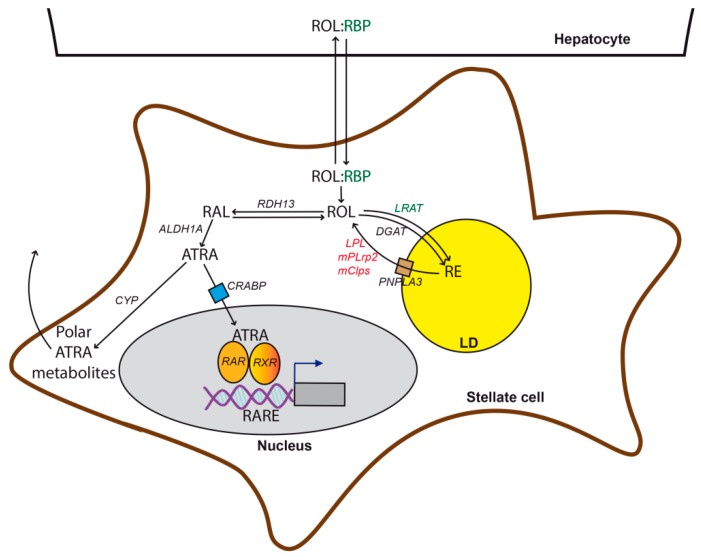 Fig. 1 Schematic of vitamin A trafficking and metabolism in hepatic stellate cells, with LRAT as the key enzyme catalyzing retinol esterification for lipid droplet storage.1
The biological functions of LRAT are focused on retinol acyl transfer and retinoid storage:
Creative Biolabs offers high-quality LRAT proteins through optimized eukaryotic expression systems, including full-length ER integral enzyme and isolated catalytic domain variants. These products retain native retinol acyltransferase catalytic activity, suitable for retinoid metabolic and retinal protective screening assays. All LRAT proteins undergo strict quality control to ensure consistent performance and reliable application across vision research platforms.
Not finding the membrane protein product you need? Contact us to start your one-stop custom service!
Creative Biolabs provides custom-engineered LRAT stable cell lines, including RPE-mimic overexpression and blank control models. These cell lines are optimized for retinoid enzyme profiling and visual cycle signal functional analysis. Each cell line undergoes stringent validation to ensure stable expression profiles and consistent functional performance in diverse experimental contexts.
Not finding the stable cell line product you need? Contact us to start your one-stop custom service!
High-specificity recombinant antibodies targeting LRAT are developed via advanced antibody engineering technologies, with no cross-reactivity with other lipid acyltransferases. These antibodies are validated for RPE ER membrane localization detection and retinal/liver tissue expression profiling, and can be combined with retinol-binding protein markers to analyze retinoid metabolic complexes in ocular cell models.
Not finding the recombinant antibody product you need? Contact us to start your one-stop custom service!
Beyond catalog products, Creative Biolabs offers specialized custom services for LRAT research:
LRAT is an ER enzyme that esterifies free retinol into storage retinyl esters to supply visual chromophore precursors in retinal pigment epithelium.
LRAT is the rate-limiting enzyme of the ocular visual cycle, critical for studying hereditary retinal degeneration disorders.
No, all LRAT products and services are strictly for research use only, not intended for clinical ophthalmic diagnosis or treatment.
Offerings include full-length LRAT ER enzyme proteins, isoform-specific detection antibodies and custom stable cell lines for retinoid research.
LRAT proteins are validated via in vitro retinol esterification catalytic functional testing.








