
Creative Biolabs is offering the most comprehensive services for antibody development projects. With strict regulation and effective execution, we are dedicated to providing the most valuable solutions to complete your projects.
HighlightsCreative Biolabs is offering the most comprehensive services for antibody development projects. With strict regulation and effective execution, we are dedicated to providing the most valuable solutions to complete your projects.
HighlightsCreative Biolabs has established a broad range of platforms for developing novel antibodies or equivalents. These cutting-edge technologies enable our scientists to meet your demands from different aspects and tailor the most appropriate solution that contributes to the success of your projects.
HighlightsWith deep understanding in antibody-related realms and extensive project experience, Creative Biolabs offers a variety of references to help you learn more about our capacities and achievements, including infographic, flyer, case study, peer-reviewed publications, and all kinds of knowledge that can assist your projects. You are also welcome to contact us directly for more specific solutions.
HighlightsGet a real taste of Creative Biolabs, one of the most professional custom service providers in the world. We are committed to providing highly customized comprehensive solutions with the best quality to advance your projects.
Highlights Loading...
All listed services and products are For Research Use Only. Do Not use in any diagnostic or therapeutic applications.
Lumican is a secreted small leucine-rich proteoglycan (SLRP) encoded by the LUM gene, mainly produced by fibroblasts and other stromal cells and widely distributed in the extracellular matrix of the cornea, skin, liver, and other tissues. Lumican interacts with collagen fibrils through its leucine-rich repeat core and contributes to the regulation of collagen fibril organization and extracellular matrix structure. Keratan sulfate modification is particularly prominent in corneal lumican, whereas lumican in other tissues may occur predominantly as less-sulfated proteoglycan or glycoprotein forms. In physiological tissue remodeling, lumican supports collagen organization, corneal transparency, and connective tissue integrity. Altered lumican expression has also been associated with fibrotic remodeling and tumor-associated extracellular matrix changes. Therefore, lumican is an important research target for SLRP biology, extracellular matrix organization, fibrosis, and tumor stroma studies.
Lumican, as a secreted matrix proteoglycan, is released into the interstitial microenvironment to play a regulatory role. It relies on leucine-rich core motifs and keratin sulfate sugar chains arranged in series to bind collagen fibrils of type I and type II with high affinity, and mediates matrix structural remodeling. Its unique glycosylation characteristics of keratin sulfate form a clear functional differentiation with other SLRP members who lack this kind of sugar chain modification, giving it exclusive ability to maintain tissue homeostasis and regulate fibrosis. Lumican-mediated collagen remodeling pathway can link tissue injury signal, fibroblast activation and tumor cell invasion and migration process, and dynamically balance physiological wound repair, pathological scar hyperplasia and malignant tumor progress according to microenvironment oxygen content and inflammation level. This molecule is widely involved in corneal structural homeostasis maintenance, hepatic stellate cell activation and CAF-mediated tumor metastasis. Lumican dysfunction will destroy the orderly assembly of collagen fibers, significantly weaken fibrosis and the activation of tumor-promoting signal pathway. To sum up, Lumican is the key target of SLRP proteoglycan mechanism research, anti-fibrosis therapy and tumor matrix targeted drug development.
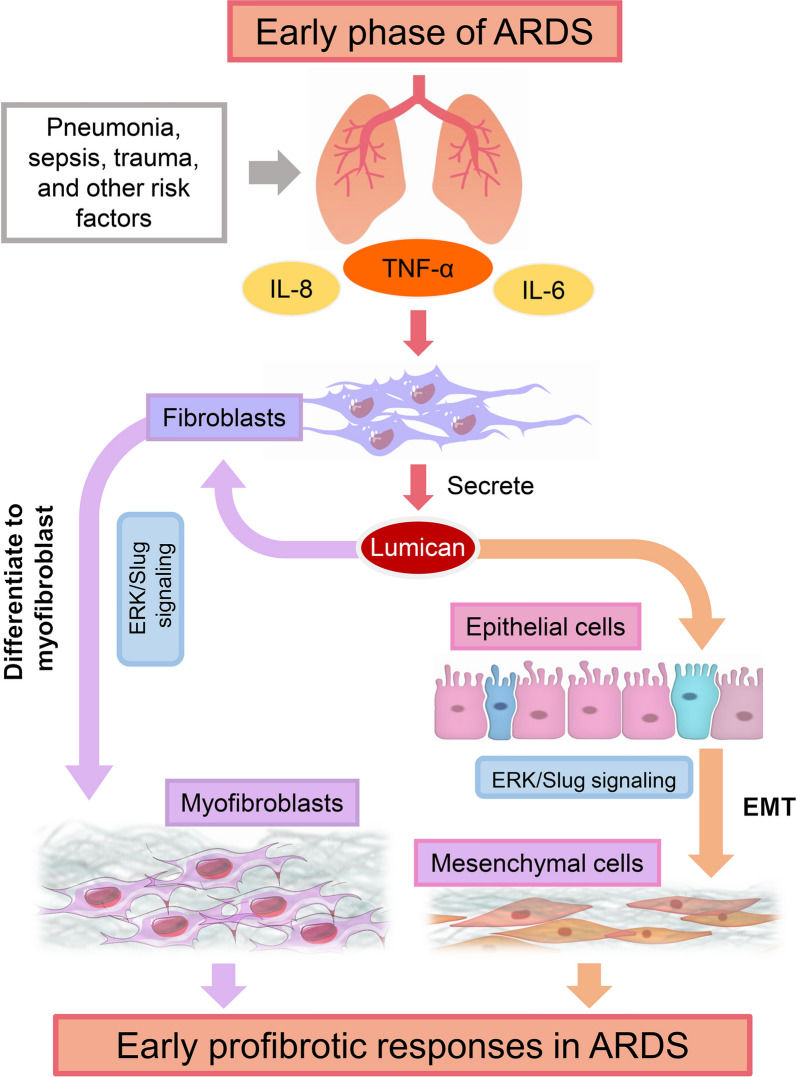 Fig. 1 Full signaling schematic for studying Lumican ERK/Slug dual-pathway regulatory function driving early fibrotic responses in acute respiratory distress syndrome lung injury.1
The biological functions of keratan sulfate-modified secreted Lumican proteoglycan are fully focused on collagen fibril crosslinking and TLR4 fibrotic signal amplification:
Creative Biolabs offers high-quality Lumican proteins through optimized mammalian fibroblast expression systems, including full keratan sulfate glycosylated mature protein and core leucine-rich domain variants. These products retain native collagen and TLR4 dual binding activity, suitable for fibrosis and tumor stromal inhibitor screening assays. All Lumican proteins undergo strict quality control to ensure consistent performance and reliable application across matrix research platforms.
Not finding the membrane protein product you need? Contact us to start your one-stop custom service!
Creative Biolabs provides custom-engineered Lumican stable cell lines, including CAF-mimic overexpression and blank empty vector control models. These cell lines are optimized for SLRP proteoglycan profiling and fibrotic migratory signal functional analysis. Each cell line undergoes stringent validation to ensure stable expression profiles during long-term hypoxic co-culture, and can be widely deployed for large-scale anti-fibrosis tumor compound screening experiments.
Not finding the stable cell line product you need? Contact us to start your one-stop custom service!
High-specificity recombinant antibodies targeting Lumican are developed via advanced antibody engineering technologies, with no cross-reactivity with decorin/biglycan SLRP paralogs. These antibodies are validated for fibroblast stromal secretion detection and liver/tumor tissue expression profiling, and can be combined with collagen marker reagents to analyze complete Lumican-collagen matrix complexes in fibroblast models.
Not finding the recombinant antibody product you need? Contact us to start your one-stop custom service!
Beyond catalog products, Creative Biolabs offers specialized custom services for Lumican research:
Lumican is a keratan sulfate SLRP that organizes collagen fibrils and activates TLR4-SMAD signaling to drive fibrosis and tumor stromal invasion.
Lumican acts as a shared biomarker for progressive organ fibrosis and metastatic epithelial malignancies.
No, all Lumican products and services are strictly for research use only, not intended for clinical diagnosis or human therapeutic trials.
Offerings include full-length glycosylated Lumican proteoglycans, isoform-specific detection antibodies and custom stable cell lines for matrix research.
Lumican proteins are validated via collagen fibrillogenesis and TLR4 co-binding functional testing.








