
Creative Biolabs is offering the most comprehensive services for antibody development projects. With strict regulation and effective execution, we are dedicated to providing the most valuable solutions to complete your projects.
HighlightsCreative Biolabs is offering the most comprehensive services for antibody development projects. With strict regulation and effective execution, we are dedicated to providing the most valuable solutions to complete your projects.
HighlightsCreative Biolabs has established a broad range of platforms for developing novel antibodies or equivalents. These cutting-edge technologies enable our scientists to meet your demands from different aspects and tailor the most appropriate solution that contributes to the success of your projects.
HighlightsWith deep understanding in antibody-related realms and extensive project experience, Creative Biolabs offers a variety of references to help you learn more about our capacities and achievements, including infographic, flyer, case study, peer-reviewed publications, and all kinds of knowledge that can assist your projects. You are also welcome to contact us directly for more specific solutions.
HighlightsGet a real taste of Creative Biolabs, one of the most professional custom service providers in the world. We are committed to providing highly customized comprehensive solutions with the best quality to advance your projects.
Highlights Loading...
All listed services and products are For Research Use Only. Do Not use in any diagnostic or therapeutic applications.
MARCHF1 (also called Marchf1) is a membrane-integrated RING-CH E3 ubiquitin ligase encoded by Marchf1 gene, which is widely expressed in dendritic cells, macrophages and B lymphocytes, and mainly located in the membrane structure of endosomes. Different from cytoplasmic RING ubiquitin ligase, MARCHF1 has N-terminal transmembrane helix structure and intracellular RING-CH catalytic domain, which can specifically target MHC II, CD86 and other antigen presenting cell surface receptors and mediate their ubiquitination modification, and finally promote the degradation of target receptors through lysosomal pathway. Under the condition of immune homeostasis, moderate MARCHF1 activity can maintain the balance of MHC II molecule expression level in cell membrane, avoid over-presentation of autoantigen and maintain peripheral immune tolerance. When the body encounters inflammatory stimulation or virus infection, the expression level of MARCHF1 is up-regulated. By down-regulating the abundance of antigen presenting receptor, the adaptive immune overactivation is inhibited and the immune damage caused by excessive inflammation is avoided. Other homologous proteins of MARCH family can't compensate for the ubiquitination regulation function of immune receptor exclusive to MARCHF1. Overexpression of MARCHF1 can significantly weaken the activation ability of T cells, while knocking out MARCHF1 can increase the level of MHC II on the cell surface and amplify the inflammatory immune response, which is the core research target of antigen presentation regulation and immune tolerance targeted drug screening.
MARCHF1 is anchored on the lipid bilayer of the inner body membrane, which plays the role of membrane-located ubiquitin ligase, and relies on the intracellular RING-CH functional motif to recruit E2 ubiquitin-binding enzyme to accurately catalyze the ubiquitination modification of lysine residues in the intracellular segment of immune receptors. Its unique transmembrane localization makes it specifically target cell membrane antigen presenting molecules and form a clear functional differentiation with soluble cytoplasmic E3 ubiquitin ligase. The receptor degradation process mediated by MARCHF1 links the endosome sorting mechanism with the adaptive immune signal attenuation pathway, which can dynamically regulate the antigen presentation level of the body according to the intensity of inflammatory stimulation. This molecule is widely involved in key biological processes such as dendritic cell immune function regulation, virus immune escape and peripheral autoimmune tolerance maintenance. MARCHF1 dysfunction can stabilize MHC II complex in cell membrane and significantly enhance the immune response of antigen-specific T cells. To sum up, MARCHF1 is the key target of membrane ubiquitin enzyme mechanism research and immunomodulatory drug development.
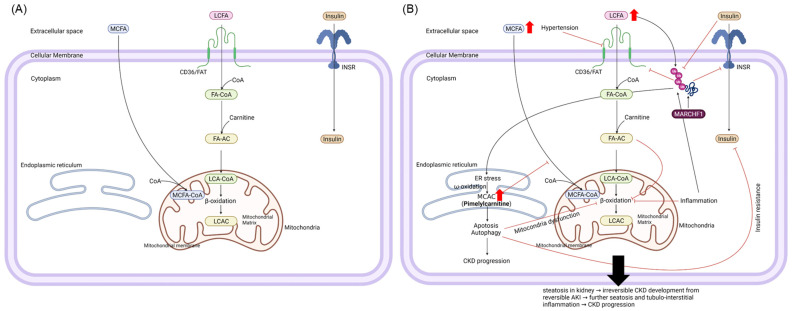 Fig. 1 Graphical Abstract Schematic (A-B): Normal renal tubular lipid-insulin homeostasis and MARCH1-triggered lipotoxic cascade driving insulin resistance and progressive chronic kidney disease.1
The biological functions of MARCHF1 are focused on MHC II ubiquitination and antigen receptor turnover:
Creative Biolabs offers high-quality MARCHF1 proteins through optimized eukaryotic expression systems, including full-length membrane ligase and isolated RING-CH catalytic domain variants. These products retain native immune receptor ubiquitination activity, suitable for antigen presentation and immunomodulator screening assays. All MARCHF1 proteins undergo strict quality control to ensure consistent performance and reliable application across diverse research platforms.
Not finding the membrane protein product you need? Contact us to start your one-stop custom service!
Creative Biolabs provides custom-engineered MARCHF1 stable cell lines, including overexpression and blank control models. These cell lines are optimized for membrane E3 ligase profiling and MHC II trafficking functional analysis. Each cell line undergoes stringent validation to ensure stable expression profiles during continuous cell passages, and can be directly applied to high-throughput immunomodulatory compound screening experiments.
Not finding the stable cell line product you need? Contact us to start your one-stop custom service!
High-specificity recombinant antibodies targeting MARCHF1 are developed via advanced antibody engineering technologies. These antibodies are validated for dendritic cell endosomal membrane immunostaining, and can be combined with MHC II detection reagents to analyze receptor ubiquitination complexes in antigen-presenting cell models.
Not finding the recombinant antibody product you need? Contact us to start your one-stop custom service!
Beyond catalog products, Creative Biolabs offers specialized custom services for MARCHF1 research:
MARCHF1 is a membrane RING-CH E3 ligase that ubiquitinates MHC II and CD86 to trigger their endosomal degradation and suppress antigen presentation.
MARCHF1 acts as a key negative regulator of adaptive immunity, critical for studying autoimmune disorders and viral immune escape mechanisms.
No, all MARCHF1 products and services are strictly for research use only, not intended for clinical diagnosis or treatment.
Offerings include full-length MARCHF1 ligase proteins, isoform-specific detection antibodies and custom stable cell lines for ubiquitination research.
MARCHF1 proteins are validated via MHC II ubiquitination functional testing.








