
Creative Biolabs is offering the most comprehensive services for antibody development projects. With strict regulation and effective execution, we are dedicated to providing the most valuable solutions to complete your projects.
HighlightsCreative Biolabs is offering the most comprehensive services for antibody development projects. With strict regulation and effective execution, we are dedicated to providing the most valuable solutions to complete your projects.
HighlightsCreative Biolabs has established a broad range of platforms for developing novel antibodies or equivalents. These cutting-edge technologies enable our scientists to meet your demands from different aspects and tailor the most appropriate solution that contributes to the success of your projects.
HighlightsWith deep understanding in antibody-related realms and extensive project experience, Creative Biolabs offers a variety of references to help you learn more about our capacities and achievements, including infographic, flyer, case study, peer-reviewed publications, and all kinds of knowledge that can assist your projects. You are also welcome to contact us directly for more specific solutions.
HighlightsGet a real taste of Creative Biolabs, one of the most professional custom service providers in the world. We are committed to providing highly customized comprehensive solutions with the best quality to advance your projects.
Highlights Loading...
All listed services and products are For Research Use Only. Do Not use in any diagnostic or therapeutic applications.
MAS1 proto-oncogene, G protein-coupled receptor (MAS1) is one of the most poorly named receptors in current biology. Blocked decades ago by its sequence association with a viral oncogene, the gene died under suspicion of being an oncogene before anyone had any idea what it did. More interesting than a mere ion channel: MAS1 is a seven-transmembrane GPCR associated with signaling by the endogenous bioactive peptide angiotensin-(1-7) within the renin-angiotensin system. It turns the orphan into a defining element of one of the body most intensively studied hormonal systems—serving as molecular anchor for its counter-regulatory arm. That is the core of what we call MAS1's scientific story counter-regulatory role. Where the classical angiotensin II receptor drives vasoconstriction, inflammation, and tissue remodeling—this system's spacial partner is carboxypeptidase activity from which the proangiotensins derive—we're left with MAS1 axis building anti-inflammatory/vasodilatory/protective tone. The two arms are not opponents as much as they are partners in balance, and the ratio between them has become a leading experimental variable in investigations of cardiovascular homeostasis, renal function metabolic states; and tissue inflammation. Notably, expression of MAS1 also transcends known key brain pathways to include heart, kidney and reproductive tissues further expanding this physiological balancing act across multiple organ systems. MAS1 provides researchers an unusual triptych of history, mechanism and great questions. However, although its ligand assignment is well defined and the complete signal repertoire for this receptor remains to be mapped, the counter-regulatory logic still deserves a quantitative assessment of functional contribution distinct from normal tissue states, while some artifacts of discovery history in labeling it as "proto-oncogene" leave not only great confusion in extraction literature searches but also obscure annotations across databases. MAS1 is classic demanding GPCR territory as a reagent target: conformationally labile, membrane-context dependent and under-served by validated antibody tools in the past. This unique niche of preclinical research could benefit from our integrated protein, cell line and antibody platforms purpose-built to address this need.
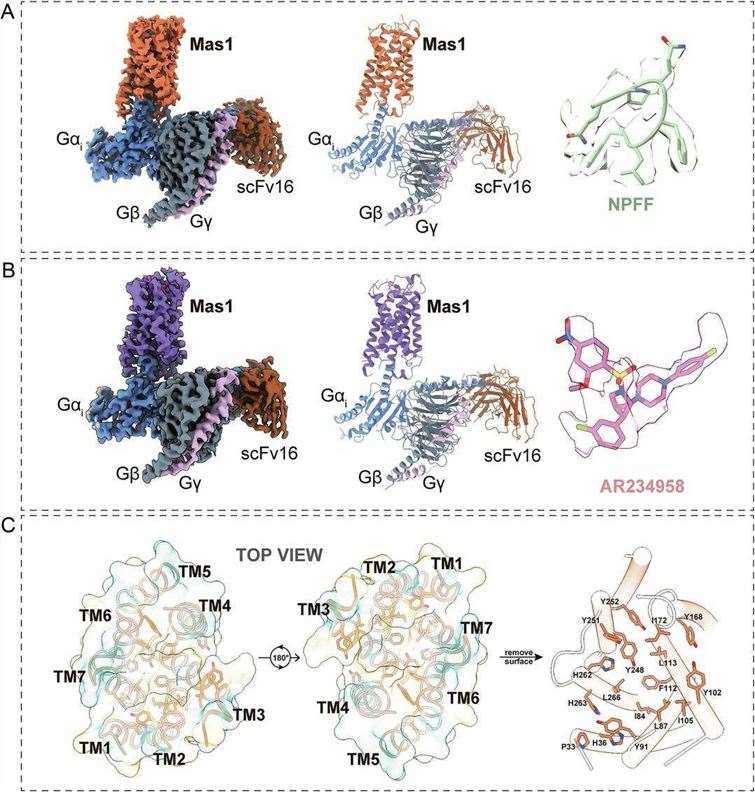 Fig.1 Cryo-EM structures of Mas1 reveal ligand recognition and a predominantly hydrophobic binding pocket.1
Research on MAS1 continues to advance along several converging paths:
We have built our MAS1 membrane protein portfolio on an article of faith: a GPCR can only be considered counter-regulatory if its activation and context in the membrane has survived preparation intact, rationale described here. The ligand pocket, G protein coupling surface and conformational dynamics of MAS1 are conditioned by native lipid surroundings & correct seven-transmembrane architecture. In addition to fulfilling these requirements, we present full-length MAS1 preparations generated by optimized eukaryotic expression systems designed for the preservation of native post-translational modifications and proper folding. Each production lot is characterized for multiple quality attributes: purity by SDS-PAGE, monodispersity via analytical size-exclusion chromatography.
Not finding the membrane protein product you need? Contact us to start your one-stop custom service!
Cellular platforms for MAS1 research must combine controlled receptor density with faithful membrane presentation and peptide-responsive signaling competence, because a counter-regulatory receptor's meaning lies in how it shifts system balance—not merely in how much of it is expressed. We provide customized, high-expressing MAS1 stable cell lines developed through sequence-optimized stable integration, ensuring sustained, uniform surface presentation within reproducible backgrounds. Our collection spans lines stably overexpressing wild-type MAS1 at defined surface-density tiers, and variants carrying engineered substitutions for different investigations. Each clone is released only after exhaustive phenotypic verification.
Not finding the stable cell line product you need? Contact us to start your one-stop custom service!
Advance your MAS1 program with our validated recombinant antibody panel, engineered for specificity and quantitative accuracy across the analytical and functional workflows that peptide GPCR research demands. These high-affinity monoclonal and recombinant clones are raised against epitopes, providing dependable selectivity for MAS1 over the broader GPCR landscape, where sequence diversity within families complicates selective recognition. Each clone is sequence-verified and expressed as a defined recombinant construct, eliminating the lot-to-lot variability and guaranteeing consistency across long-running studies. Validation spans the applications most relevant to MAS1 investigators.
Not finding the recombinant antibody product you need? Contact us to start your one-stop custom service!
Extending well beyond our standard catalog, we deliver fully customizable discovery and manufacturing solutions meticulously tailored to the sophisticated demands of MAS1-targeted research and precompound development:
All MAS1 products and services are provided strictly for preclinical research. They are not designed, validated, or authorized for any use involving human subjects.
A concise description of your application, the format you have in mind, and any acceptance criteria you already hold is enough to begin. Our team will help refine the technical specifics from there.
Catalog items are the quickest route when your application follows routine detection or binding workflows. Custom arrangements become worthwhile when constructs, formats, or quality attributes go beyond standard specifications. A brief consultation usually settles the question.
Yes. Custom format requests and combined protein, cell line, and antibody engagements are routine for us and are managed under unified quality frameworks.









