
Creative Biolabs is offering the most comprehensive services for antibody development projects. With strict regulation and effective execution, we are dedicated to providing the most valuable solutions to complete your projects.
HighlightsCreative Biolabs is offering the most comprehensive services for antibody development projects. With strict regulation and effective execution, we are dedicated to providing the most valuable solutions to complete your projects.
HighlightsCreative Biolabs has established a broad range of platforms for developing novel antibodies or equivalents. These cutting-edge technologies enable our scientists to meet your demands from different aspects and tailor the most appropriate solution that contributes to the success of your projects.
HighlightsWith deep understanding in antibody-related realms and extensive project experience, Creative Biolabs offers a variety of references to help you learn more about our capacities and achievements, including infographic, flyer, case study, peer-reviewed publications, and all kinds of knowledge that can assist your projects. You are also welcome to contact us directly for more specific solutions.
HighlightsGet a real taste of Creative Biolabs, one of the most professional custom service providers in the world. We are committed to providing highly customized comprehensive solutions with the best quality to advance your projects.
Highlights Loading...
All listed services and products are For Research Use Only. Do Not use in any diagnostic or therapeutic applications.
Major facilitator superfamily domain containing 2A (MFSD2A) spent years in the genome's orphan file before two landmark studies in the same issue of the same journal gave it a story worth the wait. The protein is a twelve-transmembrane transporter of the major facilitator superfamily—the largest and most versatile fold in secondary transport—and its address turned out to be as consequential as its chemistry: the luminal surface of endothelial cells lining the brain's microvessels, the very cells that form the blood-brain barrier. At that location, MFSD2A performs a delivery service the brain cannot live without. It transports a specific lysophospholipid carrying the omega-3 fatty acid docosahexaenoic acid across the barrier and into neural tissue, supplying the lipid that roughly a third of the brain's own membrane mass is built from. Remove the transporter, and the brain starves of its signature fatty acid—an outcome whose severity made the discovery immediate headline science. The protein's second act proved equally dramatic. Beyond its transport duty, MFSD2A turned out to be essential for the barrier's very existence. Animals lacking the protein develop a leaky blood-brain barrier, with increased endothelial transcytosis as a defining defect even when tight-junction ultrastructure is largely preserved. One protein, two indispensable jobs: delivering the brain's building blocks and maintaining the wall that protects the brain's environment. This dual identity has made MFSD2A one of the most instructive molecules in modern barrier biology—a transporter whose cargo chemistry and structural role in the barrier cannot be separated.
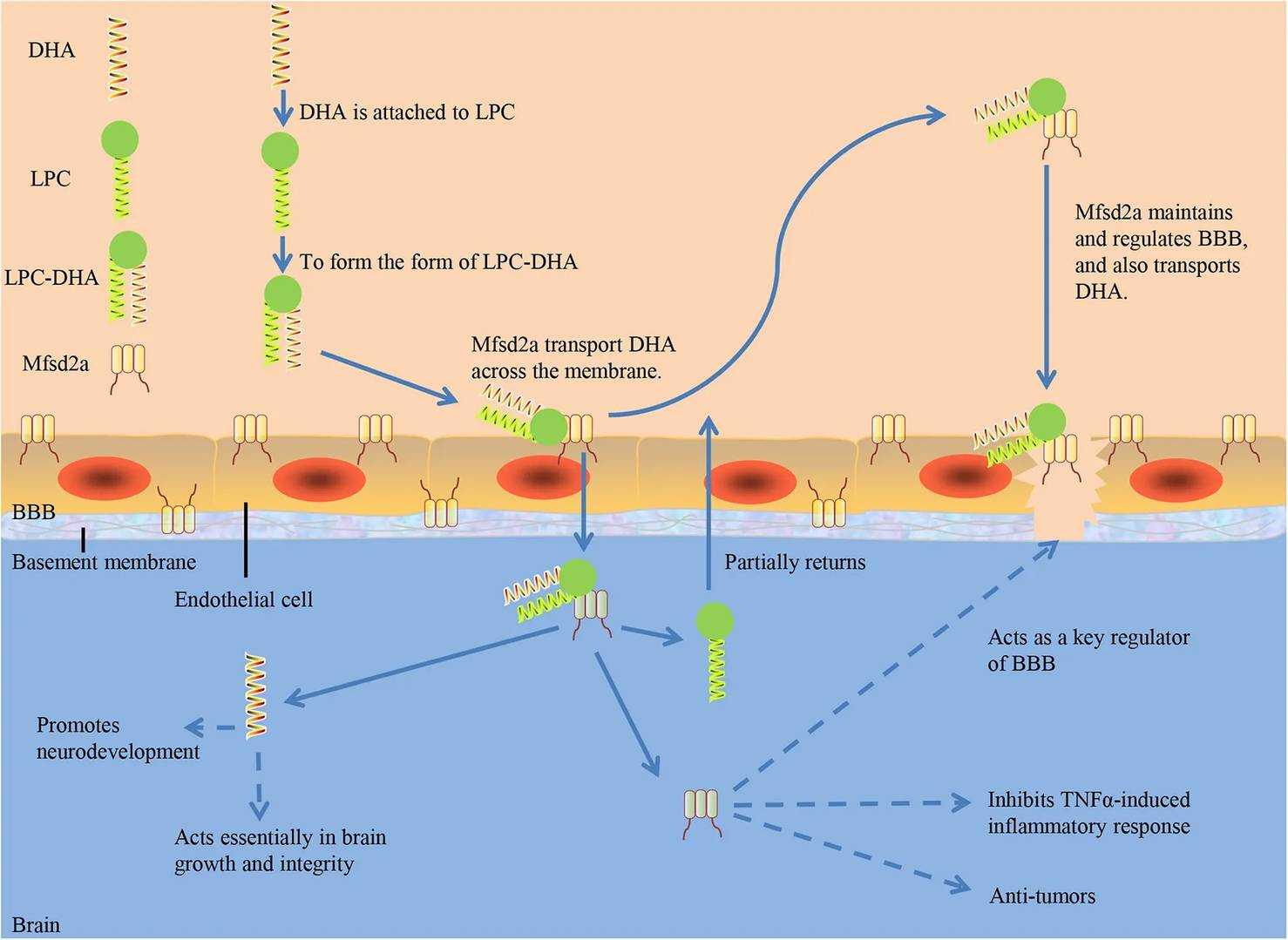 Fig.1 The role of Mfsd2a.1
Several research currents keep converging on this transporter:
To produce functional MFSD2A, the core requirement is to preserve its sodium-coupled operational structure, which forms the basis of its transport function. Simply put, this sodium-binding structure is a prerequisite for MFSD2A to work properly. If the protein loses its ability to engage in functional coupling, or is incorrectly oriented when embedded in the membrane, all core uptake experiments designed to collect valid experimental data will fail—even if the protein passes routine purity tests—meaning this batch of protein is completely unusable for rigorous research. We use an optimized eukaryotic expression system to produce the protein. Every batch of product undergoes SDS-PAGE testing to confirm purity before it leaves the factory. If your project requires a specific protein variant background, designated ionic environment, or a formulation compatible with a certain type of uptake experiment, we can adjust the product's form to fit your experimental workflow, so the protein preparation aligns with your experimental design, and our product will never disrupt your experimental schedule.
Not finding the membrane protein product you need? Contact us to start your one-stop custom service!
Cell models used to study MFSD2A must meet two criteria simultaneously: appropriate protein expression density, and the ability to simulate a barrier environment. After all, MFSD2A is strongly enriched in CNS barrier endothelium, and its functional state is inherently tied to the barrier environment of endothelial cells. If you study this transporter outside its native endothelial cell environment, the cell model you select must compensate for the native conditions missing in the artificial experimental setting; otherwise, the protein cannot fulfill its original function. The wild-type overexpressing cell lines and site-edited variant clones we provide allow researchers to explore the core operational mechanism of this protein under controlled conditions. Every cell clone completes all characterization tests before delivery. Before you begin any experimental operations, the baseline performance of this cell line has been fully confirmed, so you will never waste experimental time discovering the cell's expression status is abnormal after receiving it. If your research requires a specific protein variant background, designated expression level, or needs to schedule the protein's induced expression to align with the timeline of your barrier model experiments, our platform can customize and adjust these parameters, and the cell line will be constructed specifically to support the experiments you plan to conduct.
Not finding the stable cell line product you need? Contact us to start your one-stop custom service!
Antibody work on MFSD2A faces two stacked problems: the MFS family shares its twelve-helix scaffold, and the transporter's barrier-localized expression means the accessible sample types—tight microvessel preparations, isolated endothelium, sectioned tissue—are among the most technically demanding in membrane-protein research. Our recombinant panel here is screened for genuine MFSD2A discrimination. Sequence-defined production keeps lot-to-lot performance steady, and where a project needs a different conjugate, validation against a specific sample type, or an adjustment in clone format to fit a particular workflow, that can be arranged on request—the panel flexes to meet the experimental design it serves.
Not finding the recombinant antibody product you need? Contact us to start your one-stop custom service!
Extending well beyond our standard catalog, we deliver fully customizable discovery and manufacturing solutions meticulously tailored to the sophisticated demands of MFSD2A-targeted research and precompound development:
Its dense expression at the blood-brain barrier—and presence at other selective interfaces—means its physiology is inseparable from barrier biology. Formats are built to serve barrier-model experiments where the native context is reproduced as faithfully as practical.
Transport behavior depends on the sodium gradient and its maintenance during measurement. Ionic conditions are treated as design variables rather than background constants, and verified preparations are characterized under defined sodium conditions.
Loss-of-function models produce striking phenotypes—barrier leak and lipid starvation—that map directly onto the protein's two roles. Graded variants extend this mapping to intermediate function levels.
All MFSD2A products and services are provided strictly for preclinical research. They are not designed, validated, or authorized for any use involving human subjects.









