
Creative Biolabs is offering the most comprehensive services for antibody development projects. With strict regulation and effective execution, we are dedicated to providing the most valuable solutions to complete your projects.
HighlightsCreative Biolabs is offering the most comprehensive services for antibody development projects. With strict regulation and effective execution, we are dedicated to providing the most valuable solutions to complete your projects.
HighlightsCreative Biolabs has established a broad range of platforms for developing novel antibodies or equivalents. These cutting-edge technologies enable our scientists to meet your demands from different aspects and tailor the most appropriate solution that contributes to the success of your projects.
HighlightsWith deep understanding in antibody-related realms and extensive project experience, Creative Biolabs offers a variety of references to help you learn more about our capacities and achievements, including infographic, flyer, case study, peer-reviewed publications, and all kinds of knowledge that can assist your projects. You are also welcome to contact us directly for more specific solutions.
HighlightsGet a real taste of Creative Biolabs, one of the most professional custom service providers in the world. We are committed to providing highly customized comprehensive solutions with the best quality to advance your projects.
Highlights Loading...
All listed services and products are For Research Use Only. Do Not use in any diagnostic or therapeutic applications.
The MPZ gene at 1q23.3 encodes myelin protein zero (P0), the most abundant protein of peripheral nerve myelin comprising over half of total myelin protein and a member of the immunoglobulin superfamily. MPZ is a single-pass type I transmembrane glycoprotein, with a large extracellular immunoglobulin-like domain, a single transmembrane helix, and a basic cytoplasmic tail that interacts with acidic lipids on the opposing membrane face. Its molecular weight is approximately 28 kDa and it is specifically expressed in myelinating Schwann cells of the peripheral nervous system, where it localizes to compact myelin. As the major adhesion molecule of peripheral myelin, P0 mediates homophilic interactions between adjacent myelin wraps via its extracellular Ig-like domain, forming homotetramers that drive myelin compaction essential for rapid nerve conduction. MPZ mutations cause autosomal dominant peripheral neuropathies including Charcot-Marie-Tooth disease type 1B (CMT1B), Dejerine-Sottas syndrome, and congenital hypomyelination neuropathy. Over 200 mutations have been documented, with mechanisms including ER retention and UPR activation, protein mistrafficking, and disrupted adhesion. MPZ mutations account for approximately 10% of demyelinating CMT cases. MPZ is an important target for studying myelin biology, peripheral neuropathy mechanisms, and Schwann cell function, providing tools for understanding myelin compaction and inherited peripheral neuropathies.
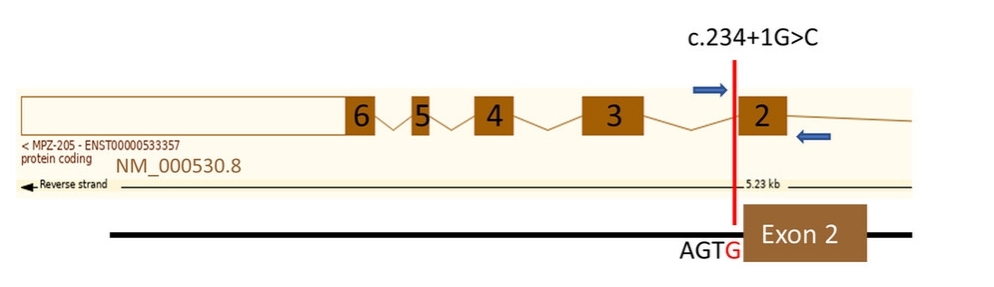 Fig. 1 Schematic representation of the MPZ minigene construct.1
The functional significance of MPZ spans multiple aspects of peripheral nerve biology:
Creative Biolabs offers a series of high-quality MPZ membrane protein products, suitable for structural and functional studies of peripheral myelin biology. Built on the independently developed MemDX™ recombinant membrane protein technology platform, MPZ proteins can be generated through various expression systems, including virus-like particles (VLP) and in vitro prokaryotic expression systems. These thoroughly characterized protein products, such as MemDX™ recombinant human MPZ membrane protein as virus-like particles and human MPZ proteins from diverse expression systems, can be used in ELISA, antibody screening and characterization, protein interaction assays, and functional investigations, providing researchers with reliable tools for analyzing the homophilic adhesion mechanism of P0 and the molecular basis of myelin compaction.
Not finding the membrane protein product you need? Contact us to start your one-stop custom service!
Constructing a robust cell model is essential for investigating the molecular mechanisms of myelin compaction and MPZ-related neuropathy pathogenesis. As the major adhesion molecule mediating homophilic interaction between myelin membranes, the structural integrity of P0 directly determines myelin sheath compaction and axonal integrity. Genetic mutations may lead to substantial differences in adhesion properties and myelinating capacity. Creative Biolabs offers customized MPZ membrane protein stable transfection cell models, encompassing wild-type and disease-associated variant forms. These models express the target protein on the plasma membrane, and are suitable for studies on MPZ homophilic adhesion, analysis of variant-specific trafficking defects, and evaluation of ER stress responses, providing a reliable platform for exploring P0-mediated adhesion, the consequences of CMT-associated mutations, and Schwann cell myelination mechanisms. Our technology ensures cell membrane integrity and correct protein localization, facilitating your research.
Not finding the stable cell line product you need? Contact us to start your one-stop custom service!
Creative Biolabs offers highly specific recombinant antibodies targeting MPZ, manufactured using advanced recombinant antibody technology. Compared to traditional antibodies, these recombinant antibodies deliver improved performance in specificity, sensitivity, and batch-to-batch consistency. They also support various modifications and labeling strategies. Our MPZ recombinant antibodies are suitable for a broad range of applications, including Western Blot, ELISA, flow cytometry, immunofluorescence, immunocytochemistry, immunohistochemistry, and immunoprecipitation, and can be used to examine MPZ expression levels in Schwann cells and peripheral nerve tissues, analyze its subcellular localization at the plasma membrane and within compact myelin, and conduct related investigations such as protein interaction studies and myelin compaction analysis. These antibodies provide dependable detection reagents for the structural characterization, functional investigation of MPZ, and the analysis of its role in peripheral nerve myelination and adhesion.
Not finding the recombinant antibody product you need? Contact us to start your one-stop custom service!
In addition to the standard products, Creative Biolabs also offers professional customized services for MPZ. MPZ has multiple documented genetic variants with functional differences, including CMT1B-associated mutations causing protein misfolding, mistrafficking, or adhesion defects. These variants present specific requirements in protein expression, trafficking analysis, and functional characterization. Leveraging our technology platform, we can assist you in completing the following customized projects:
MPZ encodes myelin protein zero (P0), the most abundant protein in peripheral nerve myelin, which functions as a homophilic adhesion molecule mediating compaction between adjacent myelin wraps. Its extracellular immunoglobulin-like domain forms tetramers that interlock across the intraperiod line, maintaining the multilamellar myelin structure essential for rapid saltatory conduction. P0 is specifically expressed in myelinating Schwann cells and is required for myelin sheath formation and long-term axonal integrity.
MPZ is the gene responsible for Charcot-Marie-Tooth disease type 1B (CMT1B) and related peripheral neuropathies, with over 200 documented disease-causing mutations. Studying MPZ provides insight into the molecular mechanisms of myelin compaction, the structural determinants of homophilic adhesion, and the diverse pathomechanisms—including ER stress, protein mistrafficking, and adhesion defects—by which mutations cause peripheral nerve disease. MPZ is therefore a target of significant interest in myelin biology and inherited neuropathy research.
Not applicable. All MPZ products and services provided by Creative Biolabs are for research purposes only and cannot be used for any clinical diagnosis, prevention, treatment or cure of any disease.
We offer a variety of product types, including recombinant MPZ membrane proteins, stable cell models expressing MPZ, high-quality recombinant MPZ antibodies, as well as comprehensive customized services.








