Creative Biolabs is offering the most comprehensive services for antibody development projects. With strict regulation and effective execution, we are dedicated to providing the most valuable solutions to complete your projects.
HighlightsCreative Biolabs is offering the most comprehensive services for antibody development projects. With strict regulation and effective execution, we are dedicated to providing the most valuable solutions to complete your projects.
HighlightsCreative Biolabs has established a broad range of platforms for developing novel antibodies or equivalents. These cutting-edge technologies enable our scientists to meet your demands from different aspects and tailor the most appropriate solution that contributes to the success of your projects.
HighlightsWith deep understanding in antibody-related realms and extensive project experience, Creative Biolabs offers a variety of references to help you learn more about our capacities and achievements, including infographic, flyer, case study, peer-reviewed publications, and all kinds of knowledge that can assist your projects. You are also welcome to contact us directly for more specific solutions.
HighlightsGet a real taste of Creative Biolabs, one of the most professional custom service providers in the world. We are committed to providing highly customized comprehensive solutions with the best quality to advance your projects.
Highlights Loading...
All listed services and products are For Research Use Only. Do Not use in any diagnostic or therapeutic applications.
Mannose receptor C type 2 (MRC2, also known as uPARAP/Endo180) is a type I transmembrane C-type lectin encoded by the MRC2 gene. It is predominantly expressed in fibroblasts and stromal cells. Its extracellular segment contains a fibronectin type II (FNII) domain responsible for direct collagen binding, plus tandem C-type lectin domains where CTLD2 mediates calcium-dependent recognition of glycosylated collagen fragments. MRC2 mediates endocytic uptake of degraded collagen for lysosomal breakdown, acting as the core scavenger receptor maintaining balanced extracellular matrix turnover after tissue injury. Impaired MRC2-dependent collagen clearance may lead to accumulation of interstitial collagen peptides and progressive fibrotic lesions.
MRC2 separates two independent functional modules to sustain ECM homeostasis: the FNII domain directly interacts with collagen backbones, while calcium-stabilized CTLD2 pockets recognize glycan modifications on cleaved collagen fragments to facilitate intracellular degradation. Unlike macrophage-restricted MRC1, MRC2 dominates stromal collagen clearance. Loss of MRC2 ligand-binding capacity disrupts the balance between matrix synthesis and degradation, decoupling wound repair from excessive fibrous tissue deposition. Reduced MRC2 transcription is detected in multiple organ fibrotic tissues, making MRC2 a valuable research target for wound healing, interstitial collagen metabolism and ECM biological studies.
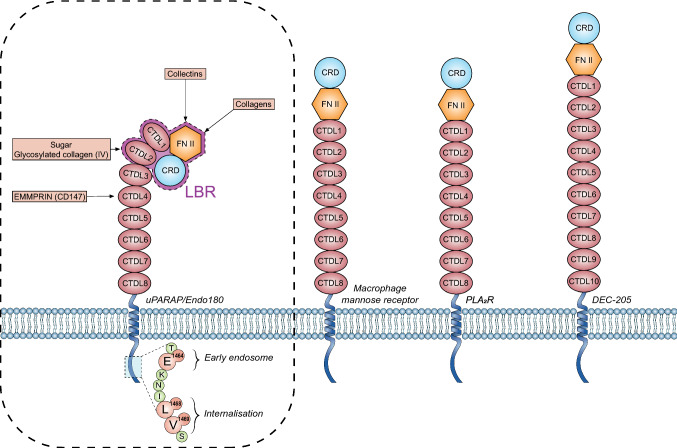 Fig. 1 Domain architecture of mannose receptor family proteins including uPARAP/Endo180 (MRC2). The FNII domain mediates collagen binding, whereas CTLD2 enables calcium-dependent recognition of glycosylated collagen, triggering ligand internalization for lysosomal degradation.1
The biological functions of MRC2 are focused on calcium-dependent glycan recognition and degraded collagen endocytosis:
Creative Biolabs offers high-quality MRC2 proteins through optimized heterologous expression systems, including full-length receptor and isolated domain variants covering collagen-binding FNII region and carbohydrate-recognition modules. These products retain native FNII-collagen binding affinity and calcium-dependent glycan recognition activity, suitable for ECM remodeling and fibrotic mechanism research. All MRC2 batches undergo strict quality control to ensure consistent performance and reliable application across diverse stromal cell research platforms.
Not finding the membrane protein product you need? Contact us to start your one-stop custom service!
Creative Biolabs provides custom-engineered MRC2 stable cell lines, including overexpressing and knockdown stromal cell research models. These cell lines are optimized for investigating collagen clearance mechanisms and fibrotic pathway functional research.
Not finding the stable cell line product you need? Contact us to start your one-stop custom service!
High-specificity recombinant antibodies targeting MRC2 are developed via advanced antibody engineering technologies, with no cross-reactivity with MRC1 paralogs. These antibodies are validated for multiple applications, including stromal cell membrane immunofluorescence localization detection, Western blot expression quantification and co-immunoprecipitation analysis of MRC2-collagen complexes, enabling precise characterization of MRC2 expression levels and cell surface distribution under physiological and fibrotic pathological conditions.
Not finding the recombinant antibody product you need? Contact us to start your one-stop custom service!
Beyond catalog products, Creative Biolabs offers specialized custom services for MRC2 research:
MRC2 uses its FNII domain to bind collagen fragments, while CTLD2 mediates calcium-dependent recognition of collagen glycans; it mediates lysosomal endocytic degradation to maintain balanced extracellular matrix turnover.
MRC2 is the primary stromal collagen clearance receptor, and its downregulation triggers progressive organ fibrosis. It is a critical core research target for ECM and fibrotic disease biology.
No, all MRC2 products and services are strictly for research use only, not intended for clinical diagnosis or treatment.
Offerings include full-length MRC2 receptor proteins, high-specificity recombinant antibodies, and custom stable ECM turnover reporter cell lines, supporting comprehensive fibrotic research projects.
MRC2 proteins are validated via separate FNII-collagen binding and CTLD glycan recognition functional assays.