
Creative Biolabs is offering the most comprehensive services for antibody development projects. With strict regulation and effective execution, we are dedicated to providing the most valuable solutions to complete your projects.
HighlightsCreative Biolabs is offering the most comprehensive services for antibody development projects. With strict regulation and effective execution, we are dedicated to providing the most valuable solutions to complete your projects.
HighlightsCreative Biolabs has established a broad range of platforms for developing novel antibodies or equivalents. These cutting-edge technologies enable our scientists to meet your demands from different aspects and tailor the most appropriate solution that contributes to the success of your projects.
HighlightsWith deep understanding in antibody-related realms and extensive project experience, Creative Biolabs offers a variety of references to help you learn more about our capacities and achievements, including infographic, flyer, case study, peer-reviewed publications, and all kinds of knowledge that can assist your projects. You are also welcome to contact us directly for more specific solutions.
HighlightsGet a real taste of Creative Biolabs, one of the most professional custom service providers in the world. We are committed to providing highly customized comprehensive solutions with the best quality to advance your projects.
Highlights Loading...
All listed services and products are For Research Use Only. Do Not use in any diagnostic or therapeutic applications.
Mitochondrial carrier homolog 2 (MTCH2) is a transmembrane protein encoded by the MTCH2 gene and widely expressed in mammalian tissues. It is integrated into the mitochondrial outer membrane and participates in mitochondrial protein insertion, lipid regulation, and apoptosis-related signaling. MTCH2 facilitates the mitochondrial recruitment of the BH3-only protein tBID, thereby contributing to BAX/BAK-dependent mitochondrial outer membrane permeabilization during apoptotic signaling. In addition, emerging evidence supports insertase and lipid scramblase activities of MTCH2 and its role in regulating cellular lipid metabolism, including pathways associated with CPT1 and fatty acid oxidation, rather than functioning as a direct long-chain fatty acid carrier. Altered MTCH2 function can therefore affect mitochondrial apoptosis, membrane organization, and metabolic homeostasis, making it an important research target for mitochondrial membrane biology, apoptosis, and lipid metabolism.
MTCH2 _ 2 is anchored on the mitochondrial outer membrane network, and plays the dual functions of BH3 apoptosis receptor and fatty acid carrier. By virtue of the conservative hydrophobic transmembrane pocket, it can recognize BH3 domain apoptosis peptide and long-chain lipid substrate synchronously. Its unique mitochondrial outer membrane localization makes it form a clear functional differentiation with the inner membrane metabolic transporter, and it is a specific carrier protein with both apoptosis initiation and lipid transport regulation. The dual regulatory pathway mediated by MTCH2 can closely link cytoplasmic stress signals with mitochondrial lipid metabolism and apoptosis threshold, and dynamically balance cell energy supply and stress-induced cell death sensitivity according to cell nutritional status and DNA damage degree. This protein is widely involved in key physiological and pathological processes such as systemic fatty acid catabolism, DNA damage response and tumor chemotherapy resistance regulation. The loss of MTCH2 function will block BH3-dependent mitochondrial apoptosis activation pathway, and at the same time break the balance of cell lipid metabolism flux. To sum up, MTCH2 is the key target for the study of mitochondrial outer membrane carrier protein mechanism and the development of anti-tumor targeted therapy.
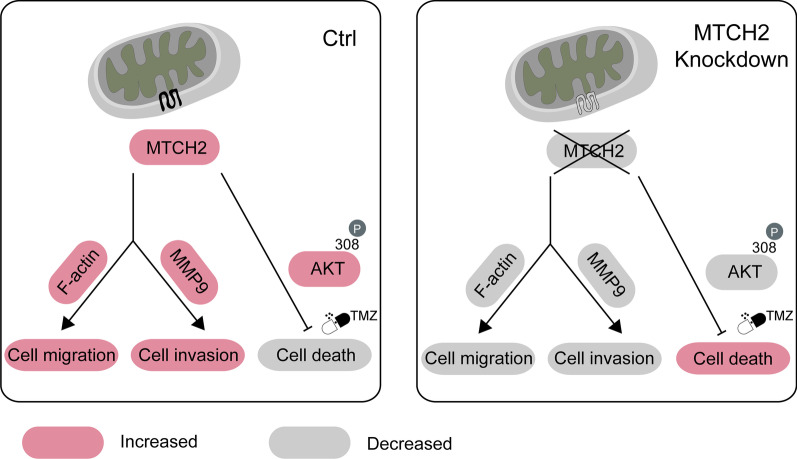 Fig. 1 Schematic comparison of cellular phenotypes between control and MTCH2-knockdown glioblastoma cells, showing the association of MTCH2 with cell migration, invasion, and stress-response signaling through the AKT/MMP9/F-actin axis.1
The biological functions of MTCH2 are fully focused on BH3 apoptotic peptide recognition and fatty acid transmembrane transport:
Creative Biolabs offers high-quality MTCH2 proteins through optimized eukaryotic expression systems, including full-length multi-pass outer mitochondrial carrier and isolated BH3-binding domain variants. These products retain native apoptotic peptide docking and lipid transport biological activity, suitable for mitochondrial apoptosis and lipid metabolic functional screening assays. All MTCH2 proteins undergo strict quality control to ensure consistent performance and reliable application across diverse research platforms.
Not finding the membrane protein product you need? Contact us to start your one-stop custom service!
Creative Biolabs provides custom-engineered MTCH2 stable cell lines, including overexpression and blank empty vector control models. These cell lines are optimized for outer mitochondrial carrier profiling and BH3 apoptotic signal functional analysis. Each cell line undergoes stringent validation to ensure stable expression profiles during long-term continuous cell culture, and can be deployed for mitochondrial targeted anti-tumor compound screening assays.
Not finding the stable cell line product you need? Contact us to start your one-stop custom service!
High-specificity recombinant antibodies targeting MTCH2 are developed via advanced antibody engineering technologies, with no cross-reactivity with inner mitochondrial solute carrier proteins. These antibodies are validated for outer mitochondrial membrane localization detection and hepatic/tumor tissue expression profiling, and can be combined with BAX marker reagents to analyze complete MTCH2-BH3 apoptotic complexes in cell models.
Not finding the recombinant antibody product you need? Contact us to start your one-stop custom service!
Beyond catalog products, Creative Biolabs offers specialized custom services for MTCH2 research:
MTCH2 is an outer mitochondrial carrier that acts as BH3 protein docking receptor to trigger apoptosis while shuttling fatty acids into mitochondria.
MTCH2 couples lipid metabolism and mitochondrial cell death, its downregulation drives tumor chemoresistance in multiple solid malignancies.
No, all MTCH2 products and services are strictly for research use only, not intended for clinical diagnosis or human therapeutic trials.
Offerings include full-length outer mitochondrial MTCH2 carrier proteins, isoform-specific detection antibodies and custom stable cell lines for mitochondrial research.
MTCH2 proteins are validated via BH3 peptide co-binding and fatty acid transport functional testing.








