Creative Biolabs is offering the most comprehensive services for antibody development projects. With strict regulation and effective execution, we are dedicated to providing the most valuable solutions to complete your projects.
HighlightsCreative Biolabs is offering the most comprehensive services for antibody development projects. With strict regulation and effective execution, we are dedicated to providing the most valuable solutions to complete your projects.
HighlightsCreative Biolabs has established a broad range of platforms for developing novel antibodies or equivalents. These cutting-edge technologies enable our scientists to meet your demands from different aspects and tailor the most appropriate solution that contributes to the success of your projects.
HighlightsWith deep understanding in antibody-related realms and extensive project experience, Creative Biolabs offers a variety of references to help you learn more about our capacities and achievements, including infographic, flyer, case study, peer-reviewed publications, and all kinds of knowledge that can assist your projects. You are also welcome to contact us directly for more specific solutions.
HighlightsGet a real taste of Creative Biolabs, one of the most professional custom service providers in the world. We are committed to providing highly customized comprehensive solutions with the best quality to advance your projects.
Highlights Loading...
All listed services and products are For Research Use Only. Do Not use in any diagnostic or therapeutic applications.
NALCN (sodium leak channel, non-selective), also known as CanIon or VGCNL1, is encoded by the NALCN gene on chromosome 13q32.3–q33.1. The gene spans about 363 kb and contains 44 exons. NALCN belongs to the four-domain voltage-gated cation channel family, which also includes voltage-gated sodium (NaV) and calcium (CaV) channels. The protein adopts the canonical architecture of this family: four homologous domains (DI–DIV), each with six transmembrane segments (S1–S6) and a pore loop. Cryo-EM structures of human NALCN in complex with its auxiliary subunit FAM155A have been solved, revealing an extracellular dome formed by FAM155A that shields the ion-selectivity filter from neurotoxin attack, as well as unusual voltage-sensor domains with asymmetric linkages to the pore. NALCN is expressed mainly in the brain, with high levels in cerebellum, cortex, brainstem, striatum, substantia nigra, and spinal cord; it is not detected in liver, skeletal muscle, bone marrow, or adipose tissue.
NALCN forms a voltage-independent, non-selective, non-inactivating cation channel permeable to Na⁺, K⁺, and Ca²⁺. It carries the major background sodium leak conductance in neurons, helping set the resting membrane potential and regulating neuronal excitability. NALCN is the pore-forming α subunit of a large complex known as the NALCN channelosome, which also contains the auxiliary subunits UNC79, UNC80, and FAM155A (NLF-1). The channel is activated by substance P and neurotensin through a mechanism that requires UNC80 and Src family kinases, rather than G protein activation. NALCN-mediated currents regulate several key physiological processes in the nervous system, including respiratory rhythm, circadian rhythm, sleep, and locomotor behavior. Mutations in NALCN cause severe neurological disorders, such as congenital contractures of the limbs and face with hypotonia and developmental delay (CLIFAHDD syndrome) and infantile hypotonia with psychomotor retardation and characteristic facies (IHPRF). NALCN is therefore a useful target for research on neuronal excitability, resting membrane potential regulation, ion channel biophysics, and the molecular mechanisms underlying NALCN channelopathies.
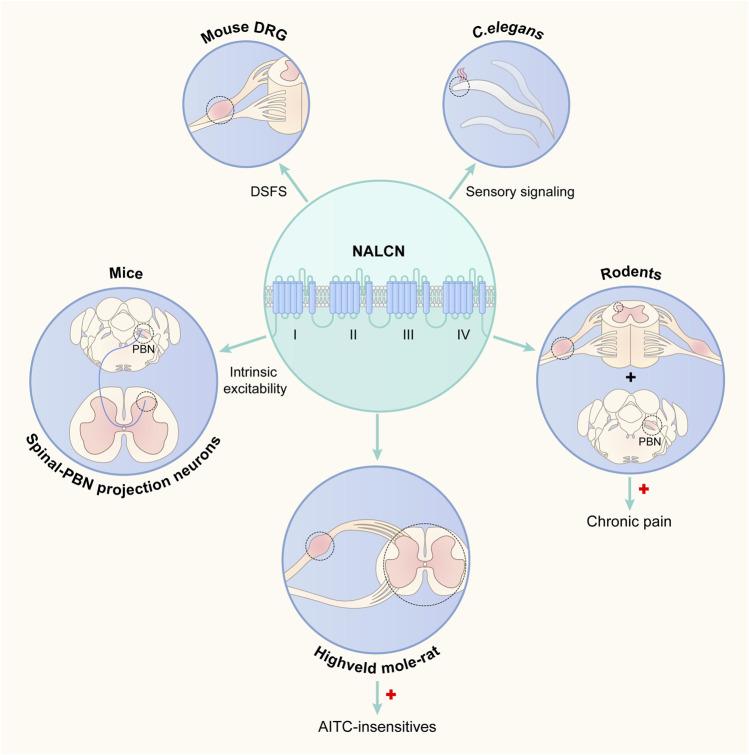 Fig. 1 Schematic plot of the association between the NALCN and sensation.1
NALCN, encoded by the NALCN gene, functions as the pore-forming α subunit of a voltage-independent cation channel complex that regulates neuronal excitability:
Creative Biolabs offers high-quality NALCN membrane protein products produced using optimized expression systems. These include full-length multi-pass transmembrane protein that retains the native four-domain architecture and pore region, as well as isolated domain variants. The four-domain voltage-gated cation channel architecture and pore-forming region mediate ion permeation and channel gating, making these proteins suitable for studies of ion channel biophysics, channelosome assembly, and functional characterization. All NALCN proteins undergo strict quality control to support consistent performance across applicable research platforms.
Not finding the protein product you need? Contact us to start your one-stop custom service!
Creative Biolabs provides custom-engineered NALCN stable cell lines, including overexpression and knockdown models. These cell lines are optimized for studies of sodium leak conductance, neuronal excitability, resting membrane potential regulation, and channelosome function. Each cell line undergoes stringent validation to ensure stable expression profiles and consistent functional performance in diverse experimental contexts.
Not finding the stable cell line product you need? Contact us to start your one-stop custom service!
High-specificity recombinant antibodies targeting NALCN are developed using antibody engineering technologies for research applications involving NALCN expression and localization. These antibodies can be used in studies of NALCN distribution in neuronal tissues and may also support characterization of NALCN-containing channelosome complexes in combination with appropriate detection reagents.
Not finding the recombinant antibody product you need? Contact us to start your one-stop custom service!
Beyond catalog products, Creative Biolabs offers specialized custom services for NALCN research:
NALCN is a voltage-independent, non-selective cation channel that mediates the major background sodium leak conductance in neurons, contributing to resting membrane potential and regulating neuronal excitability and rhythmic behaviors.
NALCN sets neuronal resting membrane potential and regulates respiration, circadian rhythm, and locomotion; its mutations cause severe neurodevelopmental disorders, making it important for ion channel and channelopathy research.
No, all NALCN products and services are strictly for research use only, not intended for clinical diagnosis or treatment.
Offerings include full-length NALCN membrane proteins, domain variants, specific detection antibodies, and custom stable cell lines for ion channel and neuronal excitability research.
NALCN proteins are validated via ion channel activity assays, membrane potential assays, and relevant functional characterization in applicable research platforms.