Creative Biolabs is offering the most comprehensive services for antibody development projects. With strict regulation and effective execution, we are dedicated to providing the most valuable solutions to complete your projects.
HighlightsCreative Biolabs is offering the most comprehensive services for antibody development projects. With strict regulation and effective execution, we are dedicated to providing the most valuable solutions to complete your projects.
HighlightsCreative Biolabs has established a broad range of platforms for developing novel antibodies or equivalents. These cutting-edge technologies enable our scientists to meet your demands from different aspects and tailor the most appropriate solution that contributes to the success of your projects.
HighlightsWith deep understanding in antibody-related realms and extensive project experience, Creative Biolabs offers a variety of references to help you learn more about our capacities and achievements, including infographic, flyer, case study, peer-reviewed publications, and all kinds of knowledge that can assist your projects. You are also welcome to contact us directly for more specific solutions.
HighlightsGet a real taste of Creative Biolabs, one of the most professional custom service providers in the world. We are committed to providing highly customized comprehensive solutions with the best quality to advance your projects.
Highlights Loading...
All listed services and products are For Research Use Only. Do Not use in any diagnostic or therapeutic applications.
Nerve growth factor receptor (NGFR), also called p75 neurotrophin receptor (p75NTR), low-affinity nerve growth factor receptor, or CD271 is a 75 kDa type I transmembrane glycoprotein and member of the tumor necrosis factor superfamily. In contrast to receptor tyrosine kinases, p75NTR signals via recruitment of adaptor proteins and regulated proteolytic processing. NGFR has a characteristic role as a promiscuous receptor binding all mammalian neurotrophins—nerve growth factor (NGF), brain-derived neurotrophic factor (BDNF,) neurotrophin-3 (NT-3) and the other member of NT family named Neurotrophine 4/5— with broad range low affinity. It is also the high affinity receptor for immature pro-neurotrophin forms (proNGF, proBDNF), when in complex with sortilin. This dual ligand specificity makes NGFR suitable to act as a molecular switch, directing cells towards survival, differentiation, apoptosis or axonal growth depending on the local concentration of cognate ligands and co-receptors available. Pleiotropic biological relevance: The receptor is expressed in neurons, Schwann cells, melanocytes, mesenchymal stem cells and an increasing list of non-neuronal cell types.
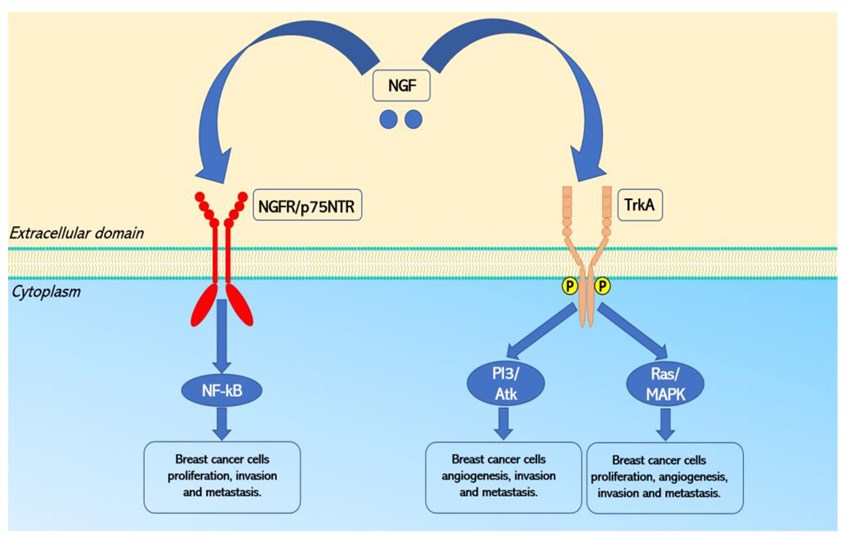 Fig.1 Signaling pathways activated by NGF in breast cancer.1
The functional repertoire of NGFR spans many interconnected biological domains:
Our recombinant NGFR protein catalogue supports mechanistic and structural studies of this receptor. The four cysteine-rich domains (CRDs) in the extracellular region, single-pass transmembrane topology, and regulated proteolytic processing of NGFR are important considerations for protein production and experimental design. We provide NGFR constructs and preparations that may include full-length membrane-associated protein, soluble extracellular domain (ECD) constructs, and intracellular domain (ICD) constructs according to specific research requirements. These products can support structural studies, ligand-binding research, antibody development and characterization, and related mechanistic investigations. Expression format, glycosylation status, construct design, and functional characteristics should be determined according to the corresponding product information.
Not finding the membrane protein product you need? Contact us to start your one-stop custom service!
That is why reliable and reproducible cellular models are generally required to understand NGFR-driven biology, as well to evaluate target candidates. Featured stable cell lines with wild-type or engineered mouse and rat NGFR; Cell lines expressing altered endogenous levels of the receptor for loss-of-function studies. Other platforms are optimized for high-throughput ligand screening, neurite outgrowth quantification, and apoptosis assays, providing the experimental reproducibility necessary to increase throughput in multi-phase research programs with co-culture models involving primary neurons or Schwann cells.
Not finding the stable cell line product you need? Contact us to start your one-stop custom service!
We offer a diverse range of high-affinity recombinant antibodies against NGFR that are ideal for stringent experimental use. Nonetheless, these antibodies are developed utilizing modern recombinant technologies that provide improved specificity, sensitivity and batch-to-batch consistency over traditional polyclonal antibodies. These NGFR recombinant antibodies are targeted and validated for WB, ELISA, FCM, IF (immunofluorescence), ICC (Immunocytochemistry), IHC Immunoprecipitation of Cancer Immunohistochemical tumor tissue staining) detection using neuronal lysates; melanoma tumours or purified Schwann cells.
Not finding the recombinant antibody product you need? Contact us to start your one-stop custom service!
In addition to our catalog products, we provide custom services for membrane protein and antibody discovery and development. Drawing on our deep understanding of neurotrophin receptor biology and regenerative medicine to help you with:
NGFR is implicated in neurodegenerative diseases (Alzheimer's, ALS, glaucoma), traumatic brain and spinal cord injury, and melanoma progression. Pharmacological modulators that block pro-neurotrophin toxicity, inhibit receptor oligomerization, or prevent axonal growth cone collapse are under active preclinical and clinical investigation.
No, all NGFR products and services are strictly for research use only.
Our catalog includes rabbit, mouse, and rat NGFR reagents. Custom production of additional orthologs or engineered mutants—including cleavage-resistant variants and CRD-specific truncations—can be arranged upon request.
Yes. We accommodate academic and industrial scale-up requirements with flexible pricing tiers. Please submit your projected volume and timeline through our inquiry portal to receive a tailored quotation.