Creative Biolabs is offering the most comprehensive services for antibody development projects. With strict regulation and effective execution, we are dedicated to providing the most valuable solutions to complete your projects.
HighlightsCreative Biolabs is offering the most comprehensive services for antibody development projects. With strict regulation and effective execution, we are dedicated to providing the most valuable solutions to complete your projects.
HighlightsCreative Biolabs has established a broad range of platforms for developing novel antibodies or equivalents. These cutting-edge technologies enable our scientists to meet your demands from different aspects and tailor the most appropriate solution that contributes to the success of your projects.
HighlightsWith deep understanding in antibody-related realms and extensive project experience, Creative Biolabs offers a variety of references to help you learn more about our capacities and achievements, including infographic, flyer, case study, peer-reviewed publications, and all kinds of knowledge that can assist your projects. You are also welcome to contact us directly for more specific solutions.
HighlightsGet a real taste of Creative Biolabs, one of the most professional custom service providers in the world. We are committed to providing highly customized comprehensive solutions with the best quality to advance your projects.
Highlights Loading...
All listed services and products are For Research Use Only. Do Not use in any diagnostic or therapeutic applications.
Neuroligin 4 Y-linked (NLGN4Y), also known as HNL4Y or KIAA0951, is encoded by the NLGN4Y gene on chromosome Yq11.221. NLGN4Y gene spans approximately 324 kb and contains 6 exons, its produced a protein of about 816 amino acids with a calculated molecular mass of roughly 92 kDa. NLGN4Y is a type I transmembrane protein and a member of the neuroligin family of postsynaptic cell adhesion molecules. Its domain architecture includes a large extracellular N-terminal domain with homology to acetylcholinesterase (the COesterase domain), a single transmembrane region, and a short cytoplasmic tail. NLGN4Y's extracellular domain contains conserved N-glycosylation sites, while the cytoplasmic tail carries a PDZ-binding motif that mediates interactions with postsynaptic scaffolding proteins. NLGN4Y is expressed in fetal and adult brain, prostate, and testis. Surface or dendritic localization is cell-context-dependent; NLGN4Y exhibits markedly limited maturation and cell-surface trafficking in several studied expression models, with substantial ER retention.
NLGN4Y forms an X-Y gene pair with NLGN4X, sharing approximately 97% amino acid sequence identity. Despite this high similarity, the two proteins differ functionally due to individual amino acid differences at key sites. In several published cell-expression models, NLGN4Y exhibits impaired maturation and cell-surface trafficking with substantial retention in the endoplasmic reticulum. In those experimental systems, NLGN4Y showed reduced ability to support synapse formation or excitatory synaptic transmission compared with NLGN4X. Heterodimerization of NLGN4Y with NLGN1, 2, 3, or 4X decreases their maturation and synaptic strength, indicating that NLGN4Y acts as a negative regulator of other neuroligins. The inability of NLGN4Y to compensate for NLGN4X deficits has been proposed as one possible explanation for sex-associated differences in NLGN4X-related neurodevelopmental phenotypes. A cluster of ASD-associated variants in NLGN4X surrounds the critical amino acid and phenocopies the trafficking deficit seen in NLGN4Y. NLGN4Y has also been identified as a negative regulator of prostate cancer progression, where lower expression is associated with higher tumor grade and increased risk of biochemical recurrence. These features make NLGN4Y an important research target for studies of synaptic adhesion molecule biology, neuroligin trafficking, and the molecular mechanisms underlying sex differences in neurodevelopmental disorders.
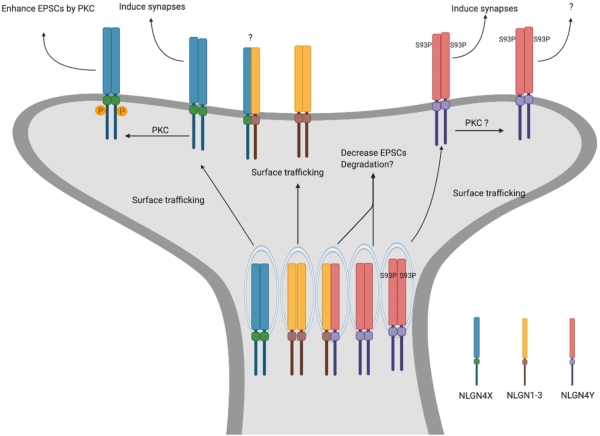 Fig. 1 NLGN4X and NLGN4Y function.1
NLGN4Y, encoded by the NLGN4Y gene, functions as a postsynaptic adhesion molecule that regulates synaptic organization and interacts with other neuroligins:
Creative Biolabs offers high-quality NLGN4Y membrane protein products produced using optimized expression systems. These include full-length type I transmembrane protein that retains the native extracellular COesterase domain, transmembrane region, and cytoplasmic PDZ-binding motif, as well as isolated extracellular domain variants. The extracellular COesterase domain mediates neurexin binding and cell adhesion, while the cytoplasmic tail mediates interactions with postsynaptic scaffolding proteins, making extracellular fragments useful for neurexin-binding and structural studies, while cell-surface trafficking and synaptic function require full-length protein in appropriately validated cell models. All NLGN4Y proteins undergo strict quality control to support consistent performance across applicable research platforms.
Not finding the protein product you need? Contact us to start your one-stop custom service!
Creative Biolabs provides custom-engineered NLGN4Y stable cell lines, including overexpression and knockdown models. These cell lines are optimized for studies of neuroligin trafficking, synaptic adhesion, heterodimerization with other neuroligins, and NLGN4Y-associated neurodevelopmental mechanisms. Each cell line undergoes stringent validation to ensure stable expression profiles and consistent functional performance in diverse experimental contexts.
Not finding the stable cell line product you need? Contact us to start your one-stop custom service!
Recombinant antibodies targeting NLGN4Y are developed using antibody engineering techniques for research applications involving NLGN4Y expression and localization. These antibodies can be used in studies of NLGN4Y distribution in brain and other tissues and may also support characterization of NLGN4Y-containing heterodimeric complexes in combination with appropriate detection reagents.
Not finding the recombinant antibody product you need? Contact us to start your one-stop custom service!
Beyond catalog products, Creative Biolabs offers specialized custom services for NLGN4Y research:
NLGN4Y is a Y-linked postsynaptic cell adhesion molecule that binds neurexins and interacts with other neuroligins. Unlike NLGN4X, it is retained in the endoplasmic reticulum due to a trafficking deficit and cannot effectively induce synapse formation.
NLGN4Y forms an X-Y pair with NLGN4X and cannot compensate for NLGN4X deficits, contributing to the male bias in NLGN4X-associated autism spectrum disorder. It also regulates prostate cancer progression, making it important for studies of synaptic biology and neurodevelopmental disorders.
No, all NLGN4Y products and services are strictly for research use only, not intended for clinical diagnosis or treatment.
Offerings include full-length NLGN4Y membrane proteins, extracellular domain variants, specific detection antibodies, and custom stable cell lines for synaptic adhesion and neuroligin trafficking research.
NLGN4Y proteins may support research on neurexin binding and protein-protein interaction, depending on protein format and experimental context.