Creative Biolabs is offering the most comprehensive services for antibody development projects. With strict regulation and effective execution, we are dedicated to providing the most valuable solutions to complete your projects.
HighlightsCreative Biolabs is offering the most comprehensive services for antibody development projects. With strict regulation and effective execution, we are dedicated to providing the most valuable solutions to complete your projects.
HighlightsCreative Biolabs has established a broad range of platforms for developing novel antibodies or equivalents. These cutting-edge technologies enable our scientists to meet your demands from different aspects and tailor the most appropriate solution that contributes to the success of your projects.
HighlightsWith deep understanding in antibody-related realms and extensive project experience, Creative Biolabs offers a variety of references to help you learn more about our capacities and achievements, including infographic, flyer, case study, peer-reviewed publications, and all kinds of knowledge that can assist your projects. You are also welcome to contact us directly for more specific solutions.
HighlightsGet a real taste of Creative Biolabs, one of the most professional custom service providers in the world. We are committed to providing highly customized comprehensive solutions with the best quality to advance your projects.
Highlights Loading...
All listed services and products are For Research Use Only. Do Not use in any diagnostic or therapeutic applications.
NPHS2 (podocin) is a lipid raft-associated stomatin family membrane protein encoded by the NPHS2 gene and highly enriched at the slit diaphragm of glomerular podocytes. Unlike widely expressed stomatin family members, podocin acts as a scaffold that interacts with slit diaphragm proteins such as nephrin and NEPH1, contributing to the structural integrity of the glomerular filtration barrier and limiting urinary loss of plasma proteins. Under physiological conditions, NPHS2 supports slit diaphragm organization and selective glomerular filtration. Biallelic pathogenic variants in NPHS2 can cause autosomal recessive steroid-resistant nephrotic syndrome (SRNS), often associated with focal segmental glomerulosclerosis (FSGS), with variable age of onset and disease severity. Other stomatin family members cannot fully compensate for the podocyte-specific function of NPHS2. Altered NPHS2 expression or function is also associated with podocyte injury and proteinuria, making it an important research target for podocyte biology and hereditary glomerular disease studies.
NPHS2 is anchored in the lipid raft region of podocyte podocyte membrane lipid bilayer, which plays a specific role in scaffold anchoring, forms a stable homodimer by relying on the conserved stomatin domain, physically bridges the nephrin-NEPH1 complex, and stabilizes the adhesion structure of the fissure membrane. Its strict glomerular tissue localization and lipid raft targeting characteristics form a clear functional differentiation with stomatin homologous protein distributed in pan-tissue, giving it exclusive ability to regulate renal filtration barrier. The cell connection stability mechanism mediated by NPHS2 can link podocyte cytoskeleton remodeling and glomerular filtration selectivity, and dynamically maintain the integrity of filtration barrier according to the development stage and injury degree of kidney. This molecule is involved in the differentiation and development of embryonic renal podocytes and the lifelong maintenance of adult glomerular filtration function. The expression defect or gene mutation of NPHS2 will completely destroy the diaphragm structure of hiatus and induce pathological proteinuria. To sum up, NPHS2 is a key research target for the study of podocyte membrane protein mechanism and the development of therapeutic targets for hereditary nephropathy.
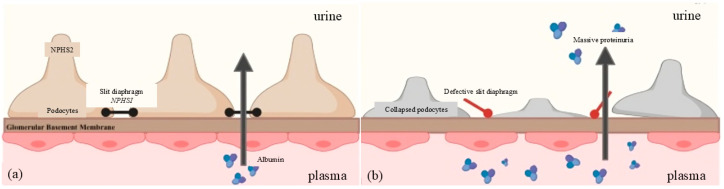 Fig. 1 Graphical Abstract Schematic (a-b): Comparison of intact glomerular filtration barrier with normal NPHS2 podocin expression and defective slit diaphragm induced by NPHS2 deficiency leading to podocyte collapse and massive proteinuria.1
The biological functions of NPHS2 are fully focused on glomerular slit diaphragm complex assembly and renal filtration barrier protection:
Creative Biolabs offers high-quality NPHS2 proteins through optimized eukaryotic expression systems, including full-length podocin transmembrane protein and isolated stomatin scaffold domain variants. These products retain native slit diaphragm complex binding activity, suitable for glomerular barrier and nephropathy inhibitor screening assays. All NPHS2 proteins undergo strict quality control to ensure consistent performance and reliable application across diverse renal research platforms.
Not finding the membrane protein product you need? Contact us to start your one-stop custom service!
Creative Biolabs provides custom-engineered NPHS2 stable cell lines, including wild-type/mutant overexpression and blank control models. These cell lines are optimized for podocyte scaffold protein profiling and filtration barrier functional analysis. Each cell line undergoes stringent validation to ensure stable expression profiles during cell differentiation culture, and can be widely applied to glomerular injury compound screening experiments.
Not finding the stable cell line product you need? Contact us to start your one-stop custom service!
High-specificity recombinant antibodies targeting NPHS2 are developed via advanced antibody engineering technologies, with no cross-reactivity with other stomatin family proteins. These antibodies are validated for glomerular podocyte foot process immunostaining, and can be combined with nephrin detection reagents to analyze slit diaphragm complexes in renal tissue models.
Not finding the recombinant antibody product you need? Contact us to start your one-stop custom service!
Beyond catalog products, Creative Biolabs offers specialized custom services for NPHS2 research:
NPHS2 (podocin) is a podocyte stomatin scaffold protein that assembles slit diaphragm complexes to maintain the glomerular filtration barrier.
Recessive NPHS2 mutations are the leading cause of childhood steroid-resistant nephrotic syndrome, core marker for glomerular damage.
No, all NPHS2 products and services are strictly for research use only, not intended for clinical renal diagnosis or treatment.
Offerings include full-length NPHS2 podocin proteins, isoform-specific detection antibodies and custom stable cell lines for glomerular research.
NPHS2 proteins are validated via nephrin co-binding and slit diaphragm stabilization functional testing.